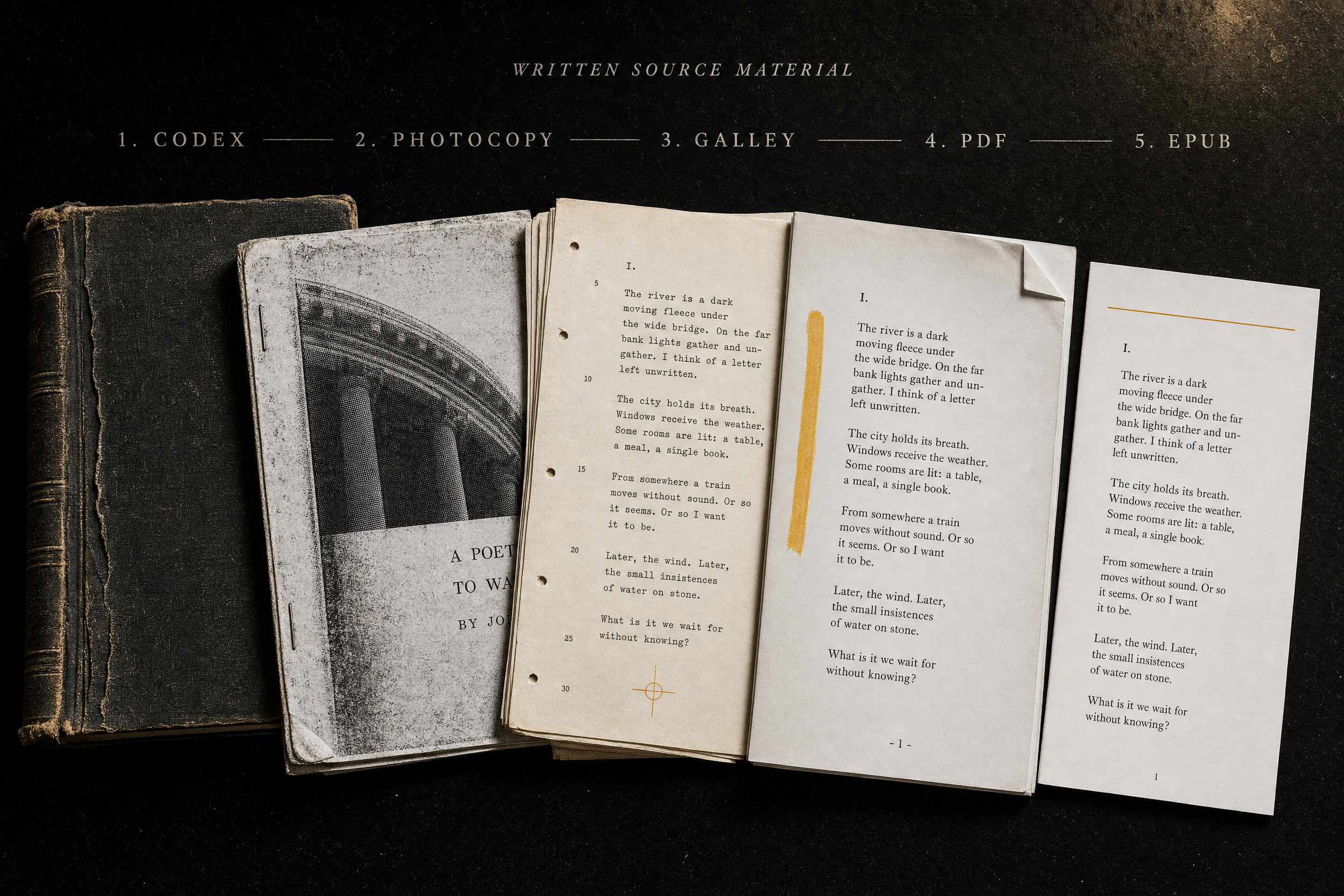
This collection contains the archive's densest written source material and works best after a reader already has some orientation and a rough sequence.
Core argument
The texts layer carries the archive's highest-density primary material. It rewards prepared reading but punishes random entry.
Metadata and sequence matter as much as file access here. Readers need help choosing an order rather than opening files at random.
What this layer contains
This collection carries the written sources most readers eventually need, especially once they move from orientation into sustained reading.
It is therefore best used with a reading question in hand: a figure, concept, or cluster you want to trace. The texts layer becomes useful when it is navigated, not merely opened.
What the collection lets a reader do
What the collection lets a reader do is follow an argument across its full extension. The Ccru, Writings 1997–2003 volume gathered by Urbanomic W4 is the obvious case, since its Lemurian time-sorcery and numogram material only resolves when read across dozens of linked fragments rather than sampled. Black Ice belongs here for the same reason: its compressed citations of Bataille on energetic contagion and Deleuze and Guattari on already being "in the machine" C3 only function if the reader can hold the surrounding prose. Land's modernity passage C5 is doing philosophical work that a pull-quote destroys. The lecture transcripts let a reader watch CCRU's reception being narrated in real time, including the line about Warwick administration and "deliberate flaunting of academic sensibilities" in the unit's second year C8 . None of that survives extraction.
The collection also lets a reader test interpretive claims against their full source. If a concept page argues that CCRU refuses Baudrillard's reduction of the real to fiction, the lecture transcript carrying that exact distinction is here to be checked C12 . If a guide claims the numogram works by reassigning arithmetic meanings, unity to one, division to two, the transcript passage is here too C6 C9 . The texts layer is where the archive's secondary writing becomes falsifiable.
Limitations and provenance
The limitations are real and need stating. First, provenance is uneven. Some items are clean publisher-grade PDFs from Urbanomic W4 W5 ; others are auto-transcribed lectures whose repetitions are artefacts of the ASR pipeline, not the speaker C0 C4 . A reader who quotes a looping line as if it were rhetorical emphasis will be wrong. Second, the collection is not complete. CCRU material continues to surface through Urbanomic's ongoing texts updates W7 and through scattered hosts like Monoskop W0 and the Internet Archive W8 , and what sits in this collection is a snapshot, not the closed canon. Third, some of the most suggestive pieces, the Occultures crypt-descent prose for instance C11 , are theory-fiction whose argumentative status cannot be settled from the text alone. They need the conceptual scaffolding the rest of the archive provides.
There is also a register problem the collection cannot solve on its own. CCRU prose moves between citation-heavy theoretical writing and pieces that perform their content. Black Ice's "noumenal scraping, abstractive surgery" C3 and Occultures' Zombie-maker sequence C11 are not failed theory; they are the form the argument takes. A reader trained only on conventional academic prose will mistake the performance for ornament and the ornament for the whole. The texts collection cannot teach that distinction by itself. The guides and concept pages exist for that reason.
How to use it well
Use guides, sections, and record pages to choose sequence first. The texts layer is most valuable when it is entered with a question, not as a random file dump.
Practical reading instruction. Do not enter through the file list. Enter through a concept page or a section hub, follow its outbound links into specific texts, and read those texts in the order the secondary page sets. When a transcript loops, treat the first clean instance as the line and the rest as transcription noise. When a passage cites Bataille, Deleuze and Guattari, Kant, or Gibson C3 C10 C13 , hold the citation; CCRU's arguments are usually doing something specific to that source rather than gesturing at a tradition. Cross-check Urbanomic's published Writings 1997–2003 W4 against the loose pieces here, since the editorial framing in the book version often clarifies what a standalone fragment leaves implicit. Read the lectures last. They assume the rest.
Worked examples
These named texts, talks, sites, and records show where the argument becomes concrete.
Nick Land Fanged Noumena Record
"Nick Land Fanged Noumena" is useful here because it keeps style and argument together on the page rather than splitting concept from delivery.
Cybergothic Record
"Cybergothic" is useful here because it keeps style and argument together on the page rather than splitting concept from delivery.
Invaders From The Future Record
"Invaders From The Future" is useful here because it keeps style and argument together on the page rather than splitting concept from delivery.
Common confusions
These are the mistakes readers most often make when they arrive through simplified internet summaries or personality cult retellings.
- The biggest file is always the best first file.
This layer is strongest once a reader already knows what kind of problem they are trying to track.
Significance
This collection matters because it carries the archive's densest primary sources, but only becomes truly usable once it is tied to guides, sections, and records.
1101 files
Canonical path: texts/
How to use it
Approach through guided routes, then use metadata-rich record pages to pick reading sequences rather than opening files at random.
Why this layer matters
Books, PDFs, EPUBs, and other written source material from the canonical corpus.
Featured records
References
Records cited
These linked sources are the quickest way to test the argument against named materials rather than second-hand summary.
Nick Land Fanged Noumena Record
"Nick Land Fanged Noumena" shows the written layer at its best: a named text where form, pressure, and argument stay visible together.
Cybergothic Record
"Cybergothic" shows the written layer at its best: a named text where form, pressure, and argument stay visible together.
Invaders From The Future Record
"Invaders From The Future" shows the written layer at its best: a named text where form, pressure, and argument stay visible together.
External references
Inherited outward references from the guides and pages that frame this collection.
Text hierarchy
Written sources are routed at the work level, then grouped by section and editorial subcluster so the texts layer surfaces problems and motifs before personality cults or file formats.
Collapsed to 1062 work-level entries across 20 sections. Duplicate-format clusters: 27.
Warwick and Formation 24 works · reviewed 11 · needs review 13
How the CCRU emerged around Warwick, Sadie Plant, Nick Land, and an unstable collaborative scene.
- Institutional context and self-description 22
- Formation histories and retrospectives 2
Virtual Futures and Para-Academia 8 works · reviewed 8 · needs review 0
Events, workshops, and off-campus method as the CCRU moved from campus structure toward para-academic circulation.
- Virtual Futures events 6
- Para-academic method and pedagogy 2
Theory-Fiction and Cyberstyle 181 works · reviewed 39 · needs review 142
How theory-fiction, cyberpunk prose, and anti-academic style became part of the archive's method.
- Theory-fiction manifestos 137
- Cyberpunk and gothic prose 12
- Style, design, and anti-academic aesthetics 32
Hyperstition and Fiction-Making 20 works · reviewed 10 · needs review 10
The archive's central model of fiction as causal force, feedback loop, and world-making process.
- Definitions and histories 11
- Myth-science and narrative causation 4
- World-building and entities 4
- Critique and afterlives 1
Lemurian Time War and Spiral Time 16 works · reviewed 8 · needs review 8
Recursive time, ghostly residues, pirates, and evolutionary dead branches as a core archive motif.
- Lemurs, Burroughs, and Madagascar 13
- Recursive and spiral time 1
- Haunting and extinct residues 2
Numogram and Occult Numeracy 27 works · reviewed 13 · needs review 14
Decimal labyrinths, syzygies, left-zero, and the archive's experiments in number as orientation.
- Primers and diagrams 10
- Decimal labyrinths and syzygies 10
- Occult mathematics and qabbala 7
Geotrauma and the Outside 30 works · reviewed 21 · needs review 9
Molten earth, Barker, the inhuman Outside, and the archive's geological imagination.
- Barker and geotrauma 3
- Inhuman earth and geology 22
- Horror, slime, and planetary decay 5
Capital, Meltdown, and Cybernetic Modernity 96 works · reviewed 55 · needs review 41
Capitalist abstraction, deterritorialization, cybernetics, and the archive's account of runaway modernity.
- Capital and abstraction 54
- Cybernetics and feedback 26
- Automation, finance, and modernity 16
Control, Virotechnics, and Swarm Systems 38 works · reviewed 19 · needs review 19
Control processes, viral language, swarms, and abstract dynamics as a media-theoretical cluster.
- Biotech and contagion 13
- Control and modulation 11
- Swarms, networks, and distributed systems 14
Sonic Futures and Audio Theory 53 works · reviewed 26 · needs review 27
Jungle, Hyperdub, sonic warfare, and the sound-centered pathways into the archive's theory culture.
- Rave, jungle, and dance cultures 15
- Sonic warfare and affect 36
- Audio technology and cultural form 2
Cyberfeminism, Xenofeminism, and Technical Subjects 66 works · reviewed 46 · needs review 20
Sadie Plant, Amy Ireland, and the technical, gendered, and synthetic subject positions running through the archive.
- Cyberfeminist interventions 54
- Technical matter and recursive bodies 7
- Xenofeminism and its critics 5
Orphan Drift and Experimental Practice 10 works · reviewed 5 · needs review 5
Collective art practice, exhibitions, interfaces, and collaborative experiment around the archive's edge.
- 0rphan Drift and collective practice 2
- Media ecology and art method 1
- Architecture, interface, and exhibition 7
Nick Land Before the Break 46 works · reviewed 34 · needs review 12
Early philosophy, Warwick-era writing, and the phase of Land most central to the CCRU's emergence.
- Collected readers and early receptions 13
- CCRU-era Land texts 32
- Interpretations and interviews 1
Nick Land After Warwick 37 works · reviewed 29 · needs review 8
Shanghai, Xenosystems, later reactionary turns, and the post-Warwick afterlife of Land's public writing.
- Xenosystems and later Land 20
- Neoreaction, patchwork, and dark enlightenment 15
- China, logistics, and later geopolitics 2
Mark Fisher and Public Theory 30 works · reviewed 21 · needs review 9
Fisher as bridge figure, public critic, and one of the clearest routes into the archive's afterlife.
- k-punk and public criticism 25
- Hauntology, the eerie, and culture 3
- Fisher on CCRU, music, and politics 2
Reza Negarestani and Inhumanism 66 works · reviewed 64 · needs review 2
Negarestani, inhumanism, and the philosophical afterlives that extend beyond shorthand accelerationism.
- Core inhumanism texts 10
- Decay, politics, and architecture 10
- Interviews and commentaries on Negarestani 46
Brassier, Grant, and Speculative Realism 113 works · reviewed 103 · needs review 10
Analytic and speculative receptions of Land and the CCRU through Brassier, Grant, and adjacent philosophical lines.
- Ray Brassier and rationalist realism 73
- Iain Hamilton Grant and nature philosophy 33
- Speculative realism anthologies and critiques 7
Accelerationism Branches and Debates 35 works · reviewed 25 · needs review 10
Left, right, unconditional, and popularized accelerationisms sorted into a cleaner research map.
- Primers and public histories 28
- Promethean and left-accelerationist debates 4
- Critiques, misuse, and aftermaths 3
AI, Basilisk, and Recursive Intelligence 25 works · reviewed 14 · needs review 11
Recursive systems, intelligence explosion, basilisk motifs, and the archive's later AI-facing afterlife.
- Artificial intelligence and computation 17
- Recursive systems and synthetic thought 1
- Basilisk, alignment, and posthuman reason 7
- Critical Computation Digital Automata and General Artificial Thinking2 source files
- Data capitalism and the counter futures of ethics in artificial intelligence
- Nick Land "The Teleological Identity of Capitalism and Artificial Intelligence" - incredible-machines-2014
China, Megacity, and Urban Futures 141 works · reviewed 114 · needs review 27
Shanghai, megacity theory, logistics, and the urban/civilizational horizons that appear in the archive's later afterlife.
- Shanghai and Chinese megacity writing 127
- Expo, logistics, and urban systems 9
- Architecture, cultivation, and China futurisms 5
- 'Lei Feng Spirit' - antidote to selfishness - sleeps
- 2035. Probably earlier. » Article » that's Magazines Shanghai, Beijing, Guangzhou, Shenzhen
- Better City, Better Life
Read next
Guide
"Nick Land Reading Guide" is the guide to open once Texts has shown you its strongest materials.
Guide
Cyberfeminism Orphan Drift And The Non Land CCRU
"Cyberfeminism Orphan Drift And The Non Land CCRU" is the guide to open once Texts has shown you its strongest materials.
Section
"Nick Land Before The Break" is the section that carries Texts into a larger cluster.