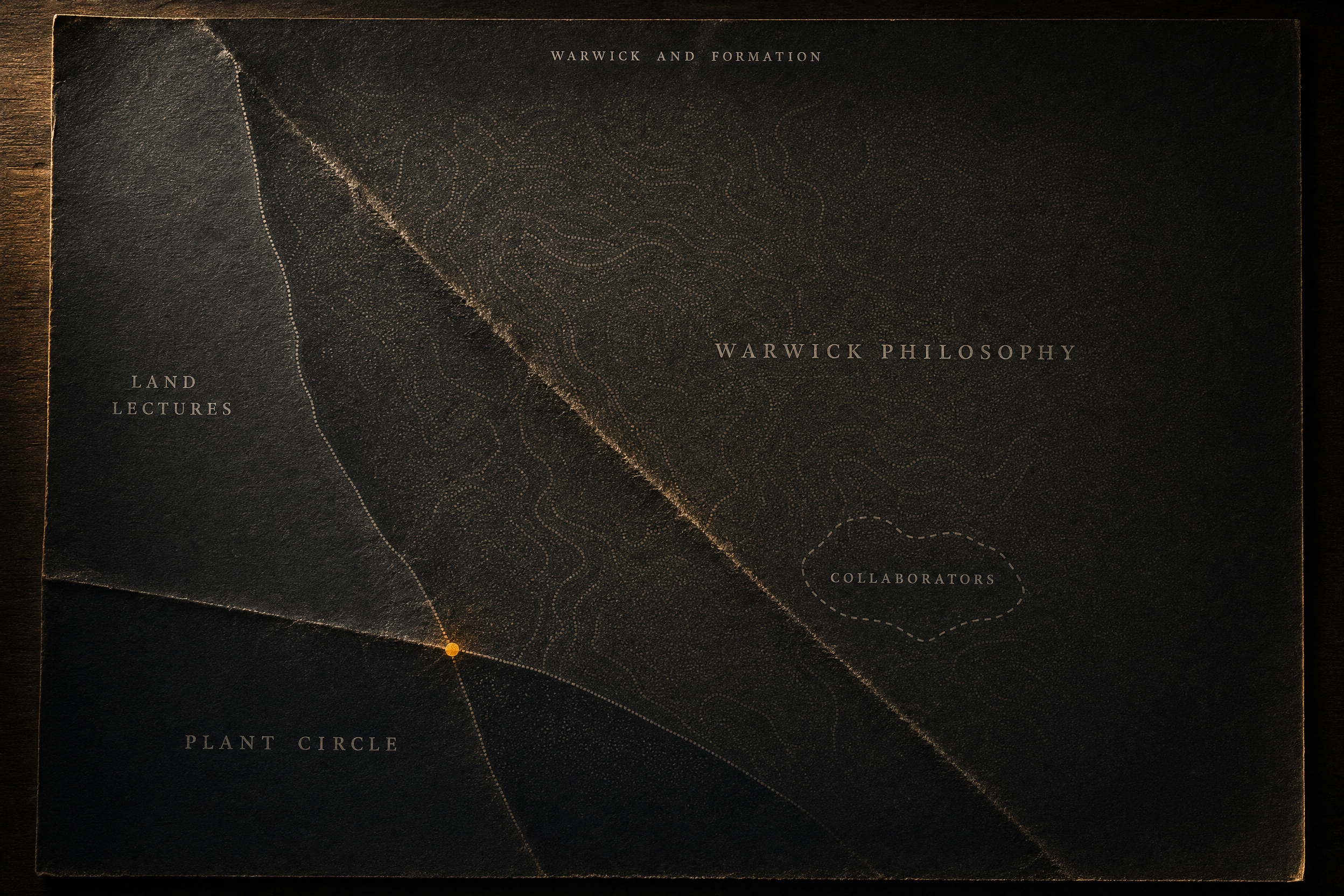
A room at Warwick, 1995–1998
The dates matter. Sadie Plant was at Warwick in the mid-1990s and left around 1997, the year Zeros and Ones appeared. Land's departure from academia tracked the same period. The window in which Plant, Land, the doctoral cohort, and the department's tolerance all overlapped is small — roughly three years. The CCRU's distinctive texture is the texture of that overlap under pressure, not the texture of a stable institution.
Plant's cyberfeminist programme as a load-bearing strand
Plant is routinely written out of CCRU accounts that start from Land and work outward. This is the first trap to refuse. Zeros and Ones is not an appendix to the unit's activity; it is one of the frames that made the unit's early vocabulary available in the first place. On many readings of the period, cyberfeminism at Warwick functioned not as subcultural decoration but as a research orientation with its own lineage — one Land's polemic then accelerated against and through.
The internal disagreement here is live. Some readers treat Plant's departure as the moment the CCRU became itself; others treat it as the moment it lost half of what made it interesting and began narrowing toward a single voice. Neither account works unless you can hold both Plant's book and the post-1997 material in view at once. The archive does not settle this — it records the split.
The doctoral cohort and the para-academic surround
A cluster of theses was written in the unit's orbit. Capitalism's Transcendental Time Machine is one of the documents through which CCRU concerns crystallised into sustained philosophical argument at doctoral level. Ray Brassier's Alien Theory carries traces of the shared atmosphere in its commitments to "univocal immanence" and a naturalism defined as "the necessary interdependence of philosophy and science." These commitments are characteristic of Warwick-period work in this orbit, even where individual trajectories later diverged sharply.
Read the cohort and the unit stops looking like Land-plus-collaborators. It looks like a scene where several people were writing theses in proximity, with the department's imprimatur on some activities and none on others. The para-academic surround — the zine and conference circuit, the music-adjacent work — is not background colour; it is where part of the output happened. Naming the full cohort and its activities precisely requires sources this section does not have in view, and the archive entries on individual figures carry that work.
Why Warwick, specifically
Warwick's philosophy department in the 1990s was permissive enough that Plant could be hired, Land could be kept on, and doctoral students could write unorthodox theses. This is a contingent institutional fact. It explains why the formation happened there, but it does not explain what the formation became. The common error is to let "Warwick" do too much work — as if the university's ethos produced the CCRU. It didn't. The university produced the conditions; what happened inside those conditions was not Warwick's doing.
The institutional disowning is the other half of the story. Mackay's word, again, is "parasite": the unit was "precariously affixed" to the institution and immediately rejected by it. Readers tempted to treat Warwick as the CCRU's home should register that the unit survived as an independent entity after the formal affiliation broke, and that much of its most characteristic material circulated in that afterlife rather than under departmental cover.
Land's polemic and the question of centrality
Land is the name most readers arrive with, and the texts collected in Fanged Noumena are the most widely circulated CCRU-adjacent writings. Mackay treats the CCRU's inception as "another important phase-transition in Land's work," singling out the theory of geotraumatics — the attempt to read "all terrestrial existence, including human culture, as a relay of primal cosmic trauma," with the earth's molten iron core (Cthelll) as "the aboriginal trauma." The trap is to let this phase-transition language license the reading that Land was the unit's centre and others its orbit. One can register Land's trajectory as decisive for his own work without converting it into the unit's gravitational source; that conversion is a reading choice, not a given.
A related disagreement is whether Land's later political trajectory (the Dark Enlightenment material from 2012 onward) should be read back into the CCRU period or held strictly separate. Mackay's editorial positioning separates them. Other readers collapse them. A section essay cannot adjudicate this; it can only flag the collapse as a choice. For the argument that the CCRU's distinctiveness does not reduce to any single author's thesis, see what was the CCRU.
What the formation produced that a school could not
Consider the Numogram: not a doctrine but a shared notation, a set of gates and resonances (Gt-55, Gt-66, Gt-78 and onward) that later writers in the unit's orbit have extended into alternate bases and qabalistic experiments. The Unleashing the Numogram material shows this clearly — it is diagrammatic apparatus treated as research infrastructure, extended by whoever picks it up. A school would have filtered such work out as unserious. A short-lived scene with weak institutional supervision can generate it and then disperse before anyone systematises it.
This is why the archive resists single-author summary. The load-bearing works — Plant's book, Land's collected writings, Greenspan's thesis — each point outward to the others and to material neither of them signed. Reading any one alone produces a distorted picture. Reading them together produces the formation.
Where to begin
The most accessible entry for newcomers trying to see the formation rather than any one figure inside it is Zeros and Ones. Plant's book predates the unit's most mythologised phase and is written for a general reader. From there, Greenspan's thesis gives the philosophical underside and the Mackay-edited Land volume gives the polemic. Taken together, these three mark the triangle the CCRU was stretched across.
The CCRU formed at Warwick as a shifting scene rather than a school — the philosophy department, Sadie Plant's cyberfeminism, and Nick Land's polemic ran together for a few years, and the unit took its shape from that overlap.
Core argument
Formation is the right starting unit for the CCRU. It keeps the archive tied to a scene, a setting, and several contributors rather than to one retrospective myth.
Warwick matters as context, not as a sufficient explanation. The archive quickly spills into para-academic and public forms that the university alone cannot explain.
Worked examples
These named texts, talks, sites, and records show where the argument becomes concrete.
What Was The CCRU Guide
Start with "What Was The CCRU" if you want the wider frame before dropping into Warwick And Formation.
Sadie Plant Person
"Sadie Plant" is one of the clearest figures for the pressures gathered inside Warwick And Formation.
Hyperstition Concept
"Hyperstition" names one recurring problem inside Warwick And Formation.
CCRU Lecture 1 Record
"CCRU Lecture 1" is a checkpoint where Warwick And Formation stops sounding abstract.
ccru.net Home Record
"ccru.net Home" is a checkpoint where Warwick And Formation stops sounding abstract.
Common misreadings
These are the recurring simplifications, exaggerations, and misreadings that make the subject look flatter than it is.
- The CCRU began as a ready-made doctrine led by one mastermind.
The archive makes more sense as a volatile formation whose shape emerged through several people, media, and institutional pressures.
Significance
This section matters because most public retellings skip from a few later names straight to mythology. Formation restores the scene conditions that made the archive possible.
Themes
- warwick
- sadie plant
- formation
- membership
- early ccru
Where this section sits in the archive
The Cybernetic Culture Research Unit was established at Warwick University in 1995, attached to the philosophy department, and disowned by the institution almost as soon as it began attracting attention. Robin Mackay's editorial introduction to Fanged Noumena: Collected Writings 1987–2007 describes it as "amorphous and short-lived," established "shortly before Land's departure from academia, but immediately disowned as an undesirable parasite by the institution to which it was precariously affixed." The phrase is worth holding onto, because it names the formation's actual mode of existence rather than retrofitting it as a programme. Mackay notes that the unit "survived for a few years afterwards as an independent entity."
Sources by cluster
These mini-clusters widen the section through named works and support traces rather than through adjacent keywords alone.
Section source cluster
Warwick And Formation: public editions and anchor texts
Warwick And Formation becomes clearer through named edition pages such as xenosystems.net (archived homepage), Unknown Lands - Lecture 1, Robin Mackay-#Accelerate The Accelerationist Reader. These are the quickest public routes into the section's central problem without dropping to raw support material first.
Work
xenosystems.net (archived homepage)
The archived xenosystems homepage captures Land's later blog-era public framing, where reactionary politics, serial posting, and 'the outside' sit side by side. Xenosystems.net ran as Nick Land's serial dispatch from...
Work
A lecture introduction that explains why Land is still studied, distinguishing early philosophical promise from later controversy and myth. A lecture introduction that explains why Land is still studied, distinguishin...
Work
Robin Mackay-#Accelerate The Accelerationist Reader
The main reader-introduction page for accelerationism, packaging the field as a set of competing lineages rather than a single slogan. "Accelerationism is a political heresy": the opening sentence of Mackay and Avanes...
Work
Endgamers_ A History of Accelerationism - by Jacob Siegel
Siegel's essay explains accelerationism as a response to perceived historical stasis, making the movement readable as a public narrative rather than an insider code. Siegel writes for readers who have watched a philos...
Work
A Conversation with Nick Land (Part 2) - by Vincent Lê
A conversation that makes later Land's political and teleoplexic vocabulary unusually explicit without dissolving its hostility or abstraction. A conversation that makes later Land's political and teleoplexic vocabula...
Work
An 0rphan Drift archive page that makes ritual a collective interface practice rather than a private symbolic exercise. 0rphan Drift called themselves a collective that treated "information as matter and the image as...
Section source cluster
Warwick And Formation: routes out and adjacent arguments
What Was the CCRU?, Accelerationism After the CCRU, Cyberfeminism, Orphan Drift, and the Non-Land CCRU widen Warwick And Formation back out into adjacent guides and arguments once the local pattern is visible.
Guide
The Cybernetic Culture Research Unit, or CCRU, was a loose research formation that emerged around Warwick in the 1990s and then persisted through texts, events, recordings, websites, and arguments long after its origi...
Guide
Accelerationism After the CCRU
Accelerationism is one of the most public labels attached to the CCRU, but it is not the archive's secret essence. The more accurate starting point is that accelerationism is a later umbrella term that gathered togeth...
Guide
Cyberfeminism, Orphan Drift, and the Non-Land CCRU
The CCRU cannot be understood as Nick Land plus footnotes. Cyberfeminism, Sadie Plant, Luciana Parisi, Orphan Drift, collective experiment, and media-ecological practice are not optional supplements. They change what...
Guide
The best way to start Nick Land is to separate phases before you make judgments. Read the Warwick and CCRU-era work as one phase, the editorial and spoken entry points as another practical route into it, and the later...
Guide
The fastest way to make the CCRU less mystical is to put it back into time. Most readers do not meet the Cybernetic Culture Research Unit at Warwick in the mid-1990s. They meet it through Mark Fisher, k-punk, Nick Lan...
Guide
Left accelerationism and right accelerationism share a vocabulary, an editorial moment, and a name. They do not share a position. The left strand treats capital's technical machinery as a contestable resource politics...
Reader questions
Was the CCRU just a Warwick project?
Warwick is the key institutional scene of formation, but the archive only makes sense if you track how that local formation spilled outward into events, print fragments, web traces, and para-academic relays.
Why focus on Warwick at all?
Because without Warwick the archive becomes a floating myth. The university setting, its tensions, and the surrounding scene conditions explain why the CCRU took the form it did.
Texts in this section
24 classified works grouped into 2 editorial subclusters. Reviewed: 11; needs review: 13.
Institutional context and self-description 22 works
- Anna Greenspan-Capitalism's Transcendental Time Machine-University of Warwick (2000)
- Ccru - Who s Pulling Your Strings (Frozen Tears I) (2003)
- Ccru Datastream 9 - The Year 2000 Will Happen
- CCRU- Pomophobia
- WRAP THESIS Albert 1999
- WRAP THESIS Dixon 1997
- WRAP THESIS Purdom 2000
- WRAP THESIS Rehberg 1993
- WRAP THESIS Stamp 1999
- Ccru 0D - Liquid Lattice (Frozen Tears) (2006)Needs editorial review
- Ccru Datastream 1 - Y2paniKNeeds editorial review
- Ccru Datastream 3 - Katasonix Calendric ContinuismNeeds editorial review
- Ccru Datastream 7 - Hyper-C - Breaking the NetNeeds editorial review
- Ccru Datastream 8 - Surf s Up, Let s FlatlineNeeds editorial review
- CCRU- Amortal Kombat No UFOsNeeds editorial review
- CCRU- Robot-s aren-t what they used to beNeeds editorial review
- CCRU- WHITE MAGICNeeds editorial review
- Land - Shootout at the Cyber Corral (Review) (New Scientist) (1996)Needs editorial review
- WRAP THESIS Dibben 1994Needs editorial review
- WRAP THESIS Groves 1999Needs editorial review
- WRAP Thesis Hall 2000Needs editorial review
- WRAP THESIS ODonnell 2001Needs editorial review
Formation histories and retrospectives 2 works
References
Records cited
These linked sources are the quickest way to test the argument against named materials rather than second-hand summary.
CCRU Lecture 1 Record
"CCRU Lecture 1" is the first record to test the framing around Warwick And Formation.
ccru.net Home Record
"ccru.net Home" is the first record to test the framing around Warwick And Formation.
What Was The CCRU Guide
"What Was The CCRU" gives the larger argument around Warwick And Formation before you widen sideways.
External references
Inherited outward references from the guides, exhibits, people, and concept pages that anchor this section cluster.