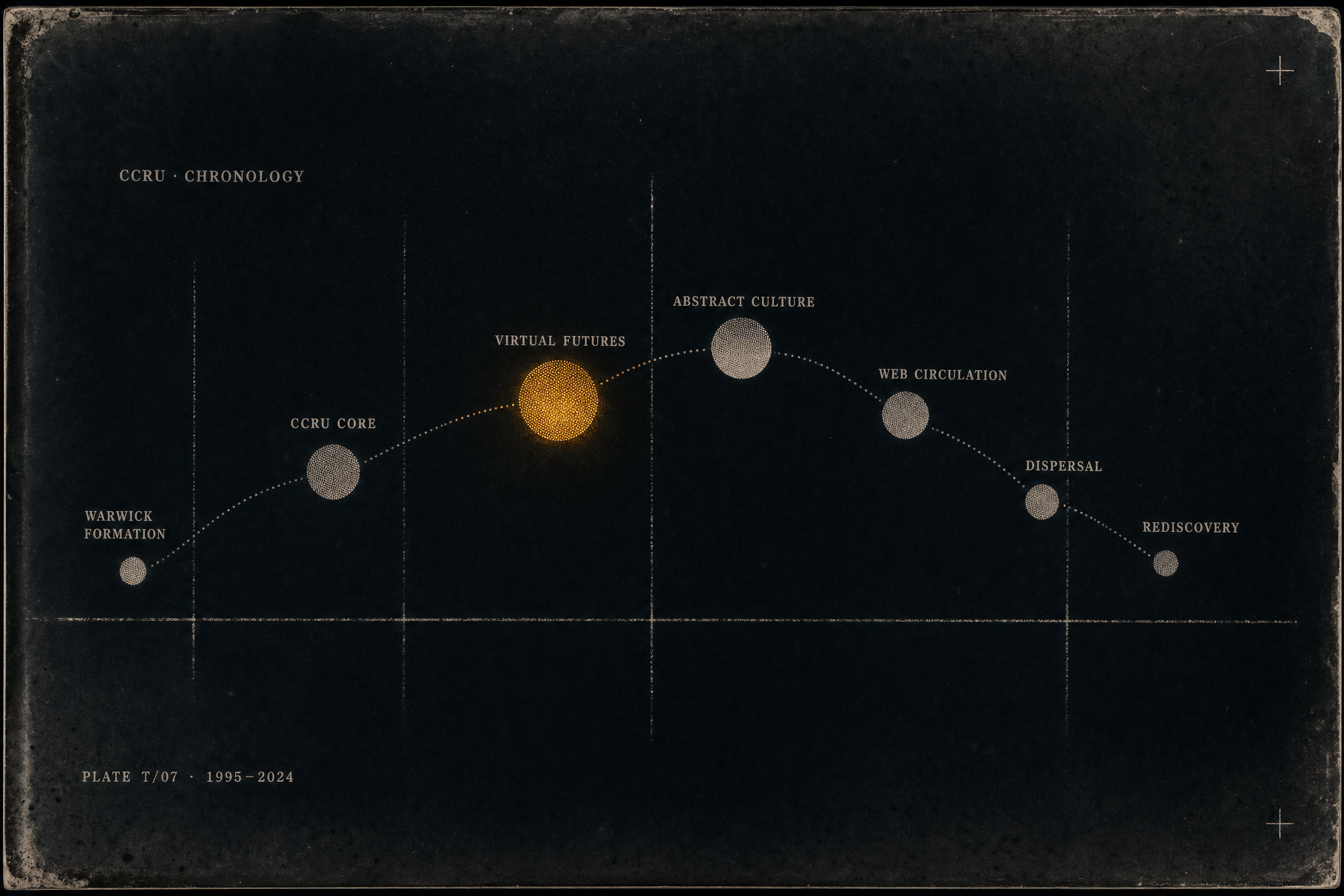
The shortest useful CCRU timeline runs from Warwick formation in the 1990s, through Virtual Futures events and ccru.net, into blog-era and editorial afterlives such as k-punk, Collapse, and later web rediscovery. The point of the timeline is not nostalgia. It is proportion: putting formation, circulation, and afterlife back into sequence.
Key points
- The CCRU begins as a Warwick-based formation but becomes publicly meaningful through para-academic events, websites, and later editorial relays.
- Virtual Futures and ccru.net are not side notes; they are turning points in how the scene presented itself and moved outward.
- Mark Fisher, Robin Mackay, k-punk, and later online circulation belong to the chronology because they changed how the CCRU was remembered.
Core argument
Chronology is a corrective to mythology. Putting Warwick, Virtual Futures, ccru.net, and blog-era afterlives in order keeps the chronology from turning into one floating legend. Example: The jump from CCRU Lecture 1 to the archived ccru.net homepage shows the scene moving from spoken formation to public interface.
The CCRU's public shape depends on circulation events as much as on texts. A timeline that ignores conferences, sites, and relay surfaces makes the CCRU look narrower than it was. Example: Virtual Futures (Book) and the Virtual Futures exhibit make the event infrastructure visible alongside the writing.
Later rediscovery is part of the subject, not a postscript. Many readers arrive through Fisher, k-punk, xenosystems, or accelerationism debates rather than through Warwick itself. Example: k-punk and xenosystems sit decades after the original formation but decisively shape the public memory of it.
Chronology is a corrective to mythology. Putting Warwick, Virtual Futures, ccru.net, and blog-era afterlives in order keeps the chronology from turning into one floating legend.
Two clocks: institutional and fictional
The Architectonic Order of the Eschaton issued its verdict early: the Ccru "does not, has not, and will never exist" ( Urbanomic ). The line is a joke and a working principle. Any timeline of the Cybernetic Culture Research Unit has to handle the fact that the group treated its own chronology as an object of attack, looping dates, back-dating documents, and publishing under collective and fictional names. The Urbanomic 2024 anthology is even titled *Ccru: Recursed 2005-1995*, running its dates backwards ( Urbanomic ).
The argument of this guide is straightforward. A timeline of Ccru is useful only if it tracks two clocks at once: the institutional clock of Warwick philosophy in the late 1990s, and the fictional clock of Lemurian time-sorcery the group built to corrode the first. Read with one clock, the archive collapses into either a quirky academic footnote or an unverifiable mythology. Read with both, the periodisation becomes legible.
On the institutional clock the dates are narrow. Sadie Plant founded the unit inside the Warwick philosophy department in 1995. Plant left in early 1997 to write full-time, with *Zeros + Ones* and *Writing On Drugs* following, and Nick Land took over as director ( k-punk archive of Simon Reynolds' 1998 interview ). The group's collected output is bracketed by Urbanomic and Time Spiral Press as *Writings 1997-2003* ( Monoskop ; Urbanomic ). The *Abstract Culture* zine swarms run inside that window, with the *Digital Hyperstition* swarm dated 1999 ( Monoskop ). The ccru.demon.co.uk site, snapshotted by the Wayback Machine in January 2002, still indexed the project under headings like Lemurian Hyperstition, Metatronics, AOE, Decadence, Axsys ( web.archive.org ). By the time of that snapshot the unit had already detached from Warwick and was operating as an autonomous, mostly online formation.
The fictional clock runs differently. Inside the writings, the Ccru positions itself as a relay for material reaching back through Lemurian occulture and forward through the Architectonic Order of the Eschaton's counter-operations. The Urbanomic catalogue copy is precise about this: the texts "document the Ccru's perilous efforts to catalogue the traces of Lemurian occulture, bringing together the scattered accounts of those who had stumbled upon lagooned relics of nonhuman intelligence", a project leading to "the recovery of the Numogram and the reconstruction of the principles of Lemurian time-sorcery" ( Urbanomic ). The Barker material, with its journal *Plutonics* and article *Spinal Catastrophism* C4 , pushes the chronology back into geotrauma, treating the accretion of the Earth itself as the deep timeline behind any human history C0 . *Recursed 2005-1995* then literalises the inversion, charting the unit's course "from its inception through subsequent 'swarms' of the zine Abstract Culture" while running the dates in reverse ( Urbanomic ).
The common bad reading wants to choose one clock. Either Ccru is reduced to a Warwick scandal: Plant out, Land in, drugs and breakdown, the department closes ranks, end of story. Or it is dissolved into pure mythography, where Lemuria and the AOE float free of any institutional substrate. Both readings throw away what made the work operative. Hyperstition, as the group used the term, requires a real calendar to corrupt. The 1998 degree-0 description, where Ccru is "the name on a door in an institution" that simultaneously denies its existence ( archive.org OCR of Time Spiral Press 2015 edition _hocr.html)), only works because the door was actually there.
Warwick was the institutional beginning, not the whole story
The chronology starts at Warwick because that is where the CCRU emerges as a recognizable formation rather than as a later editorial label. But even here the CCRU is not best imagined as a department with one doctrine. Warwick gives you a setting, some names, some infrastructure, and a moment when cybernetics, media theory, philosophy, music culture, theory-fiction, and design begin pressing into one another in a distinctive way. CCRU Lecture 1 is useful because it makes that early phase feel immediate and audible rather than retrospectively monumental.[1]
the cybernetic culture research unit was initially set up by warwick university in the uk to support philosopher cyber feminist and cultural theorist sadie plant
The point is not simply that a research group existed. The point is that a style of crossing disciplines, tones, and media existed in one place strongly enough to leave behind a sequence of texts, lectures, interfaces, and afterlives that still hang together. If the timeline stopped at Warwick, however, the CCRU would look like a local curiosity. The scene only becomes historically strange once the next relay points enter the picture.
Virtual Futures marks the jump from local formation to para-academic scene
Virtual Futures is one of the clearest reasons the timeline cannot be reduced to a few canonical texts. The event culture around Virtual Futures shows the archive operating through conferences, programs, public interfaces, flyers, and para-academic staging. The Virtual Futures (Book) source matters here because it ties the CCRU to a broader ecology of events and off-campus circulation rather than to a single institutional room. It shows ideas moving outward through mediation, invitation, and public formatting.
Virtual Futures explores the idea that the future lies in its ability to articulate the consequences of an increasingly synthetic and virtual world.
This part of the chronology matters for search intent too. Readers looking for "CCRU Warwick" are usually not only asking where the archive began. They are also asking how it became visible beyond Warwick. Virtual Futures is one of the key answers. It is a hinge between institutional formation and public relay, and it keeps the CCRU from being mistaken for a scene that mattered only inside the university that housed it.
ccru.net turns chronology into interface history
The archived ccru.net homepage is one of the most important timeline documents in the corpus because it shows the scene presenting itself publicly. It is not merely a convenient surviving website. It is part of the CCRU's self-description. Design, navigation, typography, and the phrasing of the interface all matter because they reveal how the CCRU wanted to look when it entered the web rather than only how later readers described it after the fact.[2]
That shift matters because the online life of the CCRU is not just a preservation story. It is part of the original medium ecology. Once ccru.net is in the timeline, the CCRU looks less like a body of printed theory and more like a scene that already understood interface, relay, and distributed self-presentation as parts of its operation. This is one reason the CCRU feels so at home in later internet theory culture: it was already moving through web surfaces and para-academic publicity rather than only through books.
The afterlife is chronological, not accidental
A common mistake is to treat later figures such as Mark Fisher or Robin Mackay as optional supplements. In reality they belong to the chronology because they change how the earlier material can be seen. Fisher's k-punk archive is decisive here. The blog is not merely a place where the CCRU gets mentioned. It is one of the places where CCRU-adjacent motifs are translated into public criticism about music, culture, politics, mood, and media. That makes k-punk part of the CCRU's public timeline.[3]
The same is true of later editorial and republishing work. Once #Accelerate, Collapse, and related compilation or framing projects arrive, the CCRU has entered another phase. The question is no longer only what the CCRU originally said. The question is how later carriers reordered it, simplified it, widened it, or turned particular strands into public keywords. Chronology keeps those transformations visible. Without that sequence, the afterlife either looks like noise or becomes the whole story.
Xenosystems, accelerationism, and online lore are late phases, not origins
The timeline also helps with one of the internet's most persistent distortions: the belief that blog-era Land or accelerationism discourse explains the CCRU from the start. Xenosystems matters, but as a later phase. It is part of the online afterlife in which one Land line hardens into a highly portable, highly searchable web form. Accelerationism debates matter, but they arrive after the original CCRU formation and reorganize it under a later keyword.
This distinction is crucial if you want to understand why the archive still resurfaces. Readers now often come looking for the CCRU because they were really searching for one of these later routes: Mark Fisher, Nick Land, AI, accelerationism, or internet theory culture. The timeline does not tell them they are wrong to arrive that way. It tells them where that arrival sits historically. That is the difference between orientation and lore.
Pressure points inside the archive
There are pressure points inside the archive a timeline has to acknowledge. The Plant-to-Land transition in 1997 is one. The shift moves the unit's centre of gravity from cyberfeminism and Deleuze-Guattari toward what the Lecture 1 transcript glosses, via Klein and the Meltdown faction, as accelerating "the techno commercial process against church, family, and state" C5 . Readers who arrive through Plant's *Zeros + Ones* and readers who arrive through Land's *Fanged Noumena* are reading partially different organisations under one name. A second pressure point is the status of the post-2003 material. Urbanomic's second edition flags the AOE's ongoing work "to secure the past, present, and future against the incursions of Neolemurian time-sorcery" ( Urbanomic ), which is also a way of saying that editorial decisions about what counts as Ccru-era versus post-Ccru are themselves moves in the fiction. The 2015 Time Spiral Press collection, the 2020 Spanish *Escritos* ( Monoskop ), the 2024 *Abstract Culture* compilation ( Monoskop ) and *Recursed* are all later acts of periodisation, not neutral reprints.
A third pressure point is Barker. The Barker interview material, with its account of geotrauma as "plutonic looping of external collisions into interior content, impersonal trauma as drive mechanism" C0 , is presented inside the corpus as transcribed speech from a real informant. The Ccru's timeline only coheres if Barker is read as both a character and a methodological device. The Spanish edition's table of contents, which lists the Barker section alongside AOE, Axsys, and Black Atlantis material ( archive.org ), shows how the editors handle this: Barker sits inside the same continuum as the openly fictional orders.
Why the timeline keeps being rediscovered
People keep searching for a CCRU timeline because chronology answers several broad questions at once. It answers what the CCRU was, how it moved beyond Warwick, why Virtual Futures mattered, why ccru.net and k-punk still matter, and how later internet-native theory culture ended up treating the CCRU as a recurring origin point. It also creates the missing middle that broad summaries often skip. Without the timeline, readers jump straight from a 1990s Warwick formation to a present-day keyword cloud.
A good timeline does not make the chronology tidy. It makes it legible. It restores sequence, named sites, named texts, named relays, and named figures to a scene that otherwise gets rediscovered as a mood. That is why the timeline belongs in the publication's indexable core. It does not compete with the broad guide. It gives the broad guide historical traction.
What to read differently after this guide. Treat 1995, 1997, 1999, 2003 as load-bearing dates for the institutional clock and use them to anchor reception, splits, and the migration online. Treat the Lemurian dates, the AOE's claims about the eschaton, and the reversed chronology of *Recursed 2005-1995* as the unit's own commentary on what a timeline is for. Stop trying to decide whether the Numogram is a discovery or an invention. The Ccru's position, visible across the Urbanomic catalogue and the Lecture 1 transcript's remarks on Kabbalistic feedback loops that recursively rewrite their own code C11 C9 , is that the distinction is exactly what hyperstition is built to dissolve.
Worked examples
These named texts, talks, sites, and records show where the argument becomes concrete.
CCRU Lecture 1 Record
A formative spoken source that makes the early scene sound like a live formation rather than a later anthology.
Virtual Futures (Book) Text page
A turning-point source because it ties the CCRU to conference culture, para-academic infrastructure, and public interfaces.
ccru.net homepage Record
A public-facing web surface where chronology becomes interface history.
k-punk homepage Record
One of the most important later relay sites for the CCRU's public afterlife.
Tensions and limits
A timeline can over-stabilize a scene that was messy, overlapping, and often self-mythologizing in real time.
Later online rediscovery made the material more portable, but it also encouraged selective memory around Nick Land, accelerationism, and prophecy language.
Not every surviving source can be dated or contextualized cleanly, so chronology clarifies proportion without dissolving uncertainty.
Common misreadings
These are the recurring simplifications, exaggerations, and misreadings that make the subject look flatter than it is.
- A recurring distortion
The most common distortion is to jump straight from Warwick to later AI or accelerationism discourse and skip the intervening relays. That leap erases Virtual Futures, ccru.net, k-punk, editorial work by Robin Mackay, and the web-capture layer that made the scene searchable for later readers.
- A recurring distortion
The second distortion is to make the whole chronology orbit one personality. Nick Land remains central, but the timeline changes as soon as Mark Fisher, Sadie Plant, Orphan Drift, Luciana Parisi, and later public translators are restored to the sequence.
Significance
The CCRU timeline matters because many readers discover the scene out of order. They find screenshots, Fisher essays, accelerationism arguments, or xenosystems fragments first. A timeline restores sequence without pretending the afterlife is irrelevant.
It also matters because chronology is one of the best antidotes to vague lore. Once Warwick, Virtual Futures, ccru.net, k-punk, and later editorial recovery are put back into relation, the CCRU stops looking like a timeless myth and starts looking like a scene with phases, relays, and breaks.
References
Records cited
Linked archive records for this guide. Numbers correspond to the footnote markers in the body above.
CCRU - Lecture 1 Record
A spoken formation point for the early scene.
k-punk.abstractdynamics.org (archived homepage) Record
A later relay point that made the CCRU newly legible to public theory readers.
ccru.net (archived homepage) Record
A web surface that fixes one phase of public self-presentation.
Reader questions
When did the CCRU actually happen?
The core formation belongs to the Warwick and Virtual Futures years, but the archive’s effective timeline is wider: it includes later blog culture, republication, para-academic circulation, and recurring waves of afterlife reuse.
Why does chronology matter here?
Because readers often collapse Warwick, K-Punk, Fanged Noumena, Xenogothic web circulation, and later AI-era reuse into one timeless myth. The timeline restores sequence, mutation, and discontinuity.
Reading routes through this guide
Featured exhibit
Virtual Futures and the Para-Academic Scene
A curated exhibit on the events, interfaces, and public surfaces that helped the CCRU circulate beyond one department or one medium.
Featured reading path
A short guided sequence for readers who want the clearest first path through the CCRU site.