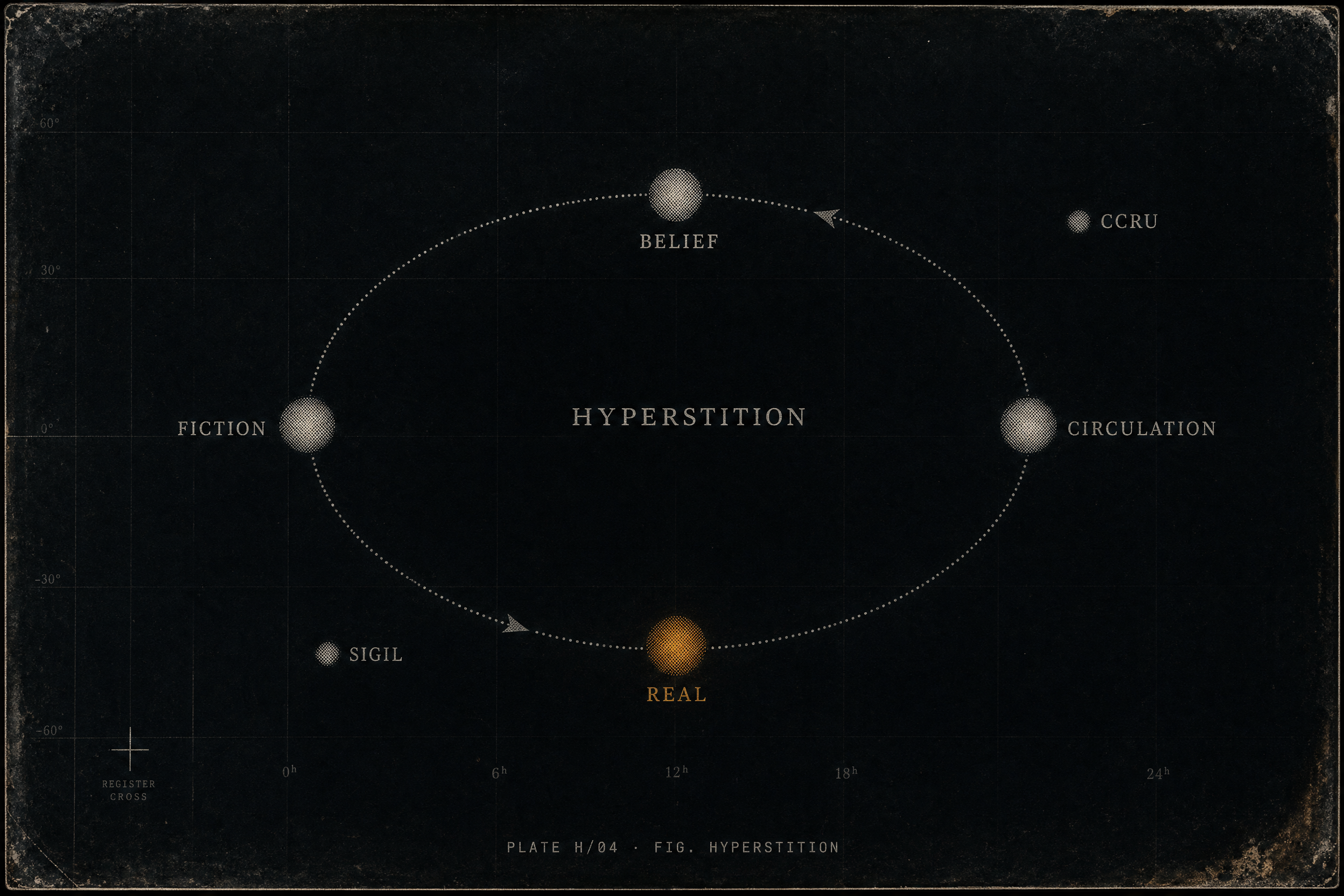
Hyperstition is the CCRU term for fictions, narratives, diagrams, or signs that start helping to make the realities they describe. The concept is strongest when stories circulate through media, institutions, markets, and collective timing rather than remaining private beliefs inside one person's head.
Key points
- Hyperstition is about distributed cultural causality, not just private belief.
- The term makes most sense when read through media circulation, timing, and feedback loops.
- Its online popularity came with a serious thinning-out of the original idea.
Core argument
Hyperstition is best understood as feedback between fiction and social reality. This keeps the concept tied to circulation, uptake, and consequence rather than to vague mysticism. Example: Hyperstition: New Weird 1 (Hyperstition & The New Weird I Entities and Worlds Genres and Climates 1 4)
It is not just self-fulfilling prophecy with stranger aesthetics. The CCRU version is infrastructural and media-conscious, not merely psychological. Example: Ghost Lemurs of Madagascar (Ghost Lemurs of Madagascar)
Its later internet career both preserved and distorted the concept. The term stayed alive because it travelled well, but portability made it easier to flatten. Example: The Emergence of Hyperstition (The Emergence of Hyperstition)
Hyperstition is best understood as feedback between fiction and social reality. This keeps the concept tied to circulation, uptake, and consequence rather than to vague mysticism.
Compare and contrast
Hyperstition vs self-fulfilling prophecy
Hyperstition
A distributed cultural mechanism in which stories, styles, theories, and media circulation help produce the futures they describe.
Self-fulfilling prophecy
A narrower causal loop built around expectation and outcome. Useful, but too thin to describe the archive's mixture of fiction, recursion, and cultural engineering.
The basic idea is feedback between fiction and reality
The CCRU uses hyperstition for loops in which stories, concepts, diagrams, or invented entities stop behaving like passive descriptions and start acting as operators. A hyperstitional narrative does not merely comment on the world. It changes how people coordinate, what they expect, what they fear, what they finance, or what they decide to build. The fiction becomes part of the causal field.[1]
The shortest workable definition is that hyperstition names fictions, narratives, diagrams, or signs that begin helping to make the realities they describe C10 . Self-fulfilling prophecy is in the background, but the CCRU framing is more mechanical. The archive talks about carriers, repetition, uptake, and timing, because the question is not whether a story is sincerely held but whether it can reorganise action, expectation, and coordination strongly enough to become causal C4 . A meme that nobody acts on is inert. A rumour that reroutes capital, or a diagram that shows up in three magazines and a record sleeve in the same season, is doing hyperstitional work.
This is why the concept matters more at the level of distributed systems than at the level of private psychology. The question is not simply whether an individual believes something strongly enough. The question is whether a story gains carriers, repetition, and traction. Once that happens, narrative becomes infrastructural. The archive keeps returning to this point through lectures, world-building, and hybrid essay-fiction forms.
That distinction matters because it changes what counts as evidence. If you treat culture as a collection of individual opinions, hyperstition collapses into psychology, and you end up with TED-talk versions of it C9 . If you treat culture as a feedback system, then the relevant material is how a fiction circulates: what carries it, how often, with what lag, into which institutions. The 1999 Digital Hyperstition collection stages exactly this. Burroughs sits next to cryptography, numerical sorcery, and the Barker interview transcripts, because the editors want the reader to see fiction operating as media, not as content W11 . Edmund Berger's later micro-history names the lineage explicitly: Burroughs's tape-splicing experiments in The Electronic Revolution are read as a hyperstitional framework for turning recorded fiction into street-level event W0 .
Why it is not just self-fulfilling prophecy
Self-fulfilling prophecy is part of the background, but hyperstition is broader and stranger. A self-fulfilling prophecy usually describes an expectation producing the conditions of its own confirmation. Hyperstition includes that, but it also cares about media systems, market signals, symbolic environments, and cultural amplification. The concept belongs to a world where fictions do not travel as isolated statements. They travel through rumor, websites, diagrams, style, repetition, and institutions.
That difference matters because it keeps the term from collapsing into a cliché. If hyperstition just meant "people believe something and it happens," it would add almost nothing. What gives it force is the idea that culture itself is recursive: stories and systems shape each other, and some narratives become powerful not because they are true first, but because they circulate effectively enough to change the landscape in which truth is negotiated.
This is where the common bad reading goes wrong. Treating hyperstition as a slogan about belief shaping reality misses the technical content. The CCRU writers were not claiming that wanting something hard enough makes it real. They were describing a recursion in which signs, once they enter circulation with the right carriers, alter the conditions under which actors decide, invest, design, and remember C10 . That recursion is observable. You can track it in market language, in branding, in cult formations, in the way a piece of theory-fiction migrates from a Warwick zine into Wired into a startup pitch deck. The archive is interested in the mechanism, not the moral.
Fiction matters because it is a carrier
The CCRU uses fiction aggressively because fiction is not decorative here. It is often the way a concept gets staged, transmitted, and tested. Weird entities, mythic fragments, fake-documentary surfaces, and hallucinatory prose are not merely aesthetic extras. They are carriers. They are part of how a concept travels and how a reader gets recruited into its logic.[2]
This is also why the best hyperstition pages in the archive look half-essay and half-narrative machine C0 . The Ccru Writings 1997-2003 piece on Cybergothic hyperstition, reprinted by Urbanomic, opens with a line about cyberspace as a black mirror through which deep antiquity returns as telecommerce accelerates W6 . That sentence is not decoration around a thesis. It is the thesis being performed: a fiction about time-loops written so as to function as one of the loops it describes. Letters, myth-science fragments, weird entities, and documentary surfaces are part of how the concept operates, not stylistic flourish C3 . Maggie Roberts's gloss, that hyperstition describes the action of successful ideas in the arena of culture, sits closer to a Dawkins-style memetics than the archive itself does, and is worth reading as one of the cleaner external paraphrases W0 .
This is one reason "Ghost Lemurs of Madagascar" matters so much as an example. It does not just define hyperstition in abstract terms. It demonstrates how narrative residue, haunting, temporal recursion, and cultural atmosphere can behave as forces. "Hyperstition: New Weird 1" is useful for a similar reason in a spoken register: it lets the concept appear as something operational, not as a static dictionary entry. The point is not to choose fiction over theory. It is to see that, for the CCRU, fiction can be one of theory's delivery systems.
Internal disagreement and the Lemurian test case
There is a real disagreement inside the archive about how far to push the operational claim. The Land-inflected wing treats hyperstition as a quasi-engineering category: fictions are tested by whether they install themselves in time. Sadie Plant's Zeros and Ones strand, and the more anthropological Lemurian materials, treat it closer to a research method, a way of writing about the present using fabricated histories so that the present becomes thinkable at all C4 . Both positions cohabit in the same publications, and that cohabitation is part of what makes the corpus difficult to summarise. A guide that flattens the two loses the texture of the dispute.
The Lemurian Time War material is the clearest worked example. Barker's geotraumatics, the numogram, the Mu archive, and the Architectonic Order of the Eschaton are not lore for its own sake C3 . They are a sustained test of whether a sufficiently detailed fictional apparatus, with internally consistent dates, factions, and diagrams, can start being cited, contested, and built on as if it were research. By the time Reza Negarestani's Cyclonopedia appears in 2008 with Re-Press, that test has produced a book that academic readers genuinely struggle to classify W0 . The fiction had begun to do the work the theory said fiction could do.
Why the term became popular online
Hyperstition travelled well because internet culture already runs on feedback loops. Memes, brands, rumors, market stories, apocalyptic scripts, and speculative narratives all shape attention and action long before anyone can cleanly separate truth from performance. The word gave later readers a memorable way to describe those dynamics. It was portable, strange enough to stand out, and flexible enough to apply across scenes.[3]
But portability came with a cost. Online usage often keeps the eerie glamour while losing the infrastructural rigor. The term gets flattened into a synonym for manifestation, vibe engineering, or any story that feels self-confirming. That is a real afterlife, not a fake one, but it is thinner than the CCRU usage. Reading hyperstition carefully means watching both processes at once: how the term stayed alive and how its popularity simplified it.
Accelerationism is the obvious downstream case. Land's later writing, much of it gathered in Fanged Noumena by Urbanomic in 2011, treats capital itself as the largest hyperstitional entity: a fiction about value that has installed enough infrastructure to enforce its own forecasts W6 . You do not have to accept that diagnosis to see why the framing matters. It says that critique aimed at the content of capitalist ideology will keep missing, because the operative level is circulatory and temporal, not propositional. Mark Fisher's k-punk writing on capitalist realism inherits the same intuition while pulling it back toward affect and mental health W0 .
How to read hyperstition without flattening it
The cleanest route is staged rather than maximal. Start with the clearest definitions and spoken summaries, then move to the texts where the concept starts operating as style and world-building, and only then step out into its later afterlives. That sequence matters because the concept is easier to understand once you have seen it move between explanation, atmosphere, and transmission.
It also helps to read hyperstition against neighboring terms like recursion, contagion, and feedback rather than treating it as an isolated miracle word. The archive is full of related attempts to describe how narratives, systems, and collective behavior begin acting on one another. Hyperstition is memorable because it condenses those pressures, but it is not the only place where they appear.
Read the archive with this in mind and several things change. The fictional apparatus stops looking like decoration around theory and starts looking like the experimental rig. The dates and footnotes inside the Lemurian materials stop being jokes and start being part of how a fiction installs itself. The disagreements between Land, Plant, Fisher, and Negarestani stop being personality clashes and become arguments about how much load a fiction can carry before it breaks or before reality bends to it. That is the reading the guide is built to support, and it is the one most worth taking into the rest of the corpus.
What the term cannot do on its own
Hyperstition is a useful concept, but it is not a master key. It can sharpen how you think about narrative causality, yet it can also become an all-purpose explanation that blurs important differences. Not every powerful story is hyperstitional in the CCRU sense. Some narratives stay rhetorical. Some change behavior without becoming world-making operators. Some are merely fashionable names for mechanisms that need more specific analysis.
This limitation matters now because the term is often used as if it automatically clarifies digital culture, politics, or AI. Sometimes it does. Just as often it tempts people to skip explanation and hide inside atmosphere. The concept stays most useful when it forces more specificity rather than less: which carrier, which medium, which institution, which timing, which form of uptake?
Templexing and time
Templexing—time folding—is central to hyperstition, as it exposes the control structures dependent on linear accumulation.
Worked examples
These named texts, talks, sites, and records show where the argument becomes concrete.
Hyperstition: New Weird 1 Record
A strong spoken route into the term's operational language and its sense of narrative machinery.
Ghost Lemurs of Madagascar Record
Shows how haunting, recursion, and residual narrative can act as carriers rather than just themes.
The Emergence of Hyperstition Work
Useful for definitional framing and for seeing how later readers stabilized the term.
ccru.net homepage Record
A reminder that interface, presentation, and circulation are part of the concept's ecology.
Tensions and limits
The term is memorable because it compresses a lot into one word, but that same compression invites simplification.
The CCRU treats fiction as operational, yet not every narrative loop deserves the name hyperstition.
Later internet uses often keep the vibe while dropping the media-theoretical rigor.
Common misreadings
These are the recurring simplifications, exaggerations, and misreadings that make the subject look flatter than it is.
- Hyperstition means magical thinking.
Occult language appears in the archive, but the concept is strongest when read through media, repetition, and cultural uptake.
- It is just self-help manifesting.
The CCRU version concerns distributed systems, narrative carriers, and social coordination rather than private wish-fulfillment.
Significance
Hyperstition still matters because it offers a compact way to think about narrative feedback in digital culture without pretending that stories are separate from markets, platforms, institutions, or timing.
It also matters because online culture continues to generate loops in which rumor, fiction, branding, fear, and coordinated belief begin changing the reality they describe.
References
Records cited
Linked archive records for this guide. Numbers correspond to the footnote markers in the body above.
cybergothic.pdf Record
Useful for seeing how fiction, atmosphere, and conceptual machinery fuse.
Ghost Lemurs of Madagascar Record
Shows hyperstition working through time, haunting, and narrative residue rather than through a flat definition.
Hyperstition & The New Weird I Entities and Worlds Genres and Climates 1 4 Record
A vivid route into the term's recursive and operational language.
External references
Selected outward references: source sites, archived copies, and durable relay surfaces that widen this guide beyond the internal archive layer.
Reader questions
What is hyperstition in plain English?
Hyperstition names stories, fictions, and symbolic constructions that help engineer the conditions of their own reality, especially when they circulate through culture, media, and institutions rather than staying at the level of private belief.
Is hyperstition just a self-fulfilling prophecy?
Not quite. A self-fulfilling prophecy is one thin causal loop; hyperstition in the CCRU archive usually involves wider circuits of fiction, distribution, aesthetic style, technical mediation, and scene formation.
Reading routes through this guide
Featured exhibit
Hyperstition in Primary Sources
A curated exhibit of the pages, talks, and texts that make hyperstition legible through actual archive evidence.
Featured reading path
A guided sequence for readers arriving through AI, recursion, cybernetics, and machinic language.