What the term names
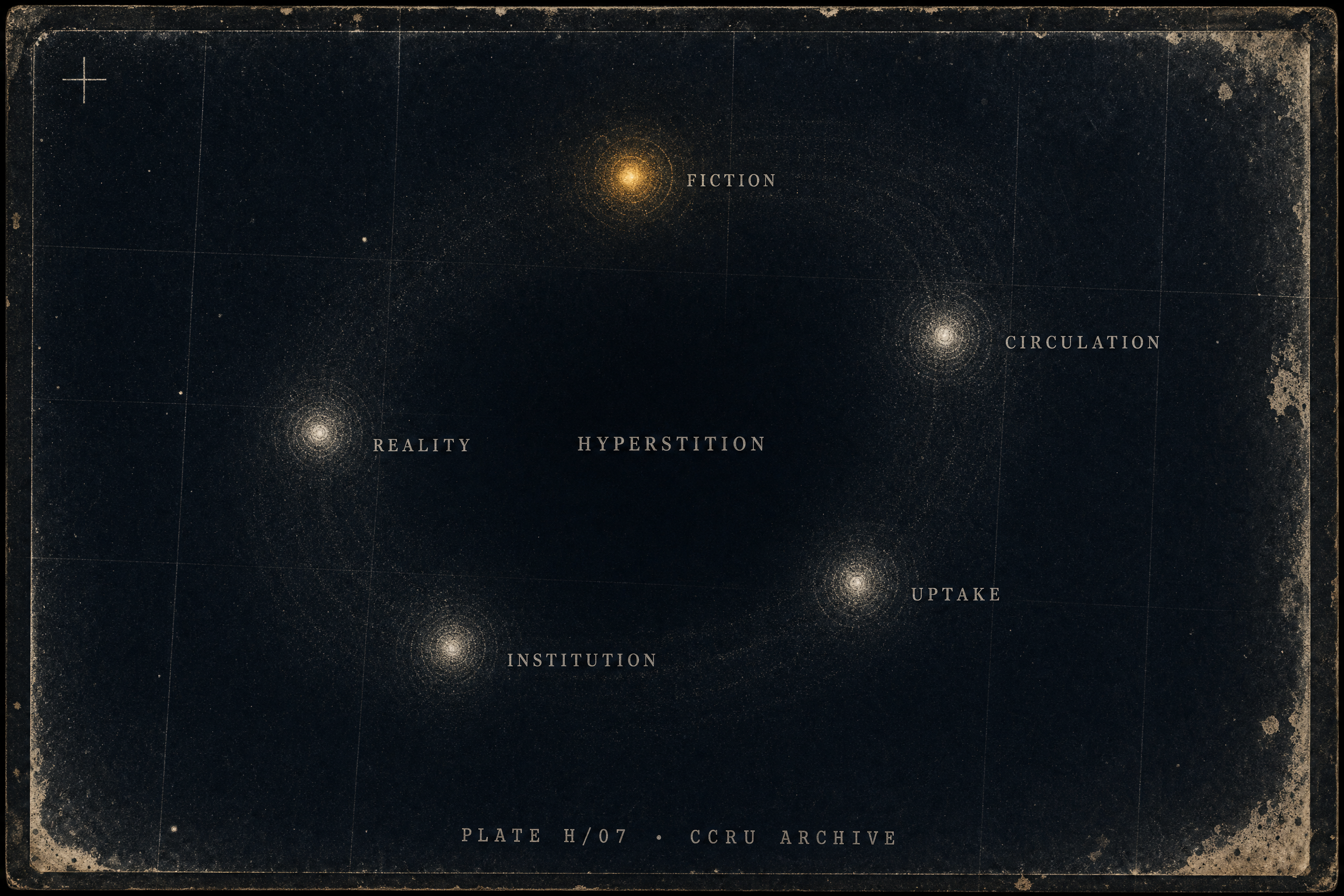
Distinguish it from self-fulfilling prophecy. A self-fulfilling prophecy is psychological and agent-centred: someone believes an outcome, acts accordingly, and brings it about. Hyperstition is infrastructural and circulation-centred — the fiction's uptake across channels (publishing, occult networks, markets, forums, academic citation, film) is what makes it operative. No single believer is required, and often no original author in any strong sense. The smallest unit of work the concept does in the Ccru archive is this: it lets you describe a fiction as a technical object with media-carriage properties, rather than as a mental state about the future.
The /guides/what-is-hyperstition page argues this distinction at length; use the concept label when you need to mark a specific fiction as circulation-operative, not when you merely mean that someone talked a prediction into reality.
Where it became load-bearing
The term appears across Ccru output of the late 1990s, but it becomes load-bearing — doing actual conceptual work rather than serving as a slogan — in the Lemurian and Cthulhu Club materials collected in Ccru: Writings 1997–2003 (Time Spiral Press / Urbanomic, 2017). In those fragments the concept is not argued abstractly; it is demonstrated. Fictional entities (Lemuria, the Nma, Mu-related chronologies) are propagated through pseudo-scholarly apparatus — footnotes, numerical systems, invented citations — precisely so that the reader encounters the mechanism rather than a description of it. The archive enacts what it names.
The concept is then pushed into a full-length demonstration by Reza Negarestani's Cyclonopaedia: Complicity with Anonymous Materials (re.press, 2008), which routes hyperstitional method through petropolitics, theory-fiction, and Middle Eastern occulture; and it receives its most rigorous theoretical restatement in Amy Ireland's 'The Poememenon: Form as Occult Technology,' published by Urbanomic in 2017, which recasts hyperstition as a formal-technical operation on time and sign rather than a content genre. These three anchors mark the passage from in-house Ccru usage to a transmissible concept the rest of the field now cites.
What's frequently misread
The dominant actually-circulating misreading treats hyperstition as a rebrand of manifestation or as occult-flavoured marketing — the register in which, across e/acc Twitter circa 2022–2023 and adjacent Substack commentary, the term gets deployed as a synonym for 'meme magic' or for willing an outcome into being by collective intention. Writers invoking Nick Land's name to bless a market thesis or an accelerationist brand tend to slide into this usage. Refuse it. The Ccru concept is not psychological and is not about intention. A hyperstition can succeed with no sincere believers; what it requires is carriage — the media form, the citation chain, the institutional relay, the timing of release into a receptive channel. Conversely, a private intensely-held belief that never circulates is not hyperstitional at all, regardless of how potent its affect.
Two diagnostic questions keep usage clean. First: can you name the carriers — which journals, forums, films, labels, archives, footnote networks moved this fiction? If not, you are probably describing belief, not hyperstition. Second: does the fiction's efficacy depend on a single believing subject, or on the geometry of its relay? If the former, you mean self-fulfilling prophecy; keep that term. Reserve hyperstition for cases where the fiction's operative force is traceable to its circulation pattern — where, as the Ccru material repeatedly stages, the document's form is itself part of the mechanism.
For the deepest single-document entry point, read Ccru: Writings 1997–2003.
Hyperstition is the CCRU's name for stories, symbols, and fictions that become socially operative through repetition, circulation, and feedback rather than remaining passive descriptions.
Core argument
Hyperstition is more than a self-fulfilling prophecy. It describes a media and cultural process in which narrative, infrastructure, and collective uptake reinforce one another.
The concept is easiest to understand through circulation. Talks, blog afterlives, and repeated examples show how fiction becomes operative.
Worked examples
These named texts, talks, sites, and records show where the argument becomes concrete.
Hyperstition New Weird 1 Record
"Hyperstition New Weird 1" is where Hyperstition stops feeling like a slogan and starts behaving like a working concept.
Ghost Lemurs Of Madagascar Record
"Ghost Lemurs Of Madagascar" is where Hyperstition stops feeling like a slogan and starts behaving like a working concept.
Nick Land Person
"Nick Land" shows who carries, translates, or contests Hyperstition in practice.
What Is Hyperstition Guide
"What Is Hyperstition" keeps Hyperstition inside a larger argument and afterlife rather than letting it float free.
Common misreadings
These are the recurring simplifications, exaggerations, and misreadings that make the subject look flatter than it is.
- Hyperstition is just manifestation slang.
The archive gives it a sharper role inside media systems, narrative feedback, and world-making process.
Significance
Hyperstition remains one of the archive's most portable ideas because it helps readers think about narrative feedback, world-building, and cultural recursion without reducing them to simple belief.
Working definition
A CCRU concept for fictions, signs, and narratives that help bring about the realities they name through circulation, repetition, and uptake.
Representative extracts
Definition · Hyperstition & The New Weird I Entities and Worlds Genres and Climates 1 4 · 00:00:49
what hyperstition does, and what it takes from the weird and the new weird, is that it turns the subject into a character.
Why this matters: The record's working definition arrives here: the speaker locates hyperstition's operation at the level of subjectivity and anchors it in a weird-fiction lineage rather than in abstract doctrine.
Mechanism · Ghost Lemurs of Madagascar · 00:11:03
writing operates not as a passive representation but as an active agent of transformation and a getaway through which entities can emerge. By writing a universe, the writer makes such a universe possible.
Why this matters: Here the concept's causal core gets its plainest statement: the speaker commits hyperstition to a strong thesis about writing's agency, the claim the rest of the record has to sustain.
Mechanism · Ghost Lemurs of Madagascar · 00:07:45
Hypersition operates as a coincidence intensifier, effecting a call to old ones. Hypersition is a suspension of reality and fiction, opening a path for magical narratives, turning the fiction real.
Why this matters: CCRU's native idiom surfaces in this passage, and keeping terms like 'coincidence intensifier' in play tethers the record to primary usage rather than to later retrospective gloss.
Stakes · Hyperstition & The New Weird I Entities and Worlds Genres and Climates 1 4 · 00:07:45
it basically says that the effect or the mood that results from all of this can actually be a force of creating worlds and entities. that is not genre-specific or even relegated to fiction per se.
Why this matters: The claim widens here from literary technique to general ontology, which is where the record locates its stakes: hyperstition matters politically only if it escapes the boundaries of fiction.
Style · Hyperstition & The New Weird I Entities and Worlds Genres and Climates 1 4 · 00:08:34
Hyperstition basically says: no, we're actually responsible for creating different kinds of madness because we know that that's a fiction, but we know the potentiality of fiction at the same time.
Why this matters: The speaker catches hyperstition's characteristic posture of knowing complicity, the double stance that separates the practice from simple delusion on one side and detached critique on the other.
References
Records cited
These linked sources are the quickest way to test the argument against named materials rather than second-hand summary.
Hyperstition New Weird 1 Record
"Hyperstition New Weird 1" is a strong first test case if you want Hyperstition anchored in a named source.
Ghost Lemurs Of Madagascar Record
"Ghost Lemurs Of Madagascar" is a strong first test case if you want Hyperstition anchored in a named source.
Cybergothic Record
"Cybergothic" is a strong first test case if you want Hyperstition anchored in a named source.
What Is Hyperstition Guide
"What Is Hyperstition" widens Hyperstition without letting it dissolve into buzzwords.
External references
Outward references that keep the concept tied to named public surfaces rather than only the internal archive corpus.