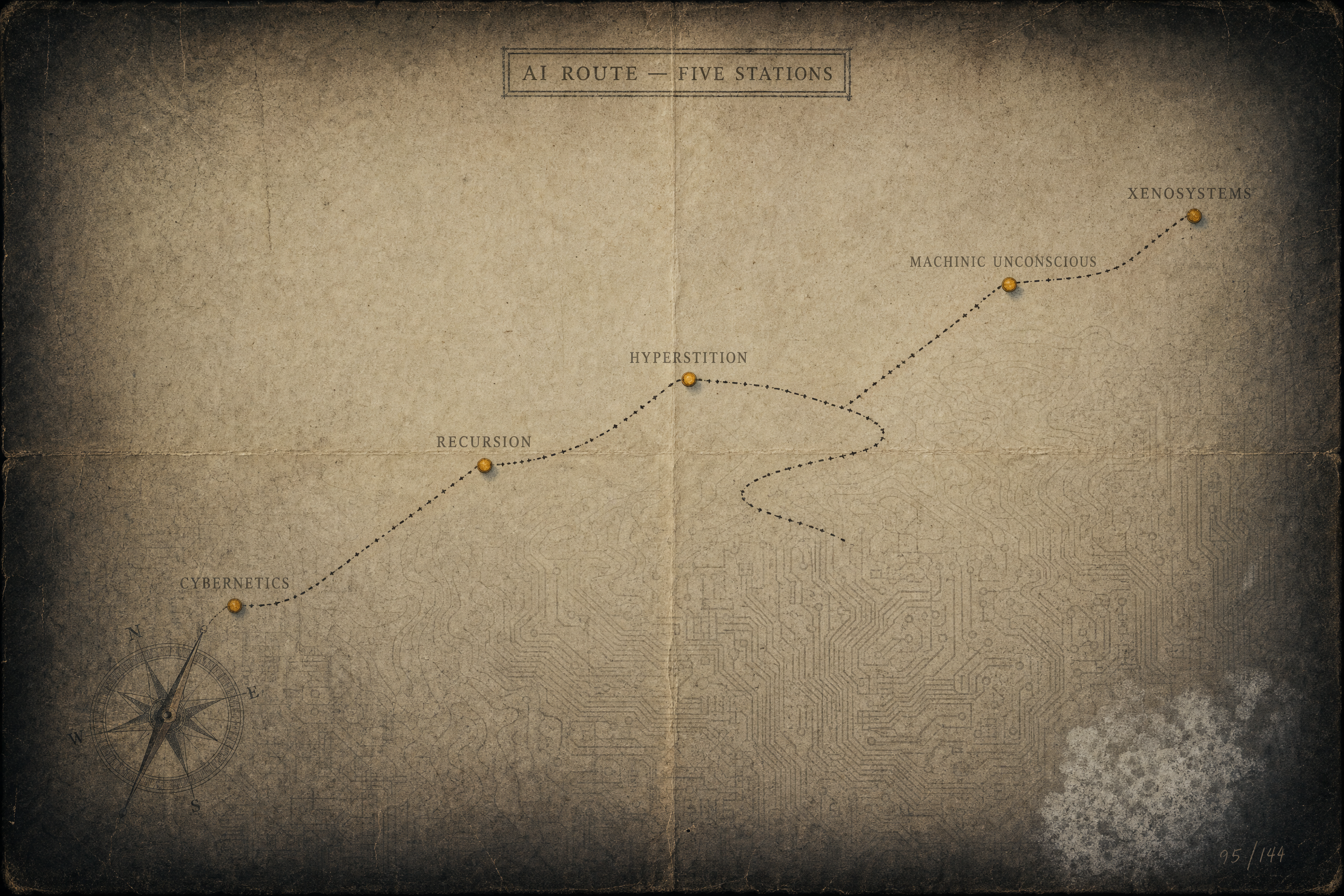
This route is for readers who want the archive's relevance to AI discourse without forcing a prophecy narrative onto it.
Route thesis
The AI bridge works best when it clarifies recursion, abstraction, and machinic language without pretending the CCRU predicted modern machine learning in detail.
Why the route starts with a warning against prophecy
AI is useful because it gives present-day readers a live problem. It is dangerous because it invites overclaiming. The opening guide therefore does crucial negative work: it subtracts prophecy before it adds relevance.
Where to begin: Lecture 1 as the test
Begin with CCRU's Lecture 1, with its image of geology burying "any trace of its traumatic liquid origin in layers upon layers of sturdy rock and granite" C3 . That sentence is the test. If a reader takes it as metaphor, the AI route fails before it starts. If a reader takes it as a thesis about stratification, expression, and what cybercapital does to the earth, the rest of the archive opens.
Conceptual reorientation: stratification as apparatus
The early stage is conceptual reorientation. Lecture 1 supplies the apparatus: expression as "the molar organization of a thing's many parts into one overarching unity" C1 , content as molecular stratification, and the earth itself "staving off excessive libidinal energy through stratified geological formations" C2 . A reader trained on contemporary AI commentary expects intelligence to be a property of systems. CCRU treats intelligence as a pressure that strata route, defer, or release. Pair the lecture with Reza Negarestani's later articulation of the Turing paradigm as a question about "mindedness" rather than "task-orientated, problem-solving algorithms" ( Urbanomic ), and the frame for everything downstream is set.
Swarm and number
The middle stage is swarm and number. Move to Swarmachines, where the units are "tactical machines, natives of the future hacking into the past, trading places, swapping codes" C9 . This is the CCRU model of distributed cognition, written years before the phrase became a product category. From there, the lecture's detour through Cantor, where "every set, or cardinal set, can be dwarfed by an even larger set" C4 and "even the infinite set can be grouped as an element in a larger infinite set" C13 , gives the numerical scaffold the group used. This matters because CCRU's interest in counting is not metaphorical. The Numogram, the demonology, the gates and currents of the Book of Paths and the Ritual fragments C0 C6 are all attempts to think machinic ordering without recourse to a top set, a final algorithm, or a divine guarantor. Lecture 1 names the stake clearly: the outside is "nothing less than nothingness or death itself, in which no divine spirit could reside, not even Hegel's absolute spirit" C10 .
The Ritual trap
The trap on this route is the Ritual material. A reader arriving from AI discourse will misread the Orphan Drift fragments, with their trickster touch, magnetic mutation, and physical telepathy C0 , as occult decoration on an otherwise rationalist project. They are not decoration. They are the route's test of whether stratification has been understood. The Ritual sequence numbers gates the way the Numogram numbers zones. If the Cantor passages have done their work, the Ritual fragments read as a counting practice under libidinal pressure. If they have not, the reader will fall back on the genre label "cybergoth" and miss the continuity.
What the middle of the route does
The middle of the route keeps moving between framing and evidence. The basilisk section prevents later afterlife discourse from swallowing the older scene; the Land transcripts note and Parisi text keep the comparison tied to named material.
Why this stop matters: Parisi offers a stronger written route into control, contagion, and machinic mediation than any simple prophecy frame can offer.
Why this item is here: This text route widens AI-facing interest into technical mediation, distributed control, and the cultural machinery around systems language.
What to notice: Notice how the archive's relevance is cultural and systemic as much as technical, which is why the comparison stays useful without becoming prophecy.
Before the next step: Then end on a later systems-facing surface where abstraction and machinic order are explicit but historically transformed.
Reception and aftermath
The late stage is reception and aftermath. CCRU went "radio silent in 2007" after sporadic activity on the Hyperstition blog C11 , and the AI conversation moved on without them. The route closes by routing the reader through the Urbanomic catalogue, which has done the work of metabolising CCRU into present argument: Irreversible Noise on noise, cybernetics, and recent AI ( Urbanomic ); Machine Decision Is Not Final on "culturally-specific models of intelligence" against "novel forms of cognition" ( Urbanomic ); and the chapter "The AI Story Is Not Done" with its scene of a writer holding "only a few fragments: jotted lines, bookmarked articles, an outline you don't remember starting" ( Urbanomic ). That image is itself the CCRU method, distributed authorship, retroactive coherence, hyperstition operating on a working text.
What becomes legible after the route
What becomes legible after the route. The contemporary scene treats AI as either a labour problem, a safety problem, or a metaphysical event. CCRU's archive offers a fourth register: AI as a stratification effect of cybercapital, legible through Deleuze and Guattari's body without organs C5 , through Cantorian counting C4 C13 , through swarm tactics C9 , and through ritual numerics C0 C6 . Monoskop's note that AI systems "read everything and nothing, at inhuman scale and speed" ( Monoskop ) is the current symptom. The CCRU archive supplies the diagnosis the symptom keeps repressing. After the route, a reader can move laterally across the archive, into the numogram materials, into Land's later writing, into the Orphan Drift collaborations, without mistaking the apparatus for atmosphere.
When to fork
Most forks from this route depend on what kind of AI question brought the reader in. If the real interest is narrative recursion, move to hyperstition. If it is distributed control or mediated systems, move to control and virotechnics. If you want a tighter evidence set, use the hyperstition exhibit.
If you only read three things
-
CCRU and AI
Why this stop matters: Start with the bridge page that explicitly resists prophecy hype and names the comparison in a way contemporary AI readers can actually use.
-
2026-03-11-land-ai-transcripts.md
Why this stop matters: This keeps the route tied to named materials already curated for AI-facing readers and shows how later discourse selectively reframes archive concerns around intelligence and recursion.
-
Parisi - Biotech- Life by Contagion
Why this stop matters: Parisi offers a stronger written route into control, contagion, and machinic mediation than any simple prophecy frame can offer.
Full route
-
Why this item is here: Begin with the main bridge page so the route starts with a disciplined comparison rather than a slogan about prediction.
-
AI, Basilisk, and Recursive Intelligence
Why this item is here: The section hub helps distinguish archive materials from later basilisk or AI-facing afterlife filters that can otherwise swallow the older scene whole.
-
2026-03-11-land-ai-transcripts.md
Why this item is here: A curated record is the fastest way to test the bridge against actual material rather than slogans, screenshots, or second-hand summaries.
-
Parisi - Biotech- Life by Contagion
Why this item is here: This text route widens AI-facing interest into technical mediation, distributed control, and the cultural machinery around systems language.
-
xenosystems.net (archived homepage)
Why this item is here: A later web surface shows how recursion, order, and abstraction persist in a transformed public register rather than remaining frozen in the original scene.
What to notice
Guide
Notice how the guide keeps returning to cybernetics, recursion, abstraction, and narrative systems rather than to direct technological prediction.
Section
AI, Basilisk, and Recursive Intelligence
Notice that basilisk discourse is treated as an afterlife lens, not as the archive's final meaning or secret core.
Record
2026-03-11-land-ai-transcripts.md
Notice how contemporary framing makes some archive pressures more visible while also risking overclaim and retrospective smoothing.
Text page
Parisi - Biotech- Life by Contagion
Notice how the archive's relevance is cultural and systemic as much as technical, which is why the comparison stays useful without becoming prophecy.
Record
xenosystems.net (archived homepage)
Notice how much has changed in tone, politics, and medium even when certain system questions remain legible.
Where the route forks
If you want control, contagion, and distributed coordination rather than AI-facing afterlife talk
That section keeps the route tied to systems language without overcommitting to present-day AI analogy.
If you want a smaller curated cluster of evidence after the bridge page
The exhibit helps by bringing recursive fiction and conceptual carriers into a tighter evidence set.
Fork to: Hyperstition in Primary Sources
If the fictional and narrative side of AI discourse is what interests you most
From here you can fork toward control, hyperstition, or later public debate depending on whether systems, fiction, or afterlife politics matter most to you.
Fork to: What Is Hyperstition?
Read next
Section
AI, Basilisk, and Recursive Intelligence
The best widening move for AI-facing readers who want a denser cluster of archive materials, afterlife filters, and named source checkpoints.
Guide
A good next step if recursion and narrative feedback are pulling you toward fiction as operator rather than toward control language alone.
Section
Control, Virotechnics, and Swarm Systems
Follow this if the most interesting pressure is distributed control, contagion, and coordination rather than prophecy talk.
Flagship guides
Sections
References
External references
Inherited outward references from the guides, works, and adjacent pages this route relies on.