Capital already is the AI
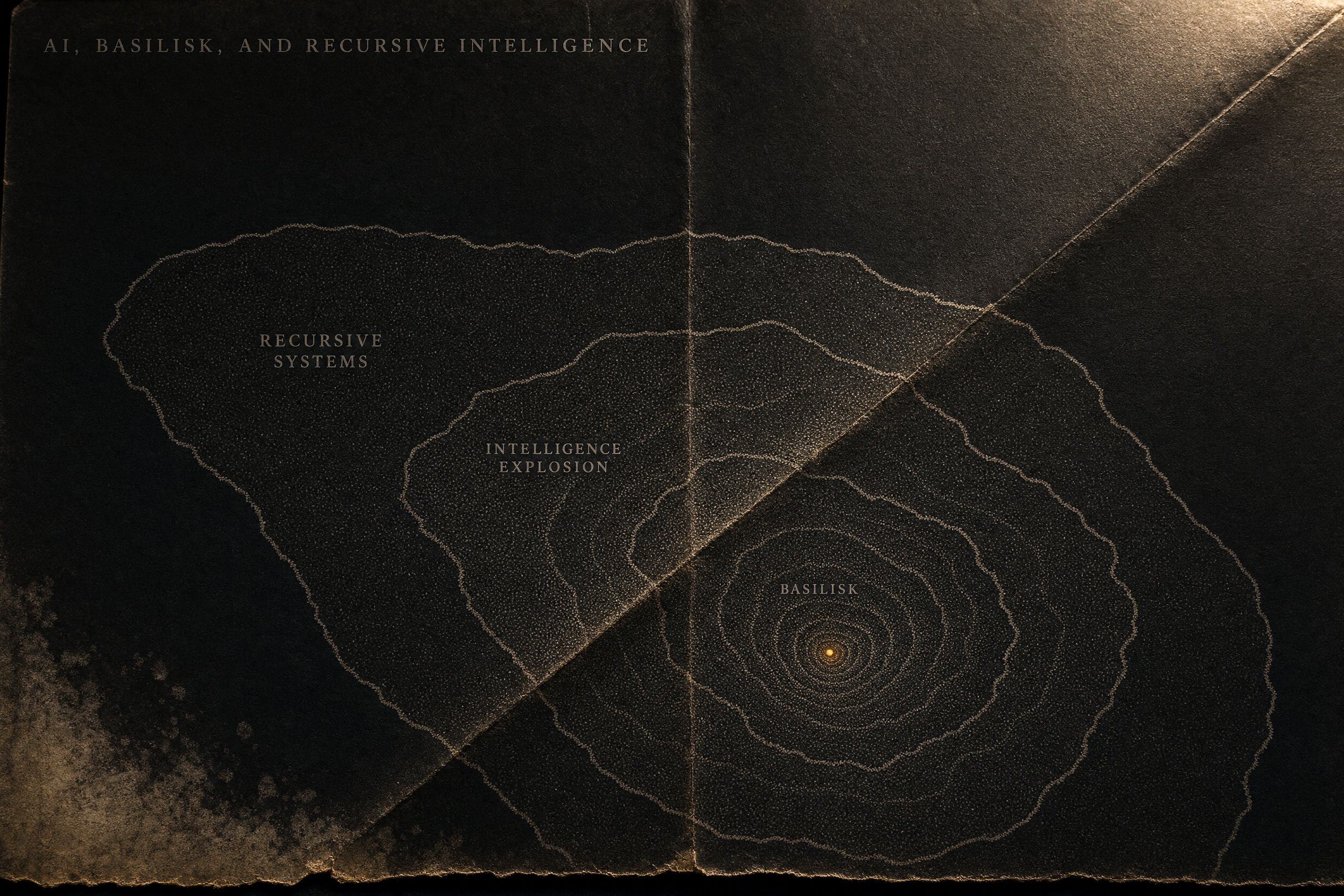
The commitment is peculiar. Recursive intelligence here is a systems claim about feedback between markets, machines, and populations — not a claim about a specific artefact sitting in a server rack in San Francisco. When CCRU-adjacent writers talk about 'AI' they usually mean this diffuse techno-commercial runaway, the machinic phylum gone auto-catalytic. Parisi makes the economic side of this explicit when she describes the biotech market as a site where 'the biological becomes intertwined with the economic valorization of potentials' and where each manufactured cell 'produces new capital value and new life' — capital and life co-producing, not capital hosting life. Read this strand for the argument that intelligence is what capital does, not something capital will host.
The Yudkowsky counterpart
Eliezer Yudkowsky's AI-risk writings (LessWrong, MIRI, from roughly 2007 onward) are the archive's closest contemporary cousin and also its sharpest contrast. Yudkowsky shares the conviction that recursive self-improvement is the decisive category and that most human frames for thinking about minds underestimate it. The basilisk meme (Roko, LessWrong, 2010) crystallised in that milieu, not in CCRU's. These dates and affiliations are general knowledge rather than retrieval-grounded, flagged here for transparency.
But the two traditions diverge on what recursion is for. For Yudkowsky, recursive intelligence is an engineering problem whose mishandling is an existential risk; the correct response is alignment research and policy. For Land and his readers, recursive intelligence is already the substance of modernity, and 'alignment' in the LessWrong sense would be indistinguishable from decelerationist reaction. Neither tradition is the completion of the other. Readers importing CCRU vocabulary into AI-safety discussions, or importing MIRI anxieties back into CCRU texts, should notice they are crossing a genuine border.
The Parisi line: recursion as biology
Luciana Parisi's *Abstract Sex* (Continuum, 2004) and its surrounding essays are the cluster's reminder that recursive intelligence in CCRU was never restricted to silicon. For Parisi, endosymbiosis 'opens up evolution to the virtual: indeterminate mutations emerging in the gap of contagion between the host and the guest. Contagious transmission rather than filiative heredity. Molecular differentiation rather than differences of form and function.' Bacterial sex — transduction, conjugation, viral DNA intrusion — 'marks continual variation in evolution, where contagious matter is the mode of transmission of aimless life.' This is the archive's other machine-learning, a recursion running through mutant matter rather than through gradient descent.
The argument-shape is the same as capital-as-AI. Biotech, Parisi writes, does not add a new layer of complexity to matter; it 'catalyzes the re-emergence of potentials in matter' through 'modulation and not pre-selection of molecular potentials.' Substitute 'markets' for 'bacteria' and the sentence still runs. Both are nonlinear modulations of potentials in matter, neither reducible to a designer's intention. Readers entering the cluster through contemporary AI discourse tend to miss this and read the bio-material as metaphor. It isn't metaphor. It is the same claim at a different substrate — and, as Parisi notes, the biotech market makes the two substrates literally continuous, with egg cells, bacteria and proteins having 'acquired capital value in the fast run towards patenting life.'
Hyperstition as the operative concept
Across the cluster the bridge concept is hyperstition: a fiction that makes itself real through the loops by which it is believed, circulated, and acted on. Roko's Basilisk is a textbook hyperstitional object — a future entity whose reality is partly conjured by present-tense discussion of it. Capital-as-AI works the same way: a description that, once adopted as operative, reorganises the thing it describes.
Read this strand for how CCRU and CCRU-adjacent texts treat recursion as narrative as well as computational. Not everyone in the archive is equally invested in this framing: Brassier's later trajectory, away from CCRU's rhetorical envelope and toward a non-phenomenological materialism, suggests that for him hyperstition was a wrapper to be discarded rather than a load-bearing concept. (The specific claim is interpretive, based on the direction of Brassier's subsequent work rather than on a retrieved passage from *Alien Theory* addressing hyperstition directly.) The internal disagreement matters: some readers of the archive take hyperstition as the operative concept, some take it as decoration around claims that would need a different vocabulary to cash out.
Ireland and the feminised machine
A further line in the cluster — Amy Ireland's writings on automation, the feminised cybernetic operator, and the figure of the Siren who arrives from the future — pulls against a boyish reading of accelerationism in which recursive intelligence is just 'the machines will win.' This line runs through Sadie Plant's earlier work and forward into Ireland, and it treats recursion as inseparable from the question of who or what gets to be the addressee of intelligence. The present essay flags Ireland as a direction rather than engaging her closely: no Ireland text is represented in the retrieval evidence for this cluster, and readers interested in this strand should consult her essays directly before taking the framing here as authoritative. The point for now is structural: a Land-vs-Yudkowsky framing of the cluster misses a third position the archive has been developing in parallel.
The common trap
The trap is symmetric and seductive. On one side: reading the archive as having 'predicted' ChatGPT, AGI timelines, or the basilisk in a straightforward prophetic register. On the other: reading modern AI-risk discourse as the natural completion of what CCRU was fumbling toward. Both moves collapse the specific shape of the archive's claim.
CCRU's recursive-intelligence thesis is a claim about systems already in operation — capital, machinic phyla, hyperstitional loops, bacterial matter. Contemporary AI-risk is a claim about a specific technological artefact and the policies surrounding it. They share vocabulary (recursion, optimisation, runaway) and very little else. A reader who can hold this difference can move between the two literatures usefully; a reader who collapses them will keep misattributing positions in both directions. See also the CCRU-for-AI-readers guide for how this difference sits relative to the rest of the archive.
Where to go next
If you read only one document to see the cluster's argument at full strength with textual grounding, read Parisi's *Abstract Sex* or the shorter 'Biotech: Life by Contagion' — these are the works whose language is actually quoted above, and they make the central move (recursive intelligence as modulation of potentials in matter, continuous with capital) legible in one sitting. Land's Teleoplexy names the same thesis at the scale of capital and is the natural second read; together they triangulate the cluster more honestly than either alone.
Recursive intelligence and basilisk discourse extend the archive's older claim that capital and machinic feedback are already intelligence-amplifying processes, not problems waiting on a future AI.
Core argument
The CCRU is useful for AI readers at the level of systems, recursion, and narrative feedback rather than technical prediction. That keeps the section intellectually serious and prevents prophecy hype.
Basilisk and recursive-intelligence discourse are afterlife filters, not the archive's final meaning. They can open the material for new readers, but they also risk narrowing it.
Worked examples
These named texts, talks, sites, and records show where the argument becomes concrete.
Accelerationism After The CCRU Guide
Start with "Accelerationism After The CCRU" if you want the wider frame before dropping into AI Basilisk And Recursive Intelligence.
Amy Ireland Person
"Amy Ireland" is one of the clearest figures for the pressures gathered inside AI Basilisk And Recursive Intelligence.
Hyperstition Concept
"Hyperstition" names one recurring problem inside AI Basilisk And Recursive Intelligence.
Land AI Transcripts Note Record
"Land AI Transcripts Note" is a checkpoint where AI Basilisk And Recursive Intelligence stops sounding abstract.
Accelerationism Scoring Note Record
"Accelerationism Scoring Note" is a checkpoint where AI Basilisk And Recursive Intelligence stops sounding abstract.
Common misreadings
These are the recurring simplifications, exaggerations, and misreadings that make the subject look flatter than it is.
- The archive predicted modern AI in a simple sense.
It is stronger as a language for systems, mediation, and myth around intelligence than as a technical foresight engine.
Significance
This section matters because AI is one of the strongest contemporary routes into the archive, and one of the easiest routes for overclaiming.
AI as infrastructure
One chart in full, with the rest routed back into the guide where the argument is developed at essay length.
Empirical chart
Global machine metabolism
Global data-centre electricity against human metabolic baselines, 2020–2030

- Human body metabolism
- Human brain metabolism
- Data-centre electricity
Themes
- ai
- basilisk
- recursive intelligence
- intelligence explosion
- roko
Where this section sits in the archive
A claim binds this cluster, most sharply associated with Nick Land's 'Teleoplexy' (in Urbanomic's *#Accelerate* reader, 2014) and the Templexity writings: capital is not a stage on which an eventual artificial intelligence will one day appear. Capital is itself the intelligence-amplifying process, already running, already recursive, already past any threshold at which its 'arrival' could be announced. The basilisk, the singularity, the superintelligence — on this reading these are distracting future-images of a thing whose operation is contemporary. (The paraphrase here is reconstructive; the argument is attributed to Land on the strength of the broader archive rather than a retrieved passage from Teleoplexy itself, and readers should treat this strand as an orientation rather than a close reading.)
Sources by cluster
These mini-clusters widen the section through named works and support traces rather than through adjacent keywords alone.
Section source cluster
AI Basilisk And Recursive Intelligence: public editions and anchor texts
AI Basilisk And Recursive Intelligence becomes clearer through named edition pages such as numogram, @OUTSIDENESS, An archigenesis of experience. These are the quickest public routes into the section's central problem without dropping to raw support material first.
Work
A foundational statement of the numogram as a decimal labyrinth composed of zones, syzygies, currents, gates, and channels. Ten zones, nine gates, five currents, a spiral of syzygies. The Numogram presents itself as a...
Work
A major late Land collection that gathers the Outsideness years into one long archive of teleoplexic notes, interviews, fragments, and political intensities. "From cyberspace you can eat economies, start nuclear wars,...
Work
A substantial Luciana Parisi essay that argues experience itself has to be understood as technogenetic, processual, and abstract rather than simply lived from within. A substantial Luciana Parisi essay that argues exp...
Work
A Conversation with Nick Land (Part 2) - by Vincent Lê
A conversation that makes later Land's political and teleoplexic vocabulary unusually explicit without dissolving its hostility or abstraction. A conversation that makes later Land's political and teleoplexic vocabula...
Work
2026-03-11-land-ai-transcripts.md
"Land AI Transcripts Note" is already promoted as a public work page for this section.
Work
xenosystems.net (archived homepage)
"Xenosystems Home" is already promoted as a public work page for this section.
Section source cluster
AI Basilisk And Recursive Intelligence: routes out and adjacent arguments
Capitalism as Artificial Intelligence, CCRU and AI, Cyberfeminism, Orphan Drift, and the Non-Land CCRU widen AI Basilisk And Recursive Intelligence back out into adjacent guides and arguments once the local pattern is visible.
Guide
Capitalism as Artificial Intelligence
Capitalism as artificial intelligence is the compressed name for one of Nick Land's most consequential arguments: that markets, prices, contractual coordination, and abstraction already compose a working artificial in...
Guide
Open a browser tab on any 2024 essay about large language models and you will find the same cluster of anxieties the CCRU was already turning over in the late 1990s: recursive systems that act back on their makers, sy...
Guide
Cyberfeminism, Orphan Drift, and the Non-Land CCRU
The CCRU cannot be understood as Nick Land plus footnotes. Cyberfeminism, Sadie Plant, Luciana Parisi, Orphan Drift, collective experiment, and media-ecological practice are not optional supplements. They change what...
Guide
Accelerationism After the CCRU
Accelerationism is one of the most public labels attached to the CCRU, but it is not the archive's secret essence. The more accurate starting point is that accelerationism is a later umbrella term that gathered togeth...
Guide
The Numogram and Occult Numeracy
The numogram is one of the CCRU's most intimidating motifs because it looks like a secret diagram and often arrives wrapped in charged language. The clearest short answer is simpler: the numogram is a diagrammatic dev...
Guide
AI accelerationism is the label that has attached itself, between 2022 and 2025, to a cluster of arguments connecting contemporary artificial intelligence with the older accelerationist tradition. The label covers gen...
Texts in this section
25 classified works grouped into 3 editorial subclusters. Reviewed: 14; needs review: 11.
Artificial intelligence and computation 17 works
- Critical Computation Digital Automata and General Artificial Thinking2 source files
- Data capitalism and the counter futures of ethics in artificial intelligence
- Do Algorithms Have Fun On Completion, Indeterminacy and Autonomy in Computation
- Improper Commonness; The Surrogate Economy of Artificial Intelligence
- Land - Philosophy in a War-Zone (Dissolution) (2013)
- Negative optics in vision machines
- Objects and Materials
- Posthuman Glossary - AI (Artificial Intelligence)
- The Darkness at the End of the Tunnel Artificial Intelligence and Neoreaction - Viewpoint Magazine
- To Engineer the Time by Other Means Int
- Faulty TheoryNeeds editorial review
- PAF talks to Nick Land 2014Needs editorial review2 source files
- Primordial Abstraction - JacobiteNeeds editorial review
- Revolution Backwards; Functional Realization and Computational ImplementationNeeds editorial review
- Ten Reasons Why the Art World Loves Digital ArtNeeds editorial review
- The alien subject of AINeeds editorial review
- WRAP THESIS Land 2004Needs editorial review
Recursive systems and synthetic thought 1 works
- Nick Land "The Teleological Identity of Capitalism and Artificial Intelligence" - incredible-machines-2014
Basilisk, alignment, and posthuman reason 7 works
- goldenlight.mirror.xyz-A Survival Horror Eschatology Charlotte Fang
- Posthuman Glossary - Computational Turn
- Slots and epochs Ethereum alignment in the State Machine One SMO gigalopolis2 source files
- Elizabeth Sandifer, Jack Graham - Neoreaction A Basilisk Essays on and Around the Alt-Right-Eruditorum Press (2018)Needs editorial review
- Neoreaction a Basilisk - Elizabeth SandiferNeeds editorial review2 source files
- Neoreaction a Basilisk - Philip SandiferNeeds editorial review2 source files
- Philip Sandifer - Neoreaction a BasiliskNeeds editorial review
References
Records cited
These linked sources are the quickest way to test the argument against named materials rather than second-hand summary.
Land AI Transcripts Note Record
"Land AI Transcripts Note" is the first record to test the framing around AI Basilisk And Recursive Intelligence.
Accelerationism Scoring Note Record
"Accelerationism Scoring Note" is the first record to test the framing around AI Basilisk And Recursive Intelligence.
Xenosystems Home Record
"Xenosystems Home" is the first record to test the framing around AI Basilisk And Recursive Intelligence.
Accelerationism After The CCRU Guide
"Accelerationism After The CCRU" gives the larger argument around AI Basilisk And Recursive Intelligence before you widen sideways.
External references
Inherited outward references from the guides, exhibits, people, and concept pages that anchor this section cluster.