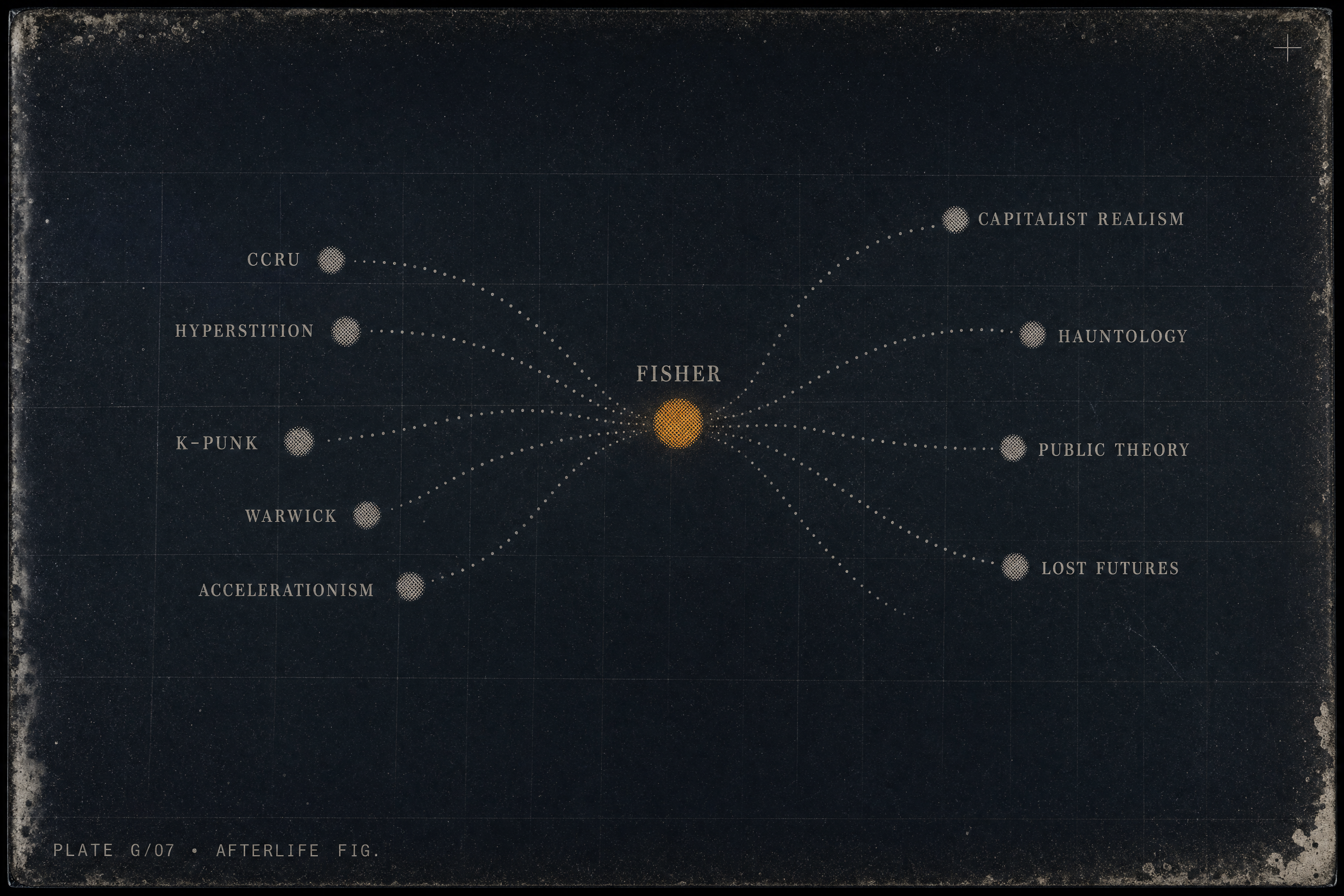
Mark Fisher is one of the best ways into the CCRU because he translated difficult archive motifs into public criticism about culture, media, mood, politics, and everyday life. He is not the archive's master key, but he is one of its strongest bridge figures.
Key points
- Fisher matters because he makes the archive socially and culturally legible without eliminating its strangeness.
- He overlaps with the CCRU, but he does not simply repeat it; his tone, politics, and method are distinct.
- Blog culture and public criticism are central here because they explain how the archive entered wider discourse.
Core argument
Fisher's main value is translational rather than merely biographical. He helps readers understand how archive motifs move into public criticism, not just who knew whom. Example: k-punk homepage (k-punk.abstractdynamics.org (archived homepage))
The k-punk afterlife is part of the CCRU story, not a side-note to it. It shows how the archive remained active through blogging, music writing, and distributed public theory. Example: Ghost Lemurs of Madagascar (Ghost Lemurs of Madagascar)
Fisher clarifies the archive most when read comparatively. You understand him best by setting his translation beside the older materials he is carrying forward, revising, or softening. Example: White Magic (Mark Fisher - White Magic)
Fisher's main value is translational rather than merely biographical. He helps readers understand how archive motifs move into public criticism, not just who knew whom.
Compare and contrast
Fisher as bridge vs Fisher as simplifier
Bridge
Fisher translated a difficult archive into public criticism, blog culture, pedagogy, and cultural argument.
Simplifier
That same portability can flatten the archive if readers treat Fisher as the whole explanation rather than one strategic route into it.
Fisher works as a bridge because he keeps theory social
One reason Fisher is so effective is that he almost never leaves theory floating at the level of atmosphere alone. He ties abstract motifs to music, television, labor, depression, neoliberalism, genre, and collective mood. That gives newer readers a way to feel the force of the archive without first mastering its most compressed language.[1]
This does not make him a simplifier in the insulting sense. It makes him a translator. Translation is part of the archive's afterlife. The CCRU would not have remained publicly legible in the same way if later figures had not restaged its problems in different idioms.
You understand him best by setting his translation beside the older materials he is carrying forward, revising, or softening.
He overlaps with the archive, but he also diverges from it
Fisher matters partly because he is close enough to the archive to carry its vocabulary, but distant enough to make the differences visible. His tone is usually clearer, more public, and more pedagogical. His politics are also different in emphasis. The result is not a purified or corrected version of the CCRU. It is a shifted one.
That shift is intellectually useful. It lets you ask what survives when theory-fictional compression becomes public criticism. Which motifs remain central? Which tones disappear? Which problems become more socially explicit? Fisher helps answer those questions because he is neither outside the archive nor identical with it.
Start with the early Fisher, because the divergence is sharpest there. "White Magic" runs sentences like "K-space produces wormholes in anthropomorphic space-time, slipping the Net of the perceptual-consciousness system" C9 , and devolves "language into words, words into (animal) noises, and noises into Klangs (anorganic semiotics)" C11 . That is not the prose of Capitalist Realism. It is CCRU-register: theory-fictional, compressed, infected by Burroughs and Deleuze, written from inside the unit's sonic and demonological vocabulary. "SF Capital" (2001) sits in the same zone, signed off with Ccru and Swarmmachines ( cinestatic mirror ). Anyone who knows Fisher only through the 2009 Zer0 book will not recognise this writer.
k-punk is part of the archive's public history
The blog matters because it is not just a secondary commentary zone. k-punk is one of the places where difficult archive themes were kept moving, argued over, and made searchable for later readers. It belongs to the history of circulation. If you leave it out, you leave out one of the mechanisms by which the archive became a living public reference rather than a sealed historical episode.[2]
This is also why Fisher is important for understanding internet-native theory culture. He shows how distributed writing, blogging, criticism, and cultural reference can carry difficult ideas without turning them into inert academic leftovers.
What happened between those two Fishers is the k-punk decade. The blog at abstractdynamics.org turned distributed writing into a working method, keeping difficult material in motion without sealing it inside specialist discourse C1 . The archived homepage shows the late texture clearly: public events on capitalist realism with Peter Fleming and Alex Niven C10 , a Showroom discussion on the eerie with Justin Barton, Kodwo Eshun, John Foxx and Gazelle Twin C7 , a conversation at the Boathouse cafe in Bawdsey about East Anglian landscape, M.R. James, and the site where radar was invented C8 . The CCRU's cybergothic became hauntology became the eerie. The route runs through sonic culture, genre, mood, and collective feeling, and that is one of the main ways theory becomes shareable and socially vivid C4 .
Music, genre, and mood are not decorative here
Fisher's route into the archive often runs through sonic culture, genre fiction, television, and public mood. That is not a lighter version of theory. It is one of the ways theory becomes socially vivid. Through Fisher, archive problems about recursion, hauntology, world-building, and futurity become linked to scenes of listening, watching, and collective feeling.
That move is one reason readers stay with him. He keeps the archive from becoming a remote doctrine. He returns it to culture as something lived, felt, and argued over.
The disagreement inside the archive
Here is the disagreement inside the archive that Fisher's afterlife papers over. In Simon Reynolds's 1998 interview, Fisher himself describes the CCRU's "perverse and literally anti-humanist identification with the dark will of capital and technology" as a deliberate provocation against "the stuffy complacency of Left-wing academic thought" ( k-punk archive ). Capitalist Realism, eleven years later, is a left-wing book. The 2010 Goldsmiths accelerationism event placed Fisher on a platform with Land, Brassier, Noys, Srnicek and Williams ( Internet Archive ), and the political distance across that table was already structural. Fisher kept the CCRU's diagnostic apparatus, capital as deterritorialising machine, time as scrambled, subjectivity as dissolving, and turned its affective charge from gloating to grief. That is a real alteration, not a continuation. The archive contains both moods. Fisher carried only one of them into public criticism.
This matters for how you read the primary material. If you come to Ccru: Writings 1997-2003 expecting the patient pedagogy of Capitalist Realism, the numogram looks like a joke and the Lemurian time-sorcery looks like a pose. If you come to it expecting Fisher's politics, Land's later trajectory becomes incomprehensible rather than legible. The CCRU was a collective experiment in welding futurism, technoscience, mysticism, numerology and science fiction into a single conceptual production line ( Monoskop ). Fisher's gift was extracting one strand, the affective and political diagnostics, and giving it a public grammar. His limit, structurally, was that the strand cannot stand for the whole.
There is a second pressure point worth naming. Urbanomic's memorial recalls Fisher's "manically productivist credo" from the 90s, the insistence that "you only are what you do, what you produce" ( Urbanomic memorial ). The CCRU operated on that credo. Capitalist Realism diagnoses exactly the burnout it produces. Fisher's later writing on depression and mental health is, among other things, a reckoning with the working conditions of the unit that formed him. The afterlife is also a critique. Robin Mackay's "To Wish Impossible Things" reads the post-CCRU fantasy as a "frigid simulacrum" that nonetheless keeps a posthumous joy alive ( Urbanomic ). That ambivalence is the honest position.
How to use Fisher without shrinking the archive
The best use of Fisher is comparative. Read him to orient yourself, then place him beside records, transcripts, and a few primary texts. Use him to understand what the archive looked like once it entered public criticism, not as a replacement for the archive's plurality.[3]
If you do that, Fisher becomes more valuable, not less. He stops being the final answer and becomes a relay: one of the best ways to move from public theory back into the archive and then out again with clearer distinctions.
That relay function is the real point of the guide. Fisher helps newcomers arrive without mistaking arrival for completion.
So what should change after you read this guide. Stop using Capitalist Realism as a CCRU primer. Use it as Fisher's settlement with the CCRU, written from outside the unit's stylistic regime. Read "White Magic" and "SF Capital" first if you want the Fisher who still wrote in CCRU-register. Read the k-punk archive for the transition. Then go to the primary CCRU material, the numogram, hyperstition, the Barker tapes in Digital Hyperstition ( Urbanomic ), the Afrofutures issue with Eshun ( Internet Archive ), and let it be as strange as it is. Use Fisher to orient yourself, not to replace the archive C3 . Watch what he translates, what he alters, and what he leaves behind. The leaving-behind is where the archive still has work to do.
The other magic
The other kind of magic is a tactics of fleeing, of communicability and propagation. Instead of asking, how do we keep things out? it asks, how can we take flight?
Worked examples
These named texts, talks, sites, and records show where the argument becomes concrete.
k-punk homepage Record
The public interface where Fisher's bridge work became searchable, serial, and widely legible.
Ghost Lemurs of Madagascar Record
A vivid source where Fisher meets a core CCRU motif directly rather than by distant commentary.
White Magic Text page
A concise route into Fisher's own explanatory language and the way he reframed archive themes.
Mark Fisher and Public Theory Section
The section hub for the longer afterlife in public criticism, mood, and blog culture.
Tensions and limits
Fisher is such an effective bridge that he can accidentally become too central, obscuring other lines in the archive.
His public clarity is a strength, but it can tempt readers to substitute him for the older materials rather than compare them.
The Fisher route emphasizes culture, mood, and criticism; it is less useful if you want a first handle on the archive's more diagrammatic or cyberfeminist strands.
Common misreadings
These are the recurring simplifications, exaggerations, and misreadings that make the subject look flatter than it is.
- Fisher is the same thing as the CCRU.
He is a crucial bridge, but the archive is wider, stranger, and more internally uneven than any one interpreter.
- His clarity proves the original archive was shallow.
Translation is part of the intellectual labor. It does not mean the original problems were trivial.
Significance
Fisher matters now because he remains one of the most persuasive routes through which newer readers find the CCRU. He ties difficult archive problems to recognizable cultural objects, collective feeling, and public discourse.
He also matters because his afterlife demonstrates how online public theory can carry difficult material without reducing it to slogans, even while changing its tone and emphasis.
References
Records cited
Linked archive records for this guide. Numbers correspond to the footnote markers in the body above.
Ghost Lemurs of Madagascar Record
A source where Fisher's voice intersects directly with one of the archive's central motifs.
k-punk.abstractdynamics.org (archived homepage) Record
The public blog surface that made Fisher's bridge role historically visible.
Ray Brassier - Mad Black Deleuzianism; On Nick Land Record
A neighboring post-CCRU conversation that helps place Fisher's route in a larger interpretive field.
External references
Selected outward references: source sites, archived copies, and durable relay surfaces that widen this guide beyond the internal archive layer.
Reader questions
How does Mark Fisher connect to the CCRU?
Fisher worked as a relay figure: he translated parts of the CCRU archive into K-Punk, pedagogy, public criticism, and later books like Capitalist Realism without simply reproducing the original scene.
Why call Fisher a bridge figure?
Because many readers arrive through Fisher rather than Warwick-era documents, and his writing offers one of the clearest routes from CCRU residues into a broader public discourse about culture, politics, and contemporary media life.
Reading routes through this guide
Featured exhibit
A curated exhibit on how Mark Fisher and adjacent materials helped translate the archive into public theory culture.
Featured reading path
A short guided sequence for readers coming to the CCRU through Mark Fisher, k-punk, and public theory.