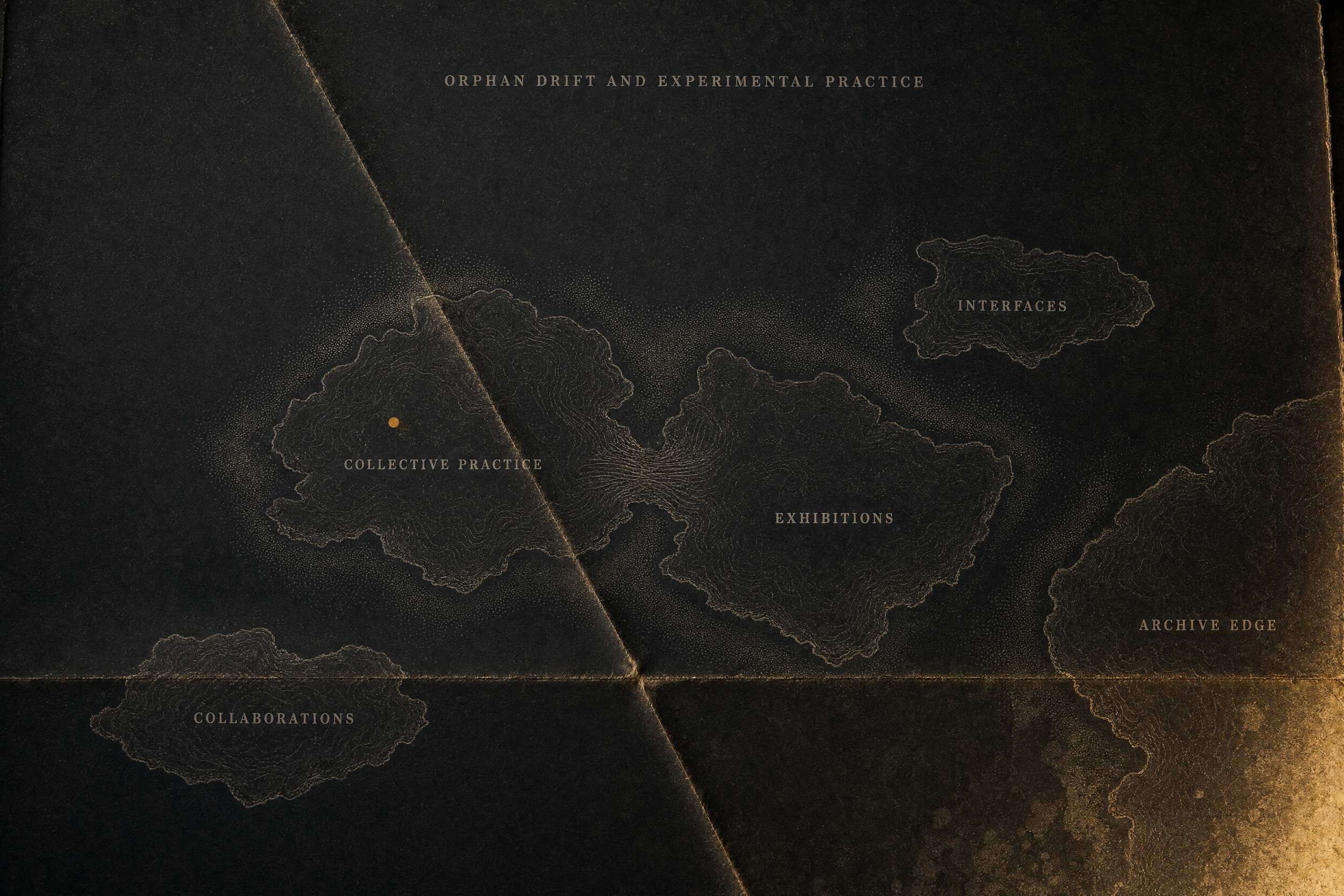
The collective as Unit of production
Ccru's own authorship was already plural — names dissolved into Vauungs and Vysparovs, lectures attributed to no single speaker. But Orphan Drift pushed this further into material practice: the same image-text object passed through several hands, several bodies of research, several aesthetic reflexes. The output looks like no single-author book could look. A disagreement inside the cluster stays live: is the collective signature a Ccru-wide method (every serious Ccru artifact is pseudo-collective, the signatures are masks) or is Orphan Drift a distinct operation that happens to run parallel? Reading the 1999 novel and the Abstract Culture contributions side by side will not settle it.
Image before argument
By received account, the 1999 *Orphan Drift* novel is a collage object — photographs, diagrams, blocks of set text, ritual-toned fragments, with the layout itself carrying the theoretical load that a philosophy essay would carry in propositions. This is the strand where readers most often stumble. They reach for the quotable sentence and find the page resisting extraction. The page is the argument.
Roberts' continuing visual practice — paintings, video, ritual installation — extends this operation. Concepts that appear in Land's prose as compressed abstraction (hyperstition, currents, chthonic transit) appear in the image work as surface, colour, creature. What to read for: the moments where a visual motif in Roberts' work rhymes with a diagram in Fanged Noumena without either citing the other. That is what transmission without argument looks like. (A caveat: the retrieval available for this essay contains no primary chunks from the 1999 novel itself, so the description here rests on received characterisation rather than direct quotation. Readers should handle the book.)
Para-academic circulation surfaces
Orphan Drift did not reach readers through university presses. It reached them through Mute magazine, through the Abstract Culture journal issues associated with Ccru in the late 1990s, through gallery handouts, zines, and later through Urbanomic's Collapse and reissue programme. These are the surfaces on which the cluster was actually reproduced.
This matters because it explains why the archive looks the way it does today. If the primary circulation had been journals, the archive would be citation-stable and thin. Because it was magazines, zines, and galleries, the archive is citation-unstable and thick — full of loose images, broken links, reprinted fragments whose provenance has to be reconstructed. The common trap: treating this as a failure of documentation rather than as the native medium. Mute and Abstract Culture were not waystations en route to real publication. They were the publication. (The specific editorial histories and datings of these venues are not grounded in the retrieval available here and should be checked against a dedicated source before being cited as fact.)
Ritual as method
Across Orphan Drift's work and the broader Ccru periphery — the numogrammatic and Yi Jing threads at Vauung's Lair, the path-texts, the lemurian calendrical material — there is a consistent refusal to distinguish research from ritual. Sessions, workings, calendrical timings, sigil production are treated as cognitive instruments, not decorative framing. The [Book of Paths] sequences and the Numogramming the Yi Jing threads show this plainly: the numerical apparatus is run as operation, not illustrated as theme.
Internal disagreement here is sharp. One faction (closer to Land's later rationalist-accelerationist writings) reads the ritual apparatus as heuristic — useful fiction, hyperstition in the engineering sense. Another faction (closer to Roberts' ongoing practice, and to writers like Amy Ireland who have circled this material) reads it as operative in its own right, not reducible to cognitive scaffolding. The 1999 novel will not settle this for you. It is built precisely to remain undecidable on the question.
Why design is not decoration
The 2020 Urbanomic / Vampire Salon reissue of *Orphan Drift* is instructive as an editorial gesture: a reissue rather than a repackaging, preserving the original collage-object rather than translating it into a standard prose format. Whether one reads this as paper-choice and typography or simply as a refusal to reset the pages, the principle is the same — the object's material form is treated as load-bearing. Robin Mackay's broader editorial work (including #Accelerate: The Accelerationist Reader) reads, interpretively, as operating on the same premise: the book as designed object carries argument.
The consequence for readers: the PDF is not the work. The scanned upload is not the work. The cluster is reproduced faithfully only when the material object is reproduced, which is why reissues matter disproportionately in this corner of the archive and why digital-only engagement tends to miss what the cluster is actually doing. Compare any plaintext transcription of an Orphan Drift page to the page itself — the loss is not ornamental.
The adjacency trap
The common error: filing Orphan Drift under "arts adjacent" — atmosphere, mood-setting, the aesthetic wing of a theoretical project whose centre is elsewhere (in Land's essays, in the Ccru pamphlets, in the seminars). This misreads the distribution of labour. The proposal this essay makes — and it is a proposal, an interpretive claim rather than a documented chronology — is that several of the textures most associated with Ccru (the affective register of hyperstition, the visual grammar of the numogram, what gets called "gothic materialism" in Mark Fisher) stabilised through Orphan Drift's practice alongside, not downstream of, their textual formulation.
Treat the collective as primary evidence, not as illustration of prior theory. The test: try to reconstruct what hyperstition means using only the text-track of the archive, with no image, no ritual, no collective-authored page. The concept goes thin. It needs the other track to be what it is.
Where to go next
For the single deepest document in this cluster, read Orphan Drift — specifically the 2020 Urbanomic / Vampire Salon reissue, with the original layout preserved. Read it as an object first: handle the pages, follow the image sequences before the text sequences, let the collage do its work before you start extracting propositions. Everything else in the cluster — Roberts' later practice, the Mute ecosystem, the Abstract Culture issues — is calibrated to readers who have already been through that book in its material form.
If you have come from a guide arguing a thesis about this material, set that thesis down for the duration of the reading. The novel is not an illustration of any thesis. It is the kind of object that thesis-writing exists downstream from.
Orphan Drift moves the archive out of philosophy and into ritual, image, and collective practice — the archive is reproduced through art and design, not only through writing.
Core argument
Collective practice is one of the archive's core forms. It makes the CCRU look like a broader experimental field rather than a stack of solitary texts.
Design and media ecology are not decorative side issues. They are part of how the archive thinks and circulates.
Worked examples
These named texts, talks, sites, and records show where the argument becomes concrete.
What Was The CCRU Guide
Start with "What Was The CCRU" if you want the wider frame before dropping into Orphan Drift And Experimental Practice.
Sadie Plant Person
"Sadie Plant" is one of the clearest figures for the pressures gathered inside Orphan Drift And Experimental Practice.
Hyperstition Concept
"Hyperstition" names one recurring problem inside Orphan Drift And Experimental Practice.
ccru.net Home Record
"ccru.net Home" is a checkpoint where Orphan Drift And Experimental Practice stops sounding abstract.
k-punk Home Record
"k-punk Home" is a checkpoint where Orphan Drift And Experimental Practice stops sounding abstract.
Common misreadings
These are the recurring simplifications, exaggerations, and misreadings that make the subject look flatter than it is.
- Orphan Drift is adjacent atmosphere rather than central evidence.
The collective practice line is one of the strongest ways to see the archive's plurality in action.
Significance
This section matters because it gives contemporary readers a concrete route into the archive through interface, design, and collective experiment.
Themes
- orphan drift
- experimental practice
- performance
- collective art
- interfaces
Where this section sits in the archive
Orphan Drift was a collective working under a single name — Maggie Roberts and collaborators, writing and image-making in London through the mid-1990s, producing the novel *Orphan Drift* in 1999 before its reissue by Urbanomic and The Vampire Salon in 2020. The collective form is not trivia. It determines what the archive can do.
Sources by cluster
These mini-clusters widen the section through named works and support traces rather than through adjacent keywords alone.
Section source cluster
Orphan Drift And Experimental Practice: public editions and anchor texts
Orphan Drift And Experimental Practice becomes clearer through named edition pages such as Ritual - 0rphan Drift Archive, @OUTSIDENESS, ccru.net (archived homepage). These are the quickest public routes into the section's central problem without dropping to raw support material first.
Work
An 0rphan Drift archive page that makes ritual a collective interface practice rather than a private symbolic exercise. 0rphan Drift called themselves a collective that treated "information as matter and the image as...
Work
A major late Land collection that gathers the Outsideness years into one long archive of teleoplexic notes, interviews, fragments, and political intensities. "From cyberspace you can eat economies, start nuclear wars,...
Work
The archived ccru.net homepage shows the collective presenting itself as a designed cultural system rather than a neutral repository of documents. The Wayback Machine capture from 4 September 2013 preserves ccru.net a...
Work
Grant - Demonology of the New Earth
A major Grant text that treats the new earth as a demonic process of becoming rather than a reconciled terrain waiting to be inhabited. Iain Hamilton Grant's The Demonology of the New Earth treats becoming, geology, a...
Work
A compact lithic page that makes stone, inscription, and cryptic materiality part of the archive's geotraumatic imagination. A compact lithic page that makes stone, inscription, and cryptic materiality part of the arc...
Work
k-punk.abstractdynamics.org (archived homepage)
"k-punk Home" is already promoted as a public work page for this section.
Section source cluster
Orphan Drift And Experimental Practice: routes out and adjacent arguments
Cyberfeminism, Orphan Drift, and the Non-Land CCRU, What Was the CCRU?, CCRU Glossary widen Orphan Drift And Experimental Practice back out into adjacent guides and arguments once the local pattern is visible.
Guide
Cyberfeminism, Orphan Drift, and the Non-Land CCRU
The CCRU cannot be understood as Nick Land plus footnotes. Cyberfeminism, Sadie Plant, Luciana Parisi, Orphan Drift, collective experiment, and media-ecological practice are not optional supplements. They change what...
Guide
The Cybernetic Culture Research Unit, or CCRU, was a loose research formation that emerged around Warwick in the 1990s and then persisted through texts, events, recordings, websites, and arguments long after its origi...
Guide
The reason people search for a “CCRU glossary” is obvious once you spend time with the material itself. Its vocabulary is part of the attraction and part of the barrier. Hyperstition, numogram, accelerationism, geotra...
Guide
Accelerationism After the CCRU
Accelerationism is one of the most public labels attached to the CCRU, but it is not the archive's secret essence. The more accurate starting point is that accelerationism is a later umbrella term that gathered togeth...
Guide
The fastest way to make the CCRU less mystical is to put it back into time. Most readers do not meet the Cybernetic Culture Research Unit at Warwick in the mid-1990s. They meet it through Mark Fisher, k-punk, Nick Lan...
Guide
The Numogram and Occult Numeracy
The numogram is one of the CCRU's most intimidating motifs because it looks like a secret diagram and often arrives wrapped in charged language. The clearest short answer is simpler: the numogram is a diagrammatic dev...
Texts in this section
10 classified works grouped into 3 editorial subclusters. Reviewed: 5; needs review: 5.
0rphan Drift and collective practice 2 works
- Ritual - 0rphan Drift Archive
- Cyberpositive Relaunch - 0rphan Drift ArchiveNeeds editorial review
Media ecology and art method 1 works
Architecture, interface, and exhibition 7 works
- Avatar Tools for Engineering Demon Convergence in a Space - 0rphan Drift Archive
- Parisi Goodman - Extensive Continuum, Towards a Rhythmic Anarchitecture
- Plant - Transarchitectures
- Algorithmic ArchitectureNeeds editorial review
- Automated Architecture; Speculative Reason in the Age of the AlgorithmNeeds editorial review
- Plant - No Plans (Architects in Cyberspace 1995)Needs editorial review
- Undercover Softness; An Introduction to the Architecture and Politics of DecayNeeds editorial review
References
Records cited
These linked sources are the quickest way to test the argument against named materials rather than second-hand summary.
ccru.net Home Record
"ccru.net Home" is the first record to test the framing around Orphan Drift And Experimental Practice.
k-punk Home Record
"k-punk Home" is the first record to test the framing around Orphan Drift And Experimental Practice.
What Was The CCRU Guide
"What Was The CCRU" gives the larger argument around Orphan Drift And Experimental Practice before you widen sideways.
External references
Inherited outward references from the guides, exhibits, people, and concept pages that anchor this section cluster.