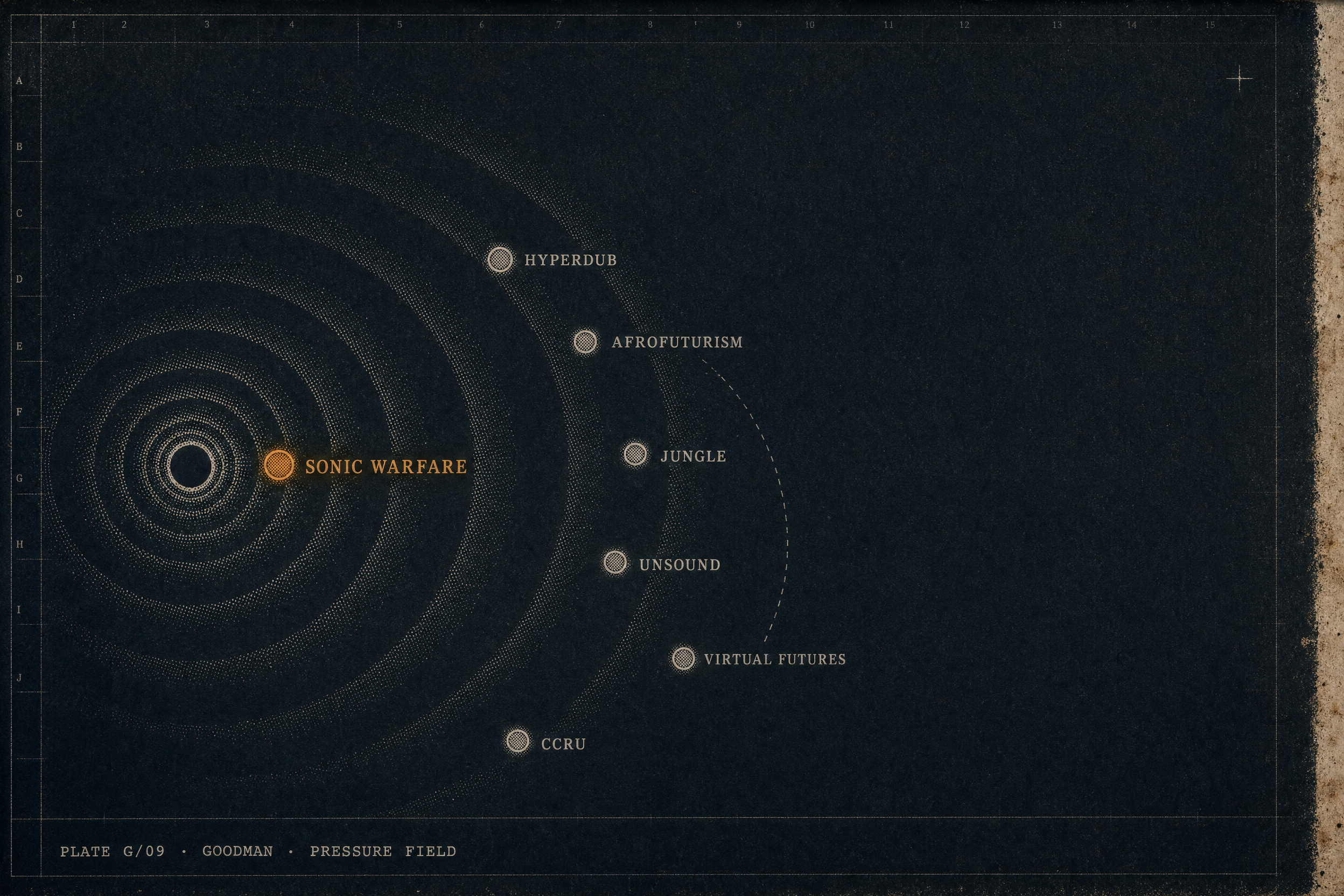
Sound as theoretical operator
The move that does the work is treating the affective tier as infrastructural rather than expressive. Dread, panic, anticipation, the pre-cognitive tightening of the chest at a sub-sonic frequency: these are approached as engineered events, not reactions to events. Once that reversal is accepted, the domains Sonic Warfare pulls together — military acoustics, commercial sonic branding, the sound-system lineage running from Jamaica through jungle and dubstep — stop being a scattered set of case studies and become one empirical terrain on which the same technical question is posed by incompatible parties.
The Ecology of Fear as pre-emption
Sonic Warfare's second achievement is to give the broader CCRU-adjacent project a usable account of pre-emption routed through the body rather than through text or code. The 'ecology of fear' names an architecture in which affective stimulus and conscious response arrive out of phase — the body responds to a frequency before the frequency is registered as an object. This is what lets Goodman describe crowd-control weapons and dancefloor build-ups as variations on one technical problem: how to modulate a body before it knows what is happening to it.
The comparative framing is interpretive rather than Goodman's own: read alongside Parisi's work on prehension and algorithmic capture, and Land's on recursive capital, Goodman's specific contribution is to locate an analogous structure at the level of vibration and hardware — the speaker stack rather than the symbol or the loop. That moves affect theory off its familiar terrain of the face, the encounter, and the linguistic event, and reconnects it to physics and to rigged infrastructure.
Hyperdub as continuation of the argument by other means
Hyperdub, the label Goodman founded and runs as Kode9, is not adjacent to the theoretical project; it is the same project on a different substrate. The catalogue's sustained attention to bass pressure, hauntological dread, and rhythmic dilation performs in sound what Sonic Warfare argues in prose. The records are not evidence for the book. They are the other half of it. To treat Hyperdub as 'the music side' and the MIT monograph as 'the academic side' is exactly the misreading the work was built to refuse.
The CCRU datastream fragments on 'Hyper-C' — oblique, fictionalised echoes of Kode9's project — give a sense of how the figure was already being mythologised within the group: as a 'tone-scientist' working 'polyrhythmic scaling, octave stretching and breakbeat nesting as short-circuits to turbulence', aligning bio-strategy with sonology via digitalisation of the audiosphere (raw::ccru-datastreams::137, ::84, ::76). These are not documentation of the label's editorial program — for that one would turn to interviews and the catalogue itself — but they record the internal recognition that what Goodman was doing with sound was continuous with what the group was doing with theory.
The genre trap
The internal tension in Goodman's work is chronological. Sonic Warfare's examples lean heavily on the jungle and dubstep moment in which the book was written, and a lazy reception has let the underlying argument age at the speed of those genres. This is a misreading. The core claim — sound as operator, affect as infrastructural, frequency as pre-cognitive weapon and pre-cognitive bliss — does not require dubstep to remain live. It requires any rhythmic or sub-bass practice at all, and the practices have continued to mutate: grime, footwork, the ongoing Hyperdub catalogue, and far beyond music into the sonic design of interfaces, alarms, and branded environments.
The tension Goodman has to manage is that some of the surrounding vocabulary was forged inside a specific UK scene and its critical orbit — Simon Reynolds's 'hardcore continuum' is the nearest neighbour term, not Goodman's own — and the concepts can be read as period pieces rather than portable tools. The portrait the archive should preserve is the one in which Sonic Warfare's claims survive the scene, readable forward into whatever the current frequency war looks like rather than backward into a 2010 basement.
Why the cluster cannot lose this
Without Goodman the CCRU constellation has no rigorous non-textual surface. Land gives it recursive prose, Parisi gives it computation, Fisher gives it the cultural diagnostic. Goodman gives it the claim that a theoretical position can be held in a frequency as seriously as in a sentence, and that the engineering of affect through sound is not a side-application of the group's thought but one of its native forms. Remove him and the project becomes a writing practice with a record collection, rather than what it actually is: a set of operations distributed across prose, code, and vibration.
Deepest single document: Sonic Warfare.
Steve Goodman, who also records and runs Hyperdub as Kode9, gives the CCRU one of its most fully realised non-textual theoretical surfaces. Sonic Warfare (MIT 2010) treats vibration, frequency, and dread as serious philosophical objects; the label and the writing are one project.
Core argument
Goodman's project treats sound as philosophical material. Sonic Warfare gives the archive a working vocabulary for affect, dread, and contagion that the textual side cannot easily produce.
Hyperdub is part of the project, not adjacent to it. The label's curatorial decisions develop the same arguments through release schedules, artists, and sonic practice.
Worked examples
These named texts, talks, sites, and records show where the argument becomes concrete.
CCRU and Internet-Native Theory Culture Guide
Where Goodman's sonic-theoretical surface intersects with the archive's wider online afterlife.
Cybergothic Concept
The register Goodman's work develops sonically — possession, contagion, dread as conceptual instruments.
Mark Fisher and the CCRU Afterlife Guide
The route through which Fisher and Goodman's overlapping music writing enters the wider scene.
Common misreadings
These are the recurring simplifications, exaggerations, and misreadings that make the subject look flatter than it is.
- Goodman is the music-side of the CCRU.
Sonic theory in his hands is a working theoretical instrument, not an extracurricular annexe. Sonic Warfare is a serious philosophical book; Hyperdub is part of the same project.
Significance
Goodman's sonic-theoretical work supplies the archive's clearest vocabulary for affect, dread, and contagious atmosphere. Contemporary debates about machine-learning aesthetics and platform mood have to reach for that vocabulary; reading him directly is faster than reinventing it.
Stakes of this figure
Philosopher and producer whose Sonic Warfare (MIT 2010) and the Hyperdub label (2004–) make sonic theory a working theoretical instrument inside the CCRU's wider project.
Periodisation
- 2000s onward
Key works for entering the figure
- Steve Goodman — Sonic Warfare: Sound, Affect, and the Ecology of Fear (MIT Press 2010)
- Hyperdub label catalogue (2004 onward)
References
Records cited
These linked sources are the quickest way to test the argument against named materials rather than second-hand summary.
CCRU and Internet-Native Theory Culture Guide
Where Goodman's sonic line intersects with the archive's online afterlife.
Cybergothic Concept
The register Sonic Warfare carries forward into a sustained book-length argument.