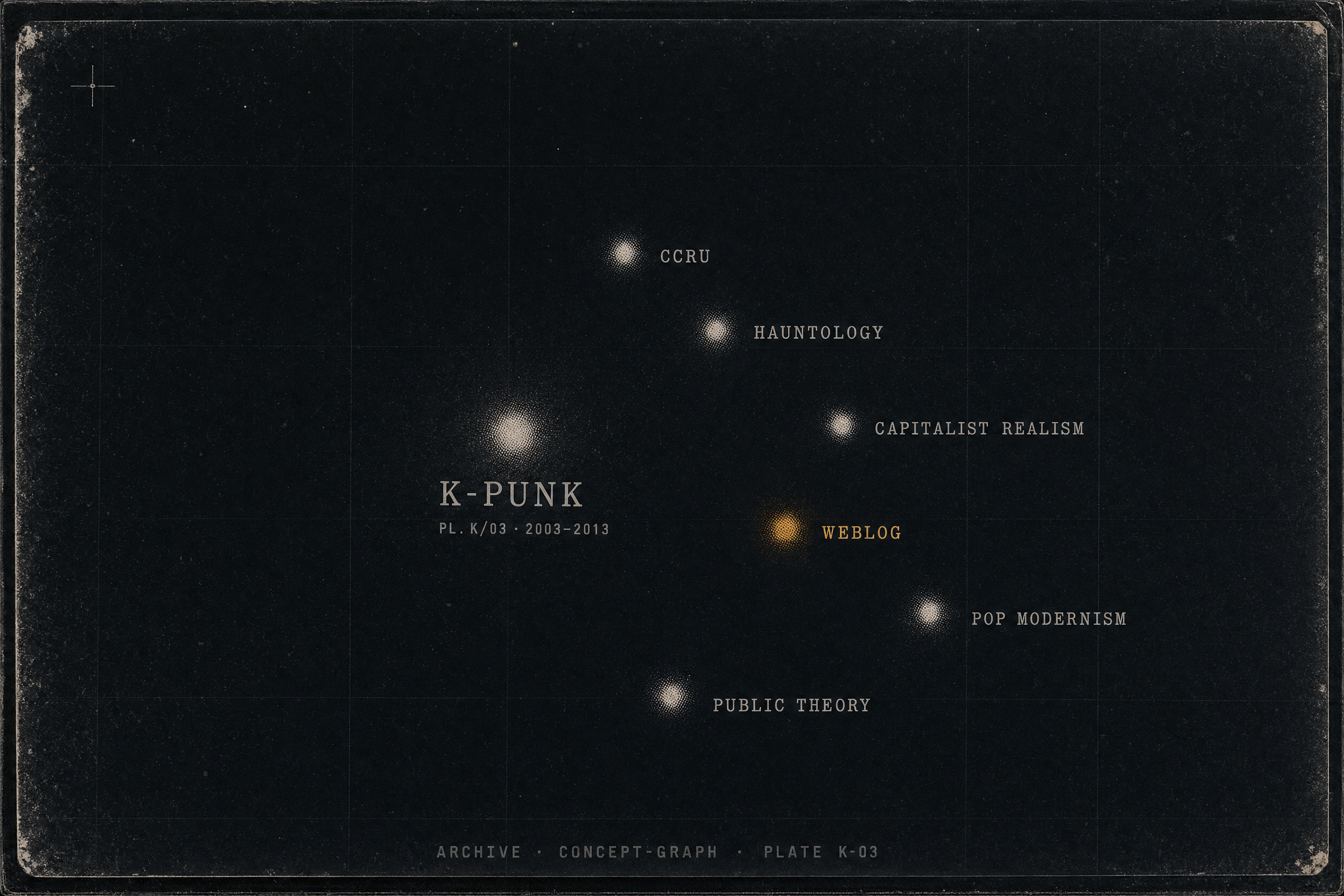
Blog-as-theoretical-practice
Distinguish k-punk from the music blog or the cultural-commentary blog it is often shelved beside. A music blog reviews releases; a commentary blog reacts to news. K-punk does neither. The smallest unit of work the term does in the archive is this: the blog post treated as theoretical writing — short, citable, argument-bearing, using CCRU-inflected vocabulary precisely rather than loosely. K-punk is the form through which a post can carry theoretical load without being a journal article, and it is also, by extension, Fisher's signature for that method wherever he practises it.
Where the method became load-bearing
The blog itself is the primary source — posts from 2003 onward on k-punk.abstractdynamics.org, where concepts were tested in public before any of them reached print. Fisher's better-known concepts (hauntology, capitalist realism) circulated in blog form in advance of their book-length treatments; Capitalist Realism: Is There No Alternative? (Zer0 Books, 2009) compressed years of blog-diagnosis into a pamphlet. The pamphlet is a translation surface; the blog is where the thinking happened — a chronology that the posthumous anthology's dating (2004–2016) makes structurally visible even where individual post-to-book lineages would need to be traced post by post.
The posthumous anthology K-Punk: The Collected and Unpublished Writings of Mark Fisher (2004–2016) (ed. Darren Ambrose, Repeater, 2018) is the load-bearing archival object. Its organisation — sections on books, film, music, politics — preserves the fact that these were adjacent registers of one practice, not separate beats. That Repeater itself publishes blog-length argument as theoretical work makes it a downstream institution of the k-punk method: the channel through which CCRU vocabulary survived into a wider readership that never touched Abstract Culture or the 1990s Warwick scene directly.
What gets misread, and where to go next
K-punk is remembered, increasingly, as "the blog where Mark Fisher wrote about music." This is the dominant misreading and it must be refused. The form was load-bearing precisely because it let CCRU-derived vocabulary enter public criticism without thinning into journalism. A Fisher post on The Fall or Burial is not cultural commentary with theoretical flavouring; it is theoretical writing that takes a specific cultural object as its working material. Treating k-punk as commentary retrospectively flattens what the blog was doing and misrepresents why its concepts travelled.
A secondary, related confusion: k-punk is sometimes treated as coextensive with the CCRU. It is not. The CCRU is a 1990s Warwick formation; k-punk is one person's post-CCRU practice, begun roughly a decade after the collective's dissolution. K-punk inherits CCRU vocabulary and a certain disposition toward theory-as-production, but its genre (the blog), its tone (first-person, polemical, accessible), and its political register (explicitly Left, trade-unionist, mental-health-attentive) are Fisher's own. Reading k-punk as CCRU continued-by-other-means erases what Fisher actually built. For the argument about why Fisher matters across the archive rather than how k-punk-the-method works, see Mark Fisher.
Deepest single document: K-Punk: The Collected and Unpublished Writings.
The Boathouse conversation: East Anglia and the eerie
In the Boathouse cafe on the banks of the River Deben, Mark Fisher and Andy Sharp (English Heretic) discuss the relationship between the East Anglian landscape and the contemporary reimagining of the eerie.
In the Boathouse cafe on the banks of the River Deben, Mark Fisher and Andy Sharp (English Heretic) discuss the relationship between the East Anglian landscape and the contemporary reimagining of the eerie.
In the Boathouse cafe on the banks of the River Deben, Mark Fisher and Andy Sharp (English Heretic) discuss the relationship between the East Anglian landscape and the contemporary reimagining of the eerie. The Boathouse is located in the grounds of Bawdsey Manor, the site where radar was invented, just opposite the locations in Old Felixstowe that inspired key scenes in M R James's story "Oh, Whistle and I'll Come To You".
The Boathouse is located in the grounds of Bawdsey Manor, the site where radar was invented, just opposite the locations in Old Felixstowe that inspired key scenes in M R James's story "Oh, Whistle and I'll Come To You". The conversation will be illustrated by readings, a screening of Fisher and Sharps short film, Bleak and Solemn (2013) and excerpts from On Vanishing Land.
The Boathouse is located in the grounds of Bawdsey Manor, the site where radar was invented, just opposite the locations in Old Felixstowe that inspired key scenes in M R James's story "Oh, Whistle and I'll Come To You". The conversation will be illustrated by readings, a screening of Fisher and Sharps short film, Bleak and Solemn (2013) and excerpts from On Vanishing Land.
The conversation will be illustrated by readings, a screening of Fisher and Sharps short film, Bleak and Solemn (2013) and excerpts from On Vanishing Land.
K-punk is Mark Fisher's blog (2003–2013) and a method for short-form public theory. It is the principal route through which CCRU vocabulary survived into a wider readership.
Core argument
K-punk is both a blog and a method. Treating it only as a blog misses what it did; treating it only as a method loses the historical conditions that produced it.
It is the principal afterlife channel for CCRU vocabulary. Hyperstition, hauntology, capitalist realism, and several other terms reach a general readership largely through this channel rather than through CCRU material directly.
Worked examples
These named texts, talks, sites, and records show where the argument becomes concrete.
k-punk Home Record
"k-punk Home" is where K-punk stops feeling like a slogan and starts behaving like a working concept.
ccru.net Home Record
"ccru.net Home" is where K-punk stops feeling like a slogan and starts behaving like a working concept.
Mark Fisher Person
"Mark Fisher" shows who carries, translates, or contests K-punk in practice.
Mark Fisher And The CCRU Afterlife Guide
"Mark Fisher And The CCRU Afterlife" keeps K-punk inside a larger argument and afterlife rather than letting it float free.
Common misreadings
These are the recurring simplifications, exaggerations, and misreadings that make the subject look flatter than it is.
- K-punk is the same as the CCRU.
Fisher was a CCRU participant, but k-punk is a substantively different project that begins after the CCRU's dispersal and addresses a different reader. Reading the two as continuous flattens both.
Significance
K-punk is the bridge through which most contemporary readers encounter CCRU vocabulary, and it remains the clearest model for how short-form public theory can do serious conceptual work without academic apparatus.
Working definition
Mark Fisher's blog (2003–2013) and, by extension, a method for short-form public theory that became the principal channel through which CCRU vocabulary reached a general readership.
Representative extracts
Definition · k-punk (Mark Fisher's blog archive) · homepage
K-punk's working assumption is that pop, theory, and politics belong to one continuous field that is properly addressed at blog length rather than at book length.
Why this matters: The method made explicit at the level of platform: the form is part of the argument, not a constraint on it.
Stakes · Mark Fisher — Capitalist Realism: Is There No Alternative? · Capitalist Realism
Capitalist realism is the widespread sense that capitalism is the only viable political and economic system, and that it is now impossible even to imagine a coherent alternative.
Why this matters: The k-punk argument's most cited compression. The book is downstream of years of blog-length development of the same claim.
History · k-punk.abstractdynamics.org (archived homepage) · archived homepage
In the Boathouse cafe on the banks of the River Deben, Mark Fisher and Andy Sharp (English Heretic) discuss the relationship between the East Anglian landscape and the contemporary reimagining of the eerie. The Boathouse is located in the grounds of Bawdsey Manor, the site where radar was invented, just opposite the locations in Old Felixstowe that inspired key scenes in M R James's story "Oh, Whistle and I'll Come To You".
Why this matters: Documents the blog's late phase: the eerie-and-landscape inquiry Fisher later condensed into The Weird and the Eerie, here still unfolding as public conversation rather than book chapters.
Afterlife · k-punk.abstractdynamics.org (archived homepage) · archived homepage
Discussion on the Eerie, with Justin Barton, Mark Fisher, Anjalika Sagar, Kodwo Eshun, John Foxx, Elizabeth Walling (Gazelle Twin)
Why this matters: The premise surviving as a milieu: theorists and musicians share a single bill, the pop-theory continuum operating as a live scene rather than a written claim.
References
Records cited
These linked sources are the quickest way to test the argument against named materials rather than second-hand summary.
k-punk Home Record
"k-punk Home" is a strong first test case if you want K-punk anchored in a named source.
ccru.net Home Record
"ccru.net Home" is a strong first test case if you want K-punk anchored in a named source.
Xenosystems Home Record
"Xenosystems Home" is a strong first test case if you want K-punk anchored in a named source.
Mark Fisher And The CCRU Afterlife Guide
"Mark Fisher And The CCRU Afterlife" widens K-punk without letting it dissolve into buzzwords.