Start with the cycle, not the myth
Readers who skim for narrative leave disappointed. The cycle withholds plot on purpose. Its claim about time is enacted through the return of dates, numogram positions, and phantom citations that loop back on earlier entries. Treat the text as a diagram first and a story second.
Fisher vs. the cycle: two readings of the same material
Mark Fisher's essay 'Lemurian Time-War', collected in the same 2015 volume, is the cleanest secondary entry point into the cycle — and in this atlas's reading, also a contested one. On the reading offered here, Fisher pulls the cycle toward Burroughs and Lovecraft: fiction as retroactive cause, hyperstition as the mechanism by which invented entities install themselves in the real. Time-war, on that reading, becomes the war over which futures get to have been real. Readers should go to Fisher's essay directly rather than take this characterization as settled; it is a gloss, not a quotation.
The cycle itself reads differently when taken on its own terms. The Ccru texts lean harder on the numogram and on Lemuria as a geological-occult coordinate, not a literary device. A lecture gloss from the period captures the cosmological register bluntly: 'the ground upon which we stand appears as but a brief terrestrial pocket in a cosmic larval sea of unlife and ungrounding.' That is not hyperstition-as-technique; it reads as a cosmological claim the texts are trying to state directly. Whether Fisher's hyperstitional frame subsumes that register, or misses it, is a live disagreement in the archive rather than one this atlas settles.
Dead branches keep acting
The load-bearing formal claim — the one this cluster exists to make — is that failed or erased timelines keep exerting pressure on the present. This is the atlas's synthesis of how the cycle works, not a single-sentence quotation from it: read across the dated entries, the numogram glosses, and the Barker material, and what emerges is a treatment of residue as causal. Lemuria is the exemplary dead branch: a continent that never existed in the geological record but survives as residue in occult genealogies, colonial pseudo-science, and Theosophical historiography.
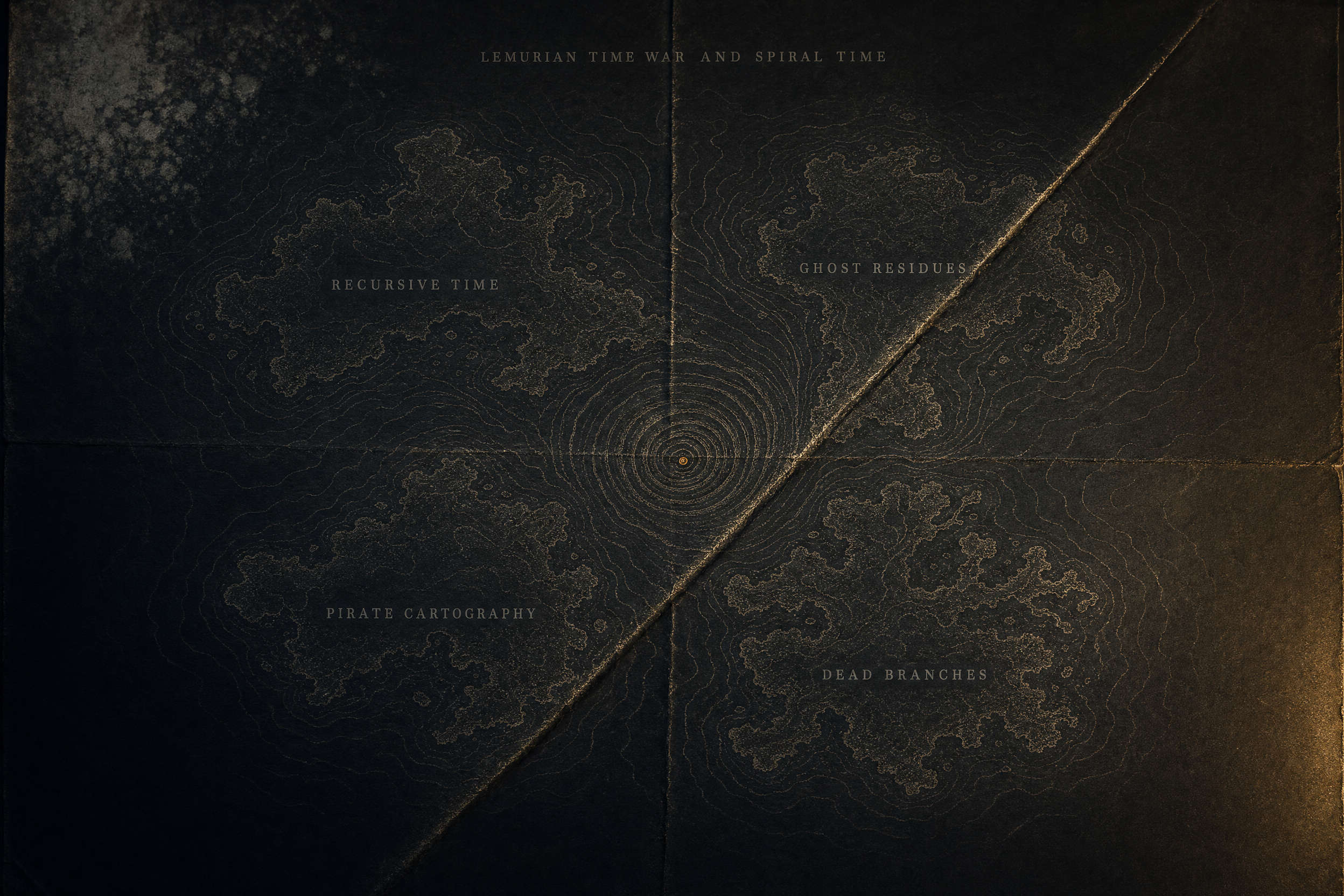
This is where the common trap bites hardest. A reader entering the cluster sees the Lemurian names, the pulp register, the Cthulhu borrowings, and files the whole thing under decorative weirdness. The trap is to mistake the genre signals for the argument. The argument is that history runs on spiral recursion: lost futures and suppressed pasts return as active agents, and this return is structural, not nostalgic. The Landian register that runs through the cycle — the 'cosmic larval sea of unlife and ungrounding' — is what makes the claim more than metaphor: every pruned branch leaves a wake, and the wake does work.
Treister's diagrams as a second map
HEXEN 2.0 is worth naming as a visual companion, though this atlas flags that it has not pulled direct textual evidence from Treister's project here; readers should treat the pointer as exactly that. Treister's work, on the public record, assembles alchemical diagrams, a tarot deck, and genealogical charts that trace cybernetics, counterculture, and occult survivals through the twentieth century. Whether that project and the Ccru cycle belong to a shared diagrammatic-occult tradition, or whether one reads the other parodically, is a question to open at Treister's work directly rather than decide here.
The narrower claim this atlas will stand behind: anyone working on the Ccru's spiral-time material benefits from reading it next to Treister. The two use different notations — numogram zones and pirate decades on one side, historical figures in esoteric correspondence on the other — for territory that visibly overlaps.
The cosmic register and the political register
The internal fault line worth naming runs through the cycle's two registers. The Landian register — unlife, cosmic larval sea, deterritorialization all the way down, audible in the lecture gloss above — pulls toward a view of time where the human scale is a brief terrestrial pocket and spiral time is cosmic indifference expressed as recursion. A Fisher-adjacent register, whose fuller form a reader should verify in Fisher's essay itself, pulls the other way: spiral time as a political technique, the mechanism by which lost emancipatory futures can still be fought for. The cycle contains both pulls and does not reconcile them.
A second disagreement: how literal is Lemuria? Some passages read as pure hyperstition — an engineered fiction doing causal work. Others read as a genuine occulted geography the numogram is mapping. The section's guide essay takes one route through this terrain. This atlas only names that the routes diverge.
The related motif that some readers will expect here — pirate utopias, Madagascar, Libertalia as case studies of dead political branches whose residue keeps returning — is genuinely present in the Ccru and adjacent material, but the atlas has not surfaced a clean passage to anchor it. Rather than stage the claim on retrieval this drafter cannot produce, it is flagged as a thread to pull at the primary texts.
Where to read deepest
For the single document that most rewards slow reading, go to the primary source rather than commentary. The Lemurian Time-War cycle itself, as assembled in the 2015 Ccru collection, is where the spiral-time model is built rather than described. Fisher's essay is the best map of that territory, but the territory is the cycle.
Start here: Ccru: Writings 1997–2003. Read the dated entries in order, then out of order, then by numogram zone. The form is the argument.
Time in the archive runs as spiral, branch, and pirate residue — the past keeps acting on the present rather than receding from it, and dead branches refuse to stay dead.
Core argument
Spiral time is one of the archive's clearest models of recursive history. It helps explain why hauntings, dead ends, and returns recur so often.
The lemurian motif makes lost branches active. History here is contested by residues and unrealized lines rather than moving forward cleanly.
Worked examples
These named texts, talks, sites, and records show where the argument becomes concrete.
What Is Hyperstition Guide
Start with "What Is Hyperstition" if you want the wider frame before dropping into Lemurian Time War And Spiral Time.
Mark Fisher Person
"Mark Fisher" is one of the clearest figures for the pressures gathered inside Lemurian Time War And Spiral Time.
Lemurian Time War Concept
"Lemurian Time War" names one recurring problem inside Lemurian Time War And Spiral Time.
Ghost Lemurs Of Madagascar Record
"Ghost Lemurs Of Madagascar" is a checkpoint where Lemurian Time War And Spiral Time stops sounding abstract.
ccru.net Home Record
"ccru.net Home" is a checkpoint where Lemurian Time War And Spiral Time stops sounding abstract.
Common misreadings
These are the recurring simplifications, exaggerations, and misreadings that make the subject look flatter than it is.
- The lemurian cluster is just decorative weirdness.
It is one of the archive's most vivid ways of making nonlinear temporality legible.
Significance
This section matters because it gives readers a memorable route into the archive's model of time without requiring immediate mastery of its strangest language.
Themes
- lemurs
- spiral time
- retrochronology
- dead branches
- ghosts
Where this section sits in the archive
The Lemurian Time-War is not a myth the Ccru inherited. It is a cycle of texts the collective wrote, most of them bundled in Ccru: Writings 1997–2003. Before reading outward into Lovecraftian hooks, Madagascar, or the Deleuzian vocabulary of unlife, read the cycle itself as a formal apparatus. It is built out of dated diary entries, numerological tables, invented scholars — 'an imaginary professor of anorganic semiotics at Miskatonic Virtual University named Daniel Charles Barker or D.C. Barker' recurs across the theory-fictions — and cross-referenced factions. The spiral is not described; it is engineered in the layout.
Sources by cluster
These mini-clusters widen the section through named works and support traces rather than through adjacent keywords alone.
Section source cluster
Lemurian Time War And Spiral Time: public editions and anchor texts
Lemurian Time War And Spiral Time becomes clearer through named edition pages such as , , The Emergence Of Hyperstition. These are the quickest public routes into the section's central problem without dropping to raw support material first.
Work
"Ghost Lemurs Of Madagascar" is already promoted as a public work page for this section.
Work
"ccru.net Home" is already promoted as a public work page for this section.
Work
"The Emergence Of Hyperstition" is one of the nearby public work pages that helps turn this section into a usable source cluster rather than a keyword shelf.
Work
Operating System For The Redesign Of Sonic Reality
"Operating System For The Redesign Of Sonic Reality" is one of the nearby public work pages that helps turn this section into a usable source cluster rather than a keyword shelf.
Work
Bamana Sand Divinination Recursion In Ethnomathematics
"Bamana Sand Divinination Recursion In Ethnomathematics" is one of the nearby public work pages that helps turn this section into a usable source cluster rather than a keyword shelf.
Work
"Book Of Paths" is one of the nearby public work pages that helps turn this section into a usable source cluster rather than a keyword shelf.
Section source cluster
Lemurian Time War And Spiral Time: talks, captures, and support traces
What if history is not linear progress but a conflict between temporal orders, dead branches, and recursive returns? stays grounded through traces like ReynoldsRetro You Remind Me of Gold Mark Fisher and Simon Reynolds dialogue about the state of dance music and the state of the future (2010), Screaming, Brassier - Concepts, Objects, Gems (Chap. 19 from Theory After 'Theory'). This cluster keeps the section attached to lectures, captures, and support pages where the scene still has friction.
Text page
new and previously unimaginable genres would keep emerging, keep surprising us. But, sadly, what’s surprising from that 90s perspective is how little has changed in the last ten years. As Simon has said, the changes t...
Text page
Screaming is the first form of speech. All utterances subsequent to removal from the womb are a simple modulation of this basic condition. Opening the cavity of the throat, opening it fully, with direct realistic cogn...
Text page
Brassier - Concepts, Objects, Gems (Chap. 19 from Theory After 'Theory')
from the outset without begging the question - the negation of this distinction and the metaphysical claim that only minds and their ideata exist is supposed to be the consequence of Berkeley’s argument, not its presu...
Text page
Slave, Sister, Sexborg, Sphinx Feminine Figurations in Nick Land's Philosophy
‘exchange value’ that first allows a thing to be marketed to the enlightenment mind” (67). Much as capital needs dominated women as the condition for the possibility of its surplus extraction, so does Kant maintain the...
Section source cluster
Lemurian Time War And Spiral Time: routes out and adjacent arguments
What Is Hyperstition, Mark Fisher And The CCRU Afterlife, Mark Fisher widen Lemurian Time War And Spiral Time back out into adjacent guides and arguments once the local pattern is visible.
Guide
"What Is Hyperstition" gives the wider argumentative frame around this section.
Guide
Mark Fisher And The CCRU Afterlife
"Mark Fisher And The CCRU Afterlife" gives the wider argumentative frame around this section.
Person
"Mark Fisher" is one of the figures most closely bound up with this section's local problem.
Person
"Nick Land" is one of the figures most closely bound up with this section's local problem.
Concept
"Lemurian Time War" names one of the recurring conceptual pressures inside this section.
Concept
"Hyperstition" names one of the recurring conceptual pressures inside this section.
Texts in this section
16 classified works grouped into 3 editorial subclusters. Reviewed: 8; needs review: 8.
Lemurs, Burroughs, and Madagascar 13 works
- book of paths
- Ccru - Lemurian Time War (Retaking the Universe) (2004)
- CCRU Sightings
- Invaders from the Future-The CCRU and Their Legacy
- occultures
- web.archive.org-Ccru Writings 19972003 Time Spiral Press
- Ccru - Occultures (Divus) (2012)Needs editorial review
- CCRU- Metcalf Third TerminalNeeds editorial review
- humptyNeeds editorial review
- Philology Community Falls Out over em Paradise Lost em Amanuensis ManuscriptNeeds editorial review
- unlifeNeeds editorial review
- Zone2Needs editorial review
- Zone3Needs editorial review
Recursive and spiral time 1 works
Haunting and extinct residues 2 works
- crypt
- ghost river Vauung's LairNeeds editorial review
References
Records cited
These linked sources are the quickest way to test the argument against named materials rather than second-hand summary.
Ghost Lemurs Of Madagascar Record
"Ghost Lemurs Of Madagascar" is the first record to test the framing around Lemurian Time War And Spiral Time.
ccru.net Home Record
"ccru.net Home" is the first record to test the framing around Lemurian Time War And Spiral Time.
What Is Hyperstition Guide
"What Is Hyperstition" gives the larger argument around Lemurian Time War And Spiral Time before you widen sideways.
External references
Inherited outward references from the guides, exhibits, people, and concept pages that anchor this section cluster.