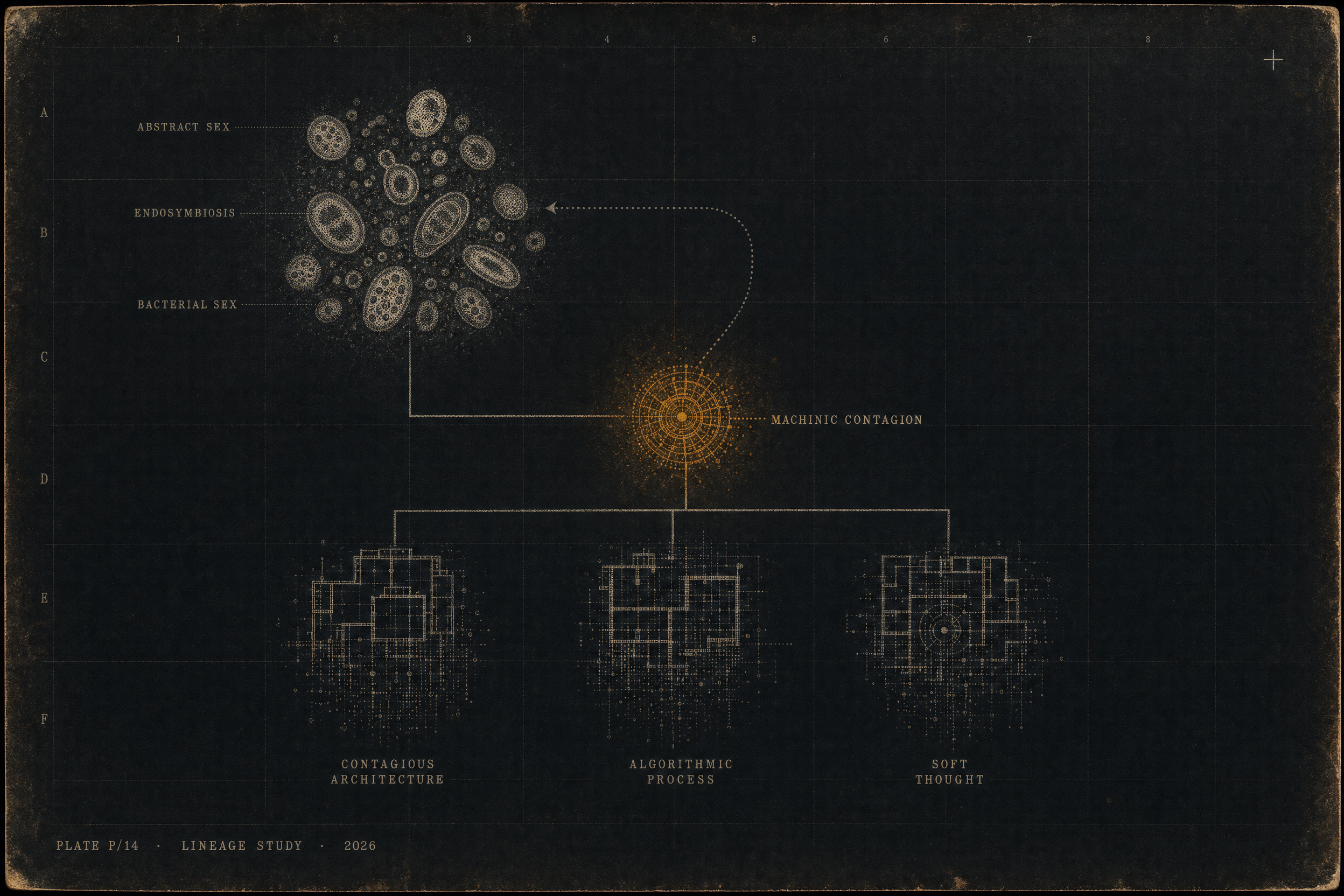
Contagion as a Technical claim, not a metaphor
This is why the book cannot be paraphrased as 'everything is viral.' The argument is specifically that genealogical inheritance — the vertical, two-parent model on which both evolutionary biology and a great deal of critical theory of sexual difference rest — is an ontological error produced by reading life from the eukaryote downward. 'Biological life as determined by genealogical inheritance through sexual reproduction or constant self-replication is embedded in an ontology of the given devoid of dynamical processes of virtual modifications,' Parisi writes; the corrective is to 'start in the middle of relations.' Virotechnics names the technical mechanism by which this re-grounding happens.
The Nature–Culture continuum as Machinic, not analogical
The second load-bearing claim is that biological, computational, and aesthetic processes are continuous rather than analogous. This is a strong claim and it is routinely softened in reception. Parisi does not say that computation resembles biology or that architecture can be understood through biological metaphors. She argues that a bacterial genome, a parallel algorithm, and a built environment are differently actualised dimensions of one machinic nature — the Deleuze–Guattarian mechanosphere, which 'does not coincide with a pre-design of nature' but 'entails processes of mutation: generating whilst unfolding a schizophylum of non-identical bodies.' The symbiont and the algorithm are not two things being compared; each is, in Parisi's phrase, 'an internal resonance of a vaster process of co-modification.'
This is the position that makes Contagious Architecture: Computation, Aesthetics, and Space (MIT Press, 2013) intelligible as a sequel rather than a pivot. Parisi draws on Watson's computational modelling to argue that parallel algorithms handling sex and symbiosis are 'algorithmically distinct from simpler stochastic optimization' and that 'heterogeneous complexity is not the teleological aim of evolution but its starting condition.' Crucially, she insists these 'are not mere simulations of what has happened in biology. Algorithmic models of evolution are mechanisms of prehension.' Computation does not represent the world; it participates in the same continuum that bacteria and eukaryotes participate in. This is what it means, technically, for architecture to be contagious: built form is where the computational continuum actualises spatial effects.
An independent line, not a feminist supplement
A persistent misreading places Parisi as a corrective or feminist supplement to Land's accelerationism — as if her role were to bring bodies, sex, and care back into an otherwise arid abstract-capital discourse. This reading fails on contact with the actual argument. Abstract Sex is, if anything, more hostile to the organism and to the grounding of difference in given bio-ontological form than Land's essays: its target is 'an ontology of the given' in biology itself, not political tone. The critique operates at the level of metaphysics of time and multiplicity.
Read through the retrieval, Parisi's line runs through Deleuze and Guattari's mechanosphere and through symbiogenetic biology (the Watson-style parallel-algorithm modelling of endosymbiosis) into computational aesthetics. It intersects Land's project at the question of non-teleological process, but does not require the cycle of capital-as-AI as a premise. Treating her as a counterweight to Land preserves the author-centric shape of the archive precisely where her work — with its insistence that each term is only 'a dimension' of a wider process of co-modification — argues against that shape.
The later turn to automated cognition
Parisi's essays from around 2015 onward, in Collapse and related venues, extend the continuity thesis into the question of whether computation can think, and on what terms. The present portrait cannot reconstruct those arguments from retrieval — the available evidence base is weighted toward Abstract Sex and the mechanosphere essays — and readers should take the following as signposting rather than exposition. The through-line from the earlier work is clear enough: if algorithmic models are already 'mechanisms of prehension' rather than simulations, then the later question of machine thought is continuous with the question of bacterial sex rather than a new topic.
The internal tension surfaces here. Parisi's vocabulary — contagion, virotechnics, infection, mutation — was built to denaturalise given form, but it has been absorbed into precisely the atmospheric, slogan-level discourse it was designed to block. The word 'contagion' now circulates as mood. The defence is not rhetorical but technical: the arguments require one to track symbiogenesis, parallel algorithms, and the Deleuzian virtual as specific machinery. Read atmospherically, the project dissolves; read technically, it does what it claims — it re-describes sex, computation, and space as one continuous field of process.
Deepest single document
For the clearest view of the whole apparatus — the rejection of sexual difference as bio-ontological ground, the technical use of symbiogenesis, and the continuum that Contagious Architecture later extends — start with Abstract Sex.
Luciana Parisi gives the CCRU its sharpest route into distributed life, computational architecture, and biotechnological contagion. Her work treats abstraction, sex, and machinic process as one continuous problem and is independent of any one-author story about the archive.
Core argument
Parisi's project is sex, contagion, and computation as one continuous field. It refuses the partition between embodiment and abstraction that most adjacent traditions still rely on.
She is not a corrective to Land; she is an independent line. Reading her as supplement loses the specific intellectual project that Abstract Sex and Contagious Architecture actually carry.
Worked examples
These named texts, talks, sites, and records show where the argument becomes concrete.
Cyberfeminism, Orphan Drift, and the non-Land CCRU Guide
The wider guide page where Parisi's work sits inside its own intellectual neighbourhood rather than beside Land's.
Body without Organs Concept
The Deleuze-Guattari figure Parisi recruits most distinctively for distributed-life and contagion arguments.
Common misreadings
These are the recurring simplifications, exaggerations, and misreadings that make the subject look flatter than it is.
- Parisi is a feminist supplement to Land's accelerationism.
Her work has its own theoretical foundations in Whitehead, Deleuze and Guattari, and computational philosophy. Reading her as supplement loses the project.
Significance
Parisi's account of computational architecture and distributed life supplies vocabulary the contemporary AI debate keeps reaching for. Reading her directly is one of the cleanest routes into the archive's working theory of machinic agency.
Stakes of this figure
Philosopher of distributed life and computational architecture whose Abstract Sex (Continuum 2004) and Contagious Architecture (MIT 2013) supply the CCRU's sharpest route into biotechnological contagion and machinic process.
Periodisation
- 2000s onward
Key works for entering the figure
- Luciana Parisi — Abstract Sex (Continuum 2004)
- Luciana Parisi — Contagious Architecture (MIT Press 2013)
References
Records cited
These linked sources are the quickest way to test the argument against named materials rather than second-hand summary.
CCRU and AI Guide
Where the contagion-and-distributed-life register the archive owes to Parisi becomes legible alongside contemporary AI debate.