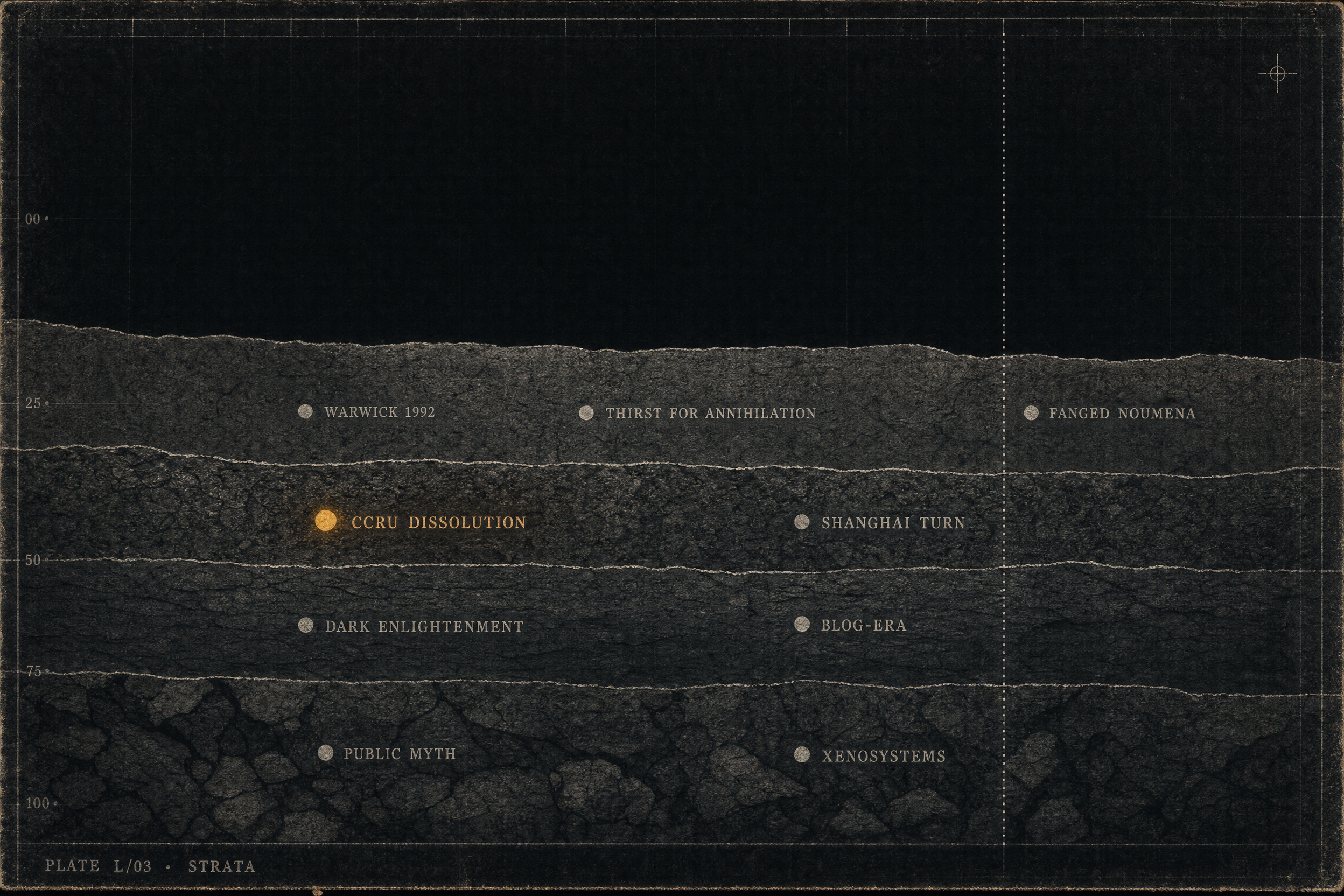
The best Nick Land reading guide separates phases before making judgments. Start with scene-setting and spoken materials, then move into Warwick-era and collected texts, and only then approach the later blog-era or political afterlife as a distinct phase rather than as the key to everything that came before.
Key points
- Land is central to the archive, but he is easiest to misunderstand when every phase is folded into one image.
- Spoken and editorial routes often work better than maximal-density primary texts as a first encounter.
- Land becomes clearer when read inside a field that includes Plant, Fisher, Mackay, Brassier, and the wider CCRU scene.
Core argument
Periodization is the first requirement for reading Land well. Without it, later blog-era notoriety gets projected backward onto very different earlier materials. Example: Unknown Lands Lecture 1 (Unknown Lands - Lecture 1)
Entry points matter because Land's style can obscure what kind of problem a text is actually pursuing. Readers often need speech, editorial framing, or shorter introductions before the denser writing pays off. Example: CCRU Lecture 1 (CCRU - Lecture 1)
Land is most useful when read comparatively, not as a solitary genius detached from the scene. That comparison keeps the archive historically accurate and makes the strongest conceptual lines easier to see. Example: A Quick and Dirty Introduction to Accelerationism (nick-land-fanged-noumena-collected-writings-19872007-1.mobi)
Periodization is the first requirement for reading Land well. Without it, later blog-era notoriety gets projected backward onto very different earlier materials.
Periodize first, argue later
Land's public image is now so strong that it can erase chronology. But the archive changes across time. Warwick-era philosophical work, CCRU scene writing, collected texts, and later xenosystems material do not operate in one stable context. They differ in medium, audience, scene, and political afterlife.[1]
The point of periodization is not to sanitize. It is to make comparison possible. Once you separate phases, you can ask sharper questions: what stays continuous, what intensifies, what gets simplified, and what later readers started overemphasizing.
Use speech and framing as entry points
For most readers, lectures and introductions are better first contacts than the densest written pages. Speech lets pace, emphasis, and explanation do some of the work that compressed prose withholds. Unknown Lands and CCRU Lecture 1 are helpful for exactly this reason. They make it easier to hear what kinds of problems the writing is pursuing before every sentence starts looking like a terminal puzzle.[2]
Editorial framing also matters. Collected or introduced materials can be useful not because they dilute the work, but because they give you handles. A reading guide should respect difficulty without worshipping it.
Start with the editorial layer. Mackay and Brassier's introduction to Fanged Noumena does the work of locating Land inside a Deleuze-Kant-Bataille lineage and naming the manoeuvre, what they call the resolution of the exit problem against Kant's pious compromises W5 . Reading that introduction first is not a compromise; it is the fastest route into the denser pages C1 . The same volume gathers Circuitries (Pli, 1992), later reprinted in the Mackay and Avanessian Accelerate reader, and this is the cleanest entry point to the cybernetic-capital argument that everything else in the 90s rotates around W0 W7 . Read Circuitries, then Meltdown, then Machinic Desire. The Internet Archive's Fanged Noumena scan and the Complete Essays collection make the primary material trivially available W9 W11 .
The Warwick-era voice
The Warwick-era voice is not the voice of a pundit. It is closer to a lecture register pushed into theory-fiction, and the CCRU lecture material preserved in the archive shows how that register actually functioned in a room. Land's name appears inside CCRU teaching as the source of the formulation that confronting the brain with its own outside registers as utter trauma, disaster or meltdown, a paralysing anxiety bordering on voodoo death C12 . That is the tonality of the early work. It is doing something to the reader, not arguing a position the reader is invited to adopt or reject. Treating Meltdown as if it were an op-ed produces nonsense.
Earth is captured by a technocapital singularity as renaissance rationalization and oceanic navigation lock into commoditization take-off.
Land's writings fold genre in on itself, splicing disparate sources from philosophy, literature, science, occultism, and pulp fiction.
Read Land inside a field
Land is much clearer when read alongside Plant, Fisher, Mackay, or Brassier. Those comparisons stop him turning into a closed mythology. They show what is specifically Landian, what belongs to the broader CCRU scene, and what later readers borrowed, clarified, or contested.[3]
That field is historically important too. The archive becomes false very quickly when Land is treated as the whole formation. A reading guide should therefore open outward as well as inward.
The middle layer, the CCRU-adjacent material, is where most readers should spend the longest. Numogram work, hyperstition, the qabbalistic apparatus, the collaborative authorship that makes attribution to Land alone misleading. The lecture transcripts gloss CCRU's method as emphasising the process of decoding itself rather than offering a doctrine C10 , and that is the right frame for the Lemurian and Cthulhu Club texts. Read these as machines that operate on the reader rather than as claims about the world. The density is functional. It is also, sometimes, just density, and one of the field's standing problems is that readerly difficulty gets treated as evidence of hidden profundity when it is not C2 .
Do not confuse afterlife with origin
Later blog-era notoriety matters. It shapes how readers arrive, what they search for, and which labels dominate public discussion. But it is still an afterlife. It should be read as a later phase with its own stakes, not as the universal decoder ring for Warwick-era and CCRU-adjacent work.
This is especially important for topics like accelerationism or AI. Those keywords pull readers toward later controversies and away from the earlier scene conditions that made the writing possible. Good reading order restores the earlier scene before returning to the later disputes.
Then, and only then, the later Land. The Shanghai years, Urban Future, Outsideness, the 2012 Dark Enlightenment essay, the Xenosystems blog, the Templexity work on Shanghai with Anna Greenspan and Suzanne Livingston W3 . The Dark Enlightenment is the text that brought a new readership and a new set of enemies. It is also the text that retroactively reorganised how the 90s archive gets read. Its argument runs through Mencius Moldbug's design rules for an optimal memetic parasite and ends in a genealogy of Anglo-Calvinist progressivism C5 , with extended passages on race and crime statistics that the AltWoke Companion and most subsequent commentary treat as the defining Land W1 C8 C13 . Whether one finds this continuous with Meltdown or a break from it is the live disagreement inside the archive.
The live disagreement
There is a real disagreement here, and the guide should name it rather than smooth it over. One reading, closer to Mackay and Brassier's editorial framing, treats the reactionary turn as a separable political afterlife and insists the philosophical content of the 90s work survives independently W5 . Another reading, common among hostile critics and some sympathetic ones, argues the libidinal-cybernetic apparatus of Meltdown already contains the later politics in compressed form, and that exit, hierarchy and anti-egalitarianism were always the destination. A third reading, visible in the AltWoke material, simply collapses Land into Moldbug's zaddy and treats the philosophy as decoration W1 . None of these is obviously wrong. The point of a reading order is to give the reader enough primary material to adjudicate rather than inheriting the verdict.
A workable first sequence
One practical route is simple. Start with one overview of the CCRU scene. Then use a spoken Land entry point. Then move to one collected or editorially framed text. Only after that should you approach later blog-era materials or the noisier public mythology around the name. This sequence will not remove disagreement, but it will keep those disagreements historically legible.[4]
A practical sequence. First, the Mackay and Brassier introduction to Fanged Noumena W5 . Second, Circuitries and Machinic Desire from the same volume W0 . Third, Meltdown, with the lecture-room gloss on meltdown-as-trauma in mind C12 . Fourth, the CCRU collective writing, Lemurian time-sorcery and the numogram, read as operational machinery rather than doctrine C10 . Fifth, Templexity and the Shanghai material, which sits between the Warwick voice and the blog voice W3 . Sixth, The Dark Enlightenment and selected Xenosystems posts, read with the question of continuity held open C5 . The Internet Archive holdings cover almost all of this without paywall W8 W9 W11 .
That is the real job of a Land guide: not to decide what Land ultimately means, but to stop the usual collapses long enough for a reader to make better distinctions.
What changes after the guide. The reader stops asking whether Land is a philosopher or a reactionary, which is a bad question, and starts asking which Land is on the page in front of them and what that text is trying to do to its reader. The later notoriety stops absorbing the early archive C2 . Density stops counting as argument by default. And the parts of the 90s work that genuinely do the philosophical labour, the rereadings of Kant and Bataille, the cybernetic recasting of capital, the theory-fiction method that CCRU built around him, become available again as objects one can think with rather than symbols one is required to salute or burn.
Worked examples
These named texts, talks, sites, and records show where the argument becomes concrete.
Unknown Lands Lecture 1 Record
A spoken route that lets concepts arrive with pacing and explanation instead of maximum compression.
CCRU Lecture 1 Record
Useful for hearing the archive's Land line inside a wider scene rather than in isolation.
A Quick and Dirty Introduction to Accelerationism Record
A later but compact text that is useful precisely because it should not be mistaken for the entire story.
Fanged Noumena Record
The collected-writings route once you are ready for denser and more historically spread material.
Tensions and limits
Land's later public notoriety makes him easy to find and hard to contextualize.
The strongest Land route for a newcomer is not always the route that most committed readers eventually prefer.
No reading guide can fully settle the relation between early philosophical stakes, CCRU scene writing, and later reactionary afterlife; it can only stop them collapsing into each other.
Common misreadings
These are the recurring simplifications, exaggerations, and misreadings that make the subject look flatter than it is.
- All Nick Land writing belongs to one stable project.
The archive changes over time, and Land's public function changes with it. Early philosophy, CCRU-era experimentation, collected writings, and later blog-era politics should not be treated as one seamless block.
- The hardest text is the best place to start.
For most readers, lectures, introductions, and carefully chosen collected texts produce a stronger first understanding.
Significance
Land matters now because he remains one of the main names through which readers discover the CCRU at all. That visibility makes a careful route unusually important.
He also matters because the archive's later public controversies keep tempting readers to confuse notoriety with explanation. A good guide restores chronology, context, and comparison.
References
Records cited
Linked archive records for this guide. Numbers correspond to the footnote markers in the body above.
Nick Land - A Quick and Dirty Introduction to Accelerationism Record
A useful later text if it is kept in its proper phase rather than treated as the whole picture.
Unknown Lands - Lecture 1 Record
A spoken entry point that slows the concepts down enough to hear what kind of project is in view.
CCRU - Lecture 1 Record
A scene-facing source that keeps Land inside the archive rather than above it.
nick-land-fanged-noumena-collected-writings-19872007-1.mobi Record
The collected-text route once you need the denser written material.
Reading routes through this guide
Featured exhibit
Virtual Futures and the Para-Academic Scene
A curated exhibit on the events, interfaces, and public surfaces that helped the CCRU circulate beyond one department or one medium.
Featured reading path
A staged reading route that keeps early Land, collected writings, and later afterlives distinct.