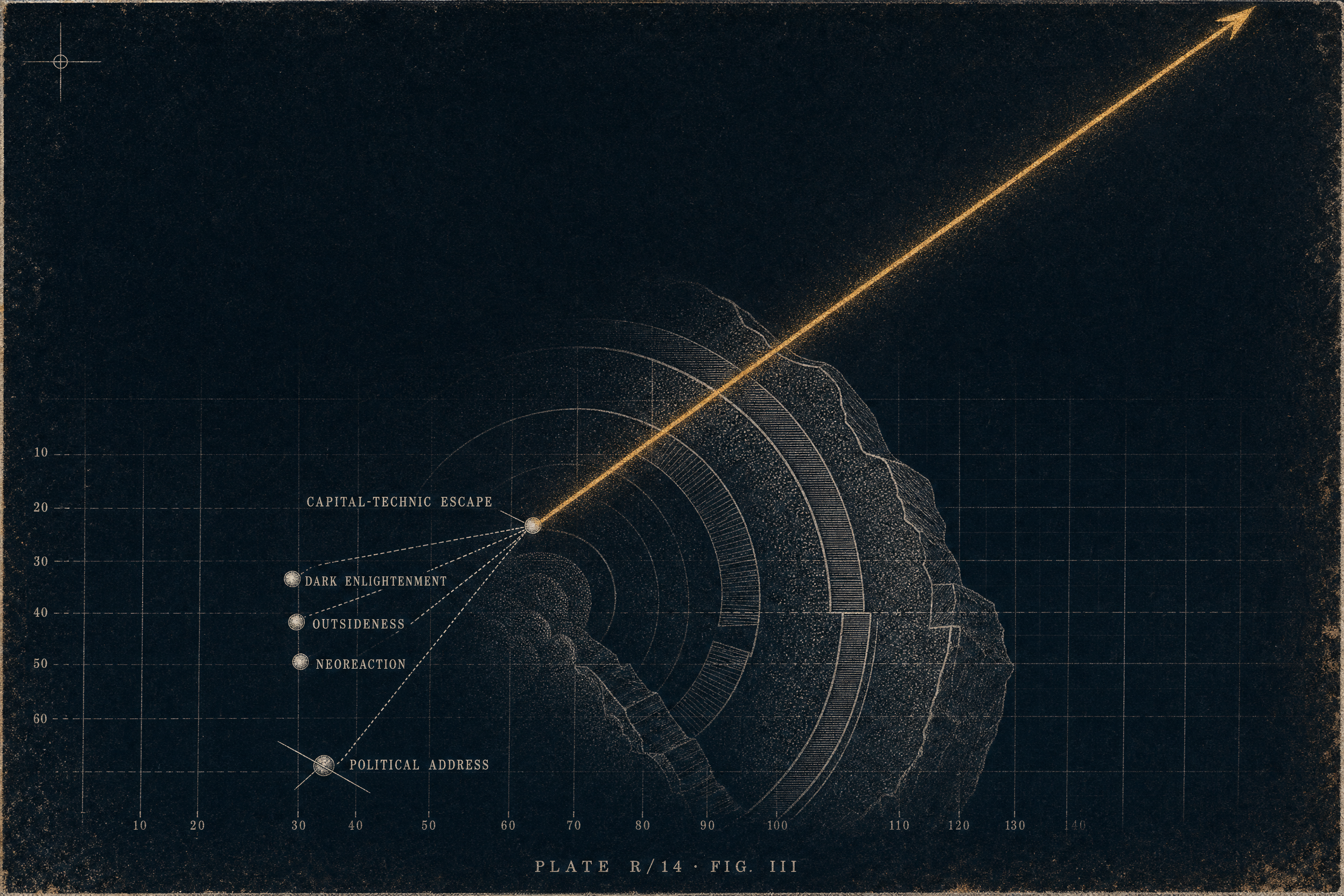
What Right Accelerationism names
The closest adjacent term is neoreaction (NRx), and the two must be kept separate. NRx is a regime-design programme: it asks what institutional form (sovereign corporation, exit-over-voice, formalism) should replace liberal democratic governance. R/ACC is prior to that question and largely indifferent to its answer. NRx can draw selectively on R/ACC — using the broad Landian claim that democratic politics registers as friction on, rather than a source of, material progress — as leverage for a design argument, but R/ACC does not require the NRx conclusion. A reader can reject every NRx institutional proposal and still be committed to the R/ACC thesis about capital.
The smallest unit of work the term does in the archive: marking a text or argument as treating capital-acceleration as non-political (impersonal, transcendental, escape-directed) rather than as a political project to be hastened, captured, or redirected. That is the whole test. If the argument assumes a 'we' who could steer the process, it is not R/ACC.
Where it became load-bearing
R/ACC becomes load-bearing in Land's work between the 2012 'Dark Enlightenment' essays (originally serialised online in 2012 and now collected in A Nick Land Reader: Selected Writings (Nick Land, Imperium Press, 2024)) and the 2017 synthesis 'A Quick-and-Dirty Introduction to Accelerationism' (Jacobite, 25 May 2017). The 2012 essays do the conceptual work of separating capital-dynamics from democratic legitimation; the 2017 essay does the taxonomic work, framing acceleration as a transcendental horizon — 'an absolute horizon – and one that is closing in' — against which political deliberation is structurally too slow. Templexity: Disordered Loops Through Shanghai Time (Nick Land, Urbanomic, 2014) supplies the temporal mechanics: capital as a time-structure, not a policy variable.
These are the texts where the concept stops being ambient and starts carrying argumentative weight. Before 2012, Land's cyberpositive writings (collected in Fanged Noumena: Collected Writings 1987–2007, Urbanomic/Sequence Press, 2011) already frame capital as an escape-process, but without the explicit break against left and progressive accelerationisms that R/ACC as a named position requires. R/ACC emerges alongside and in contrast to the L/ACC currents consolidated around 2013. For the comparative map across branches, see /sections/accelerationism-branches-and-debates.
What's frequently misread
The circulating misreading: R/ACC is reactionary politics with futurist branding — Land's late work treated as a rhetorical upgrade of NRx talking points. This misreading absorbs R/ACC into a regime-preference and loses the argument. The stronger version of R/ACC is structural, not preferential: the claim is that capital-acceleration has a direction independent of whether anyone endorses it, and that political programmes (reactionary or progressive) register as friction, ornament, or delay rather than as steering inputs. One can find the structural claim compelling and find every associated cultural-political gesture in Land's blog-era writing distasteful; the two assessments are separable, and the concept page exists partly to keep them separable.
A secondary confusion folds R/ACC into effective accelerationism (e/acc). For working purposes here, treat e/acc as the techno-optimist advocacy position — accelerate because it's good — against which R/ACC's register looks sharply different. R/ACC makes no normative offer. Its register is diagnostic and often fatalist: 'you'll be too slow to deal with it coherently,' as the 2017 essay puts it; the process escapes you whether you cheer it or not. If the text you are reading assumes the reader is being recruited to want acceleration, it is e/acc or L/ACC in R/ACC vocabulary, not R/ACC.
Deepest single document for the position in Land's own voice: A Nick Land Reader: Selected Writings.
Source quotations and adjacent argument
These passages quoted or paraphrased from primary literature widen the page's argument. They sit here as a reading appendix rather than the main exposition.
Land himself reappeared in the same year, writing a series of essays called The Dark Enlightenment. The essays expounded a formal political theory of “neoreaction” through an extended commentary on the writings of software engineer and political theorist, Curtis Yarvin, who was blogging at the time under the pseudonym Mencius Moldbug. “Neoreaction is Accelerationism with a flat tire,” Land wrote on his blog.
“Neoreaction is Accelerationism with a flat tire,” Land wrote on his blog. The case for neoreaction, he explained in a blog post on re-acceleration, is that “beside the speed machine, or industrial capitalism, there is an ever-more perfectly weighted decelerator, which gradually drains techno-economic momentum into its own expansion, as it returns the dynamic process to meta- stasis.
Land’s blanket denunciation of the left’s ‘transcendental miserabilism’, the apparent degeneration of his once scalpel-sharp dissection of the body of capitalism into schizophrenizing and repressive tendencies, may seem to dissolve the complexities of his work into a superlative cosmic version of the familiar neo-liberal narrative according to which ‘there is no alternative’, and the wholesale identification of capital with life, growth, and history.
Eventually she started making things up, but even that became entangled with coincidence, and with Cybergoth hyperstition (assembled from fictional quantities which make themselves real). She had found herself investigating various neolemurian cults, most of whom anticipated something huge around about the 1999 Spring-Equinox (when Pluto exits from the clutch of Neptune, triggering the return of the Old Ones).
Right accelerationism is the label most commonly attached to Nick Land's post-2010 writing, including the Dark Enlightenment essays. Its central claim is that capital and technology compose a process that escapes ordinary political address.
Core argument
Right accelerationism is structurally distinct from left and effective variants. Treating the three as variations on a theme misses that they make incompatible claims about whether the technical-capital process is open to political redirection.
Its strongest version is a structural argument, not a political programme. The descriptive claim — that capital escapes political control — is separable from the prescriptive claim that this escape is desirable; conflating them collapses much of the actual writing.
Worked examples
These named texts, talks, sites, and records show where the argument becomes concrete.
Xenosystems Home Record
"Xenosystems Home" is where Right Accelerationism stops feeling like a slogan and starts behaving like a working concept.
Nick Land Quick And Dirty Introduction Record
"Nick Land Quick And Dirty Introduction" is where Right Accelerationism stops feeling like a slogan and starts behaving like a working concept.
Nick Land Person
"Nick Land" shows who carries, translates, or contests Right Accelerationism in practice.
Accelerationism After The CCRU Guide
"Accelerationism After The CCRU" keeps Right Accelerationism inside a larger argument and afterlife rather than letting it float free.
Common misreadings
These are the recurring simplifications, exaggerations, and misreadings that make the subject look flatter than it is.
- Right accelerationism is just reactionary politics with futurist branding.
Some of the corpus is openly that, but the strongest theoretical material is making a structural argument about feedback dynamics that can be evaluated independently of its political voice.
Significance
Right accelerationism is the strand most actively cited by contemporary AI and capital discourse, and the strand most often misread; the archive needs a precise reading because the loose readings are doing most of the public work.
Working definition
The strand emerging from Land's post-2010 writing — the Dark Enlightenment essays, the Outsideness blog, and the teleoplexy material — that treats capital and technology as escaping ordinary political address.
Representative extracts
Definition · Nick Land — A Quick-and-Dirty Introduction to Accelerationism · introduction
What we now call accelerationism is, intellectually, a quite specific tradition stretching back to the early modern period — a collateral effect of capital's self-construction.
Why this matters: Land's own framing places the position inside a longer history rather than treating it as a recent rhetorical posture.
Mechanism · Endgamers_ A History of Accelerationism - by Jacob Siegel · extracted passage
The case for neoreaction, he explained in a blog post on re-acceleration, is that “beside the speed machine, or industrial capitalism, there is an ever-more perfectly weighted decelerator, which gradually drains techno-economic momentum into its own expansion, as it returns the dynamic process to meta- stasis. Comically, the fabrication of this braking mechanism is proclaimed as progress.
Why this matters: Land's own mechanism for the political turn: once a compensating brake is posited inside modernity, removing the brake rather than steering the machine becomes the whole programme.
Stakes · Nick Land — Fanged Noumena · collected writings
Capital is the only thing that escapes from the human, by re-engineering the conditions of its own escalation.
Why this matters: The descriptive claim that the political conclusions later draw on. Assessing the conclusions requires first holding this proposition steady.
History · Endgamers_ A History of Accelerationism - by Jacob Siegel · extracted passage
Land himself reappeared in the same year, writing a series of essays called The Dark Enlightenment. The essays expounded a formal political theory of “neoreaction” through an extended commentary on the writings of software engineer and political theorist, Curtis Yarvin, who was blogging at the time under the pseudonym Mencius Moldbug. “Neoreaction is Accelerationism with a flat tire,” Land wrote on his blog.
Why this matters: Fixes the position to a datable corpus and a named interlocutor, so the label reads as commentary on specific texts rather than a free-floating internet mood.
Afterlife · nick-land-fanged-noumena-collected-writings-19872007-1.mobi · extracted passage
The Sarkon stories had been full of holes, which added to the confusion. Eventually she started making things up, but even that became entangled with coincidence, and with Cybergoth hyperstition (assembled from fictional quantities which make themselves real). She had found herself investigating various neolemurian cults, most of whom anticipated something huge around about the 1999 Spring-Equinox (when Pluto exits from the clutch of Neptune, triggering the return of the Old Ones).
Why this matters: The reception problem stated from inside Land's own corpus: sympathetic editors concede how readily the position reads as a cosmic version of 'there is no alternative'.
References
Records cited
These linked sources are the quickest way to test the argument against named materials rather than second-hand summary.
Xenosystems Home Record
"Xenosystems Home" is a strong first test case if you want Right Accelerationism anchored in a named source.
Nick Land Quick And Dirty Introduction Record
"Nick Land Quick And Dirty Introduction" is a strong first test case if you want Right Accelerationism anchored in a named source.
Endgamers History Of Accelerationism Record
"Endgamers History Of Accelerationism" is a strong first test case if you want Right Accelerationism anchored in a named source.
Accelerationism After The CCRU Guide
"Accelerationism After The CCRU" widens Right Accelerationism without letting it dissolve into buzzwords.