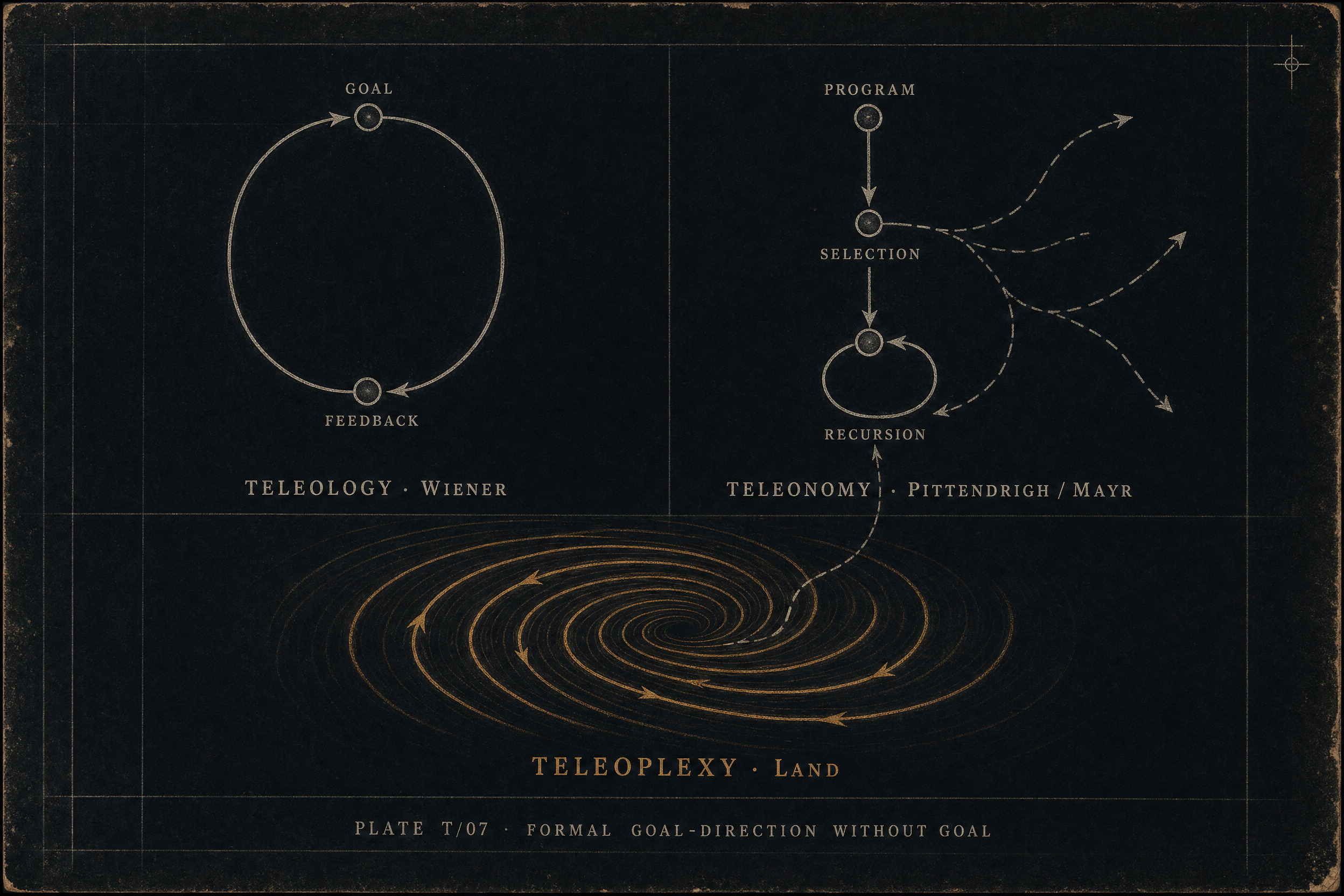
Teleology and teleonomy describe two different kinds of apparent goal-directedness. Teleology supplies a final state the system is heading toward; teleonomy describes systems that behave as if they had a goal because of their feedback structure, without a goal being supplied from outside (Pittendrigh 1958; Mayr 1961). The distinction is foundational for cybernetics (Wiener 1948) and underwrites Nick Land's neologism teleoplexy (Land 2014).
Key points
- Teleology supplies the goal; teleonomy supplies the structure that makes a system look goal-directed.
- The distinction was sharpened mid-twentieth century by Pittendrigh (1958) and Mayr (1961) to keep evolutionary biology free of unnecessary final causes.
- It is the conceptual hinge under Nick Land's teleoplexy — the structural claim that capital and technology are formally goal-directed without supplying the goal.
Core argument
Teleology and teleonomy are not synonyms. Conflating them collapses the central move of cybernetic explanation, which is that feedback can produce apparent purpose without final causes. Example: Mackay & Avanessian, #Accelerate Reader (2014) (Robin Mackay-#Accelerate_ The Accelerationist Reader)
The distinction was developed to do real philosophical work. It let evolutionary biology and cybernetics describe goal-like behaviour without smuggling teleology back into a materialist framework (Mayr 1961; Wiener 1948). Example: Nick Land, Fanged Noumena (nick-land-fanged-noumena-collected-writings-19872007-1.mobi)
It is the underlying structure of Land's teleoplexy. Teleoplexy splices teleology with complexity to mark a process that is teleonomic in form: formally goal-directed without supplying the goal (Land 2014). Example: Nick Land — A Quick-and-Dirty Introduction (Ray Brassier - Mad Black Deleuzianism; On Nick Land)
Teleology and teleonomy are not synonyms. Conflating them collapses the central move of cybernetic explanation, which is that feedback can produce apparent purpose without final causes.
Compare and contrast
Where the goal comes from
Teleology
A final state the system is heading toward, supplied externally — a goal, an end, a purpose specified outside the system itself.
Teleonomy
Goal-like behaviour produced by the system's feedback structure, with no goal supplied from outside (Pittendrigh 1958; Mayr 1961).
Why the distinction matters
Teleology
Smuggles final causes into descriptions of mechanism — the move materialist and Darwinian explanation was developed to exclude.
Teleonomy
Lets cybernetics, evolutionary biology, and systems theory describe goal-like behaviour without committing to anything more than feedback structure (Wiener 1948).
Where the distinction lands in accelerationism
Teleology
Reading capital as teleological treats it as if it had a goal — the move critics often attack right accelerationism for making.
Teleonomy
Land's teleoplexy is a teleonomic claim: capital exhibits formally goal-directed behaviour because of its recursive feedback, without supplying the goal (Land 2014).
Where the distinction came from
The term *teleonomy* was coined by Colin Pittendrigh in 1958 (Pittendrigh 1958) for biological systems whose behaviour looks goal-directed but whose goal-directedness is explained by feedback structure rather than by an external final cause. Ernst Mayr generalised the distinction in "Cause and Effect in Biology" (Mayr 1961), arguing that teleonomic explanation was the proper materialist alternative to teleological explanation in evolutionary biology. Wiener's *Cybernetics* (Wiener 1948) had already prepared the ground a decade earlier: servomechanisms and homeostatic systems behave as if pursuing a goal, but the goal is supplied by feedback structure, not by any prior intention.[1]
It let evolutionary biology and cybernetics describe goal-like behaviour without smuggling teleology back into a materialist framework (Mayr 1961; Wiener 1948).
The standard pedagogical line runs like this. Teleology says the heart exists in order to pump blood; the purpose is metaphysically real. Teleonomy, the term Pittendrigh and Mayr promoted in the mid-century, says the heart appears purposive because selection retained ancestors whose hearts pumped. Purpose is a surface effect of a blind algorithm. The recent MIT Press collection Evolution "on purpose" reopens the file, treating teleonomy as evolved purposiveness rather than as a denial of purpose ( Corning, Kauffman, Noble et al. 2023 ). That reopening is the live context for any CCRU reading: the biologists themselves no longer think the question was settled.
What the distinction lets you say
Once the distinction is in hand, you can describe a system as formally goal-directed — exhibiting all the structural features of purposive behaviour — without committing to a goal being specified outside the system. That is the move cybernetics, evolutionary biology, and systems theory need to remain coherent under a materialist frame. The distinction also makes contestable claims precise. Saying capital is "teleonomic" rather than "teleological" is a specific argument about what kind of process capital is. These claims can be wrong, but they are the right shape of claim. Without the distinction, the same arguments collapse into vague gesturing at "purpose" or its absence.
For accelerationism the crucial lesson was this: A negative feedback circuit - such as a steam-engine 'governor' or a thermostat - functions to keep some state of a system in the same place.
Land's teleoplexy as a teleonomic process
Nick Land's neologism *teleoplexy* (Land 2014) is built directly on the teleology-versus-teleonomy distinction. The word splices teleology with complexity to mark a process that has the formal shape of a goal-directed system — escalation, recursion, self-correction — without supplying the goal. Capital, in Land's account, is teleonomic in exactly Pittendrigh's and Mayr's sense. Reading "Teleoplexy: Notes on Acceleration" with the distinction in hand transforms the essay: what looks like atmospheric prose about capital escaping the human becomes a structural argument about a teleonomic process running at scale (cf. Mackay 2014, editorial introduction).[2]
Teleoplexy splices teleology with complexity to mark a process that is teleonomic in form: formally goal-directed without supplying the goal (Land 2014).
Land's Crypto-Current critique: the singular event
Land's intervention in section 34 of Crypto-Current refuses both sides of the inherited dispute. "There are two basic types of teleological metaphysics. Both involve an untenable objectification" C2 . The Aristotelian version objectifies the goal; the modern version (vitalism, entelechy, even certain readings of teleonomy) objectifies a purposive substance. Critique strips the apparatus down to "raw singularities. There are no general goals, or generic purposive forces. The sheer thing that is becoming is not an instance of anything other than itself" C2 . The event coincides with its causality. This is not the standard teleonomic deflation, which keeps a hidden generality (the algorithm of selection) doing the explanatory work. Land's move is harder: the directionality is real but it is singular, not generic.
Directional dependency and the future as cause
This is where the CCRU programme parts company with mainstream philosophy of biology. Read Land's 1993 "Machinic Desire" against the teleonomy literature and the difference is sharp. "Patterned as drives, virtual systems, desiring machines, are guided by control circuits passing through outcomes yet to come. Such directional dependency circuits of actual/virtual, past/future, are only accessible to cybernetic intervention" C5 . The future is doing causal work. Not as a represented goal in the present (Aristotle), and not as an illusion produced by past selection (Mayr), but as a virtual attractor that loops back through the system. "What appears to humanity as the history of capitalism is an invasion from the future by an artificial intelligent space that must assemble itself entirely from its enemy's resources" C13 . Capital, in this telling, is teleonomic in form (no homunculus, no entelechy) and teleological in effect (a real attractor in the future organising the present).
The lecture transcripts make the temporal point in plainer language. The CCRU reading of hyperstition rests "on a certain conception of time, of temporality, which is not necessarily, doesn't necessarily function by linear causality where things now are, it's like there's a past and there's a present and there's a future and the present emerges out of the past" C9 . If you keep linear causality, you have to choose between Aristotle and Mayr. If you allow the future to participate in the production of the present, the dichotomy collapses. The I.J. Good speculation about an intelligence explosion, which the lecture circles repeatedly [c0, c8], is the textbook hyperstitional object: a future event whose anticipation is already organising present capital flows, AI labs, governance debates. Teleonomy cannot describe this without smuggling teleology back in. Land's bet is that we should stop smuggling and accept that some causal arrows run the other way.
A pressure point inside the archive
There is a pressure point inside the archive that readers should not paper over. Land's Crypto-Current position (no general goals, no generic purposive forces, only singular events coinciding with their causality) sits awkwardly with the more cosmic-scale claims of "Machinic Desire" about a "planetary technocapital singularity" C13 and "terminal productive outcome of human history as a machinic process" C5 . The earlier text reads as if there is a generic attractor (Synthanatos, the singularity) doing exactly the work that the later critique forbids. One way to hold the two together: the singularity is not a goal but a topological feature of the process, the place where the trajectories converge because of how the circuits are wired, not because anything wants them there. Whether that rescue actually works is one of the open arguments the archive leaves to its readers. Wolfendale's Object-Oriented Philosophy has pushed hard on exactly this kind of methodological slippage in post-Land speculative work ( Urbanomic ).[3]
Adjacent vocabulary
For adjacent vocabulary the archive treats as cognate rather than equivalent: cybernetic feedback (Wiener's circular causality is the engineering substrate for any directional-dependency claim), Uexküll's Umwelt-biology (Helene Weiss's 1948 study reads Uexküll as recovering an Aristotelian functionalism inside modern biology, Monoskop ), and the hyperstition apparatus itself, where fiction operates as a vector for its own realisation. Each of these is doing related work on the same problem: how to talk about directionality after the death of the final cause.[4]
Why the distinction matters for AI debate
Current discussion of AI alignment turns repeatedly on whether large language models are "goal-directed". The vocabulary is borrowed from cybernetics and evolutionary biology but rarely used with the precision either tradition demands. A model can be teleonomically goal-directed — exhibiting goal-like behaviour as a function of its feedback structure — without being teleologically goal-directed in any sense that supports claims about agency or intention. If AI systems are merely teleonomic, the alignment problem is about feedback structure and training dynamics. If they are teleologically goal-directed, the problem becomes one about agency, intention-formation, and value-alignment in a more demanding way.
What gets lost when the distinction collapses
When teleology and teleonomy are used interchangeably, the argumentative structure flattens. Cybernetic explanations of homeostasis become indistinguishable from claims about purpose in nature. Evolutionary descriptions of adaptation slide back into the design talk Mayr wanted to exclude. Land's teleoplexy stops being a structural claim and becomes either enthusiasm or dread. The collapse is not only sloppy reading; it has political consequences. When right accelerationism is read as teleological — as if capital had a goal it was pursuing — critics rightly object that capital has no such goal. But the strongest version of the argument is teleonomic. The argument is contestable on its own terms (Brassier, in *Mad Black Deleuzianism*, presses on it from outside) but only assessable if the distinction is preserved.
Returning to the sources with sharper questions
Read the guide and then go back to the sources with a sharper question. When Mayr or a contemporary biologist says "teleonomy," ask what they are protecting and what they are conceding. When Land says the event coincides with its causality, ask whether the singularity-talk in the 1990s essays survives that strict criterion. When the lecture invokes I.J. Good's intelligence explosion, notice that the argument only works if you grant that anticipated futures exert present force. The teleology/teleonomy split was designed to keep that thought out. The CCRU corpus is the place where it gets back in.
Sources cited
Primary works:
- Land, Nick. "Teleoplexy: Notes on Acceleration." In Mackay & Avanessian (eds.) 2014, pp. 511–520. - Mackay, Robin & Avanessian, Armen, eds. *#Accelerate: The Accelerationist Reader*. Urbanomic, 2014. - Mayr, Ernst. "Cause and Effect in Biology." *Science* 134, no. 3489 (1961): 1501–1506. - Pittendrigh, Colin S. "Adaptation, Natural Selection, and Behavior." In Anne Roe and George Gaylord Simpson (eds.), *Behavior and Evolution*. Yale University Press, 1958, pp. 390–416. - Wiener, Norbert. *Cybernetics: or Control and Communication in the Animal and the Machine*. MIT Press, 1948. - Maturana, Humberto & Varela, Francisco. *Autopoiesis and Cognition: The Realization of the Living*. D. Reidel, 1980.
Contemporary commentary:
- Brassier, Ray. "Mad Black Deleuzianism." Lecture and discussion, transcribed; cf. ray-brassier-mad-black-deleuzianism. - Mackay, Robin. Editorial introduction to *#Accelerate: The Accelerationist Reader*, 2014.
Worked examples
These named texts, talks, sites, and records show where the argument becomes concrete.
Mackay & Avanessian, #Accelerate Reader (2014) Record
The volume containing 'Teleoplexy', where Land's neologism makes the teleology-versus-teleonomy distinction explicit at the level of capital.
Nick Land, Fanged Noumena Record
The Meltdown-era writing where the structural argument that becomes teleoplexy is first developed, before the formal vocabulary arrives.
Nick Land — A Quick-and-Dirty Introduction Record
Land's compact framing of the teleoplexy claim inside an early-modern history of capital's self-construction.
Ray Brassier — Mad Black Deleuzianism Record
Brassier's later critique of Land tests whether the teleonomic-process claim survives without sliding back into either pure teleology or mere atmosphere.
CCRU Lecture 1 Record
The lecture register where the cybernetic vocabulary the distinction depends on becomes audible alongside the more theatrical CCRU surface.
Tensions and limits
The teleology-versus-teleonomy distinction is sharpest in evolutionary biology and cybernetics; it loses some clarity when transposed to capital, finance, or culture without careful argument.
Land's teleoplexy uses the distinction explicitly but compresses the underlying biological and cybernetic literature into stylised prose; readers can lose the precise meaning if they do not bring it to the page.
Most popular invocations of 'teleology' in current AI and accelerationism debate are imprecise; the distinction is therefore a precondition for a serious reading rather than something the wider literature reliably supplies.
Common misreadings
These are the recurring simplifications, exaggerations, and misreadings that make the subject look flatter than it is.
- Teleonomy is just a fancier word for teleology.
It is the opposite. Pittendrigh (1958) coined teleonomy precisely to mark systems that behave as if goal-directed because of their feedback structure, without committing to a final cause being supplied externally (Mayr 1961).
- The distinction is purely biological.
It originated in evolutionary biology but became foundational for cybernetics and is now used across systems theory, philosophy of mind, and accelerationism. Wiener (1948) treats teleonomic feedback as the defining feature of cybernetic explanation.
Significance
The distinction makes Nick Land's later writing legible as a structural argument rather than as a political mood. Holding teleology and teleonomy apart is what lets readers separate teleoplexy's recursion claim from its political afterlives.
It also clarifies what is at stake when current AI debate treats systems as 'goal-directed'. Without the distinction, a teleonomic feedback structure and a teleological end-state look identical at the level of vocabulary, and the wider conversation drifts.
References
Records cited
Linked archive records for this guide. Numbers correspond to the footnote markers in the body above.
CCRU - Lecture 1 Record
The cybernetic register the distinction depends on, made audible in CCRU vocabulary.
Robin Mackay-#Accelerate_ The Accelerationist Reader Record
The Reader where Land's teleoplexy formalises the teleonomic-process argument.
Ray Brassier - Mad Black Deleuzianism; On Nick Land Record
A philosophical pressure test for the teleonomic-process reading.
nick-land-fanged-noumena-collected-writings-19872007-1.mobi Record
The earlier writing where the underlying structural claim takes shape before the explicit vocabulary.
Reading routes through this guide
Featured exhibit
Hyperstition in Primary Sources
A curated exhibit of the pages, talks, and texts that make hyperstition legible through actual archive evidence.
Featured reading path
A guided sequence for readers arriving through AI, recursion, cybernetics, and machinic language.