The external critic who took Land seriously
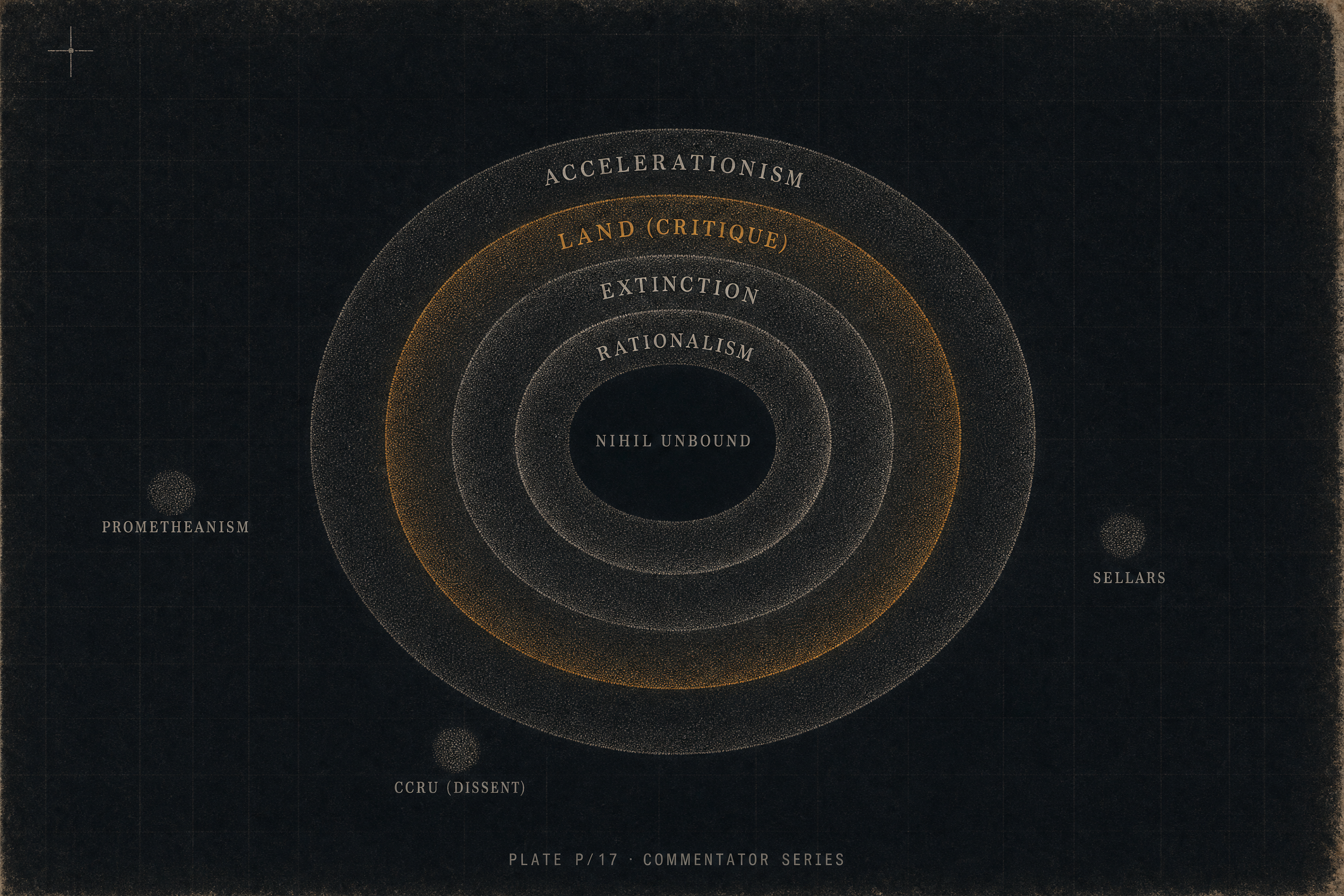
The specific move across *Nihil Unbound: Enlightenment and Extinction* (Palgrave Macmillan, 2007), read as a whole, is to promote extinction from a rhetorical device into a load-bearing concept. Where Land treats extinction as an asymptote the cosmic process tends toward and the libido secretly desires, Brassier's book is standardly read as arguing that extinction is a truth the rationalist tradition has the conceptual means to face without needing the Deleuzo-Landian machinery of intensities, anorganic continua, or Thanatos-as-carrier-wave. The result — on this reading — is a nihilism that runs on disenchanted naturalism and a post-Laruellean register rather than on schizoanalytic velocity. This is why the book matters to the CCRU page: it demonstrates, by counter-example, what in Land was argument and what was style.
The editorial canonization
The second contribution is curatorial and is often underrated because curatorial work looks passive. The editorial apparatus Brassier produced with Robin Mackay for *Fanged Noumena: Collected Writings 1987–2007* (Urbanomic / Sequence, 2011) decided, more than any single piece of secondary literature, how Land would be read for the next generation. Gathering the 1987–2007 writings between covers, sequencing them, and introducing them as a trajectory rather than a scatter of provocations performs an act of canonization: the essays stop being zine-adjacent artefacts and become primary philosophical texts with an apparatus.
This is load-bearing for the CCRU page because *Fanged Noumena* is the object most readers actually encounter when they encounter Land at all. What they read is Brassier-and-Mackay's Land — collected, bound, indexed. The portrait of the CCRU as a philosophical formation rather than a subcultural eddy is partly an editorial achievement, and the shape of that achievement was set by editors who had already decided the material warranted the treatment usually reserved for canonical philosophy.
Rationalist Nihilism against Accelerationist Politics
The continuity across Brassier's work is anti-correlationism: the refusal to grant thought any privileged relation to being, and the willingness to follow that refusal into the extinction of the thinker. The discontinuity is the political turn that accelerationism took around him. 'Prometheanism and Its Critics' was collected in the *#Accelerate: The Accelerationist Reader* (Urbanomic, 2014), whose editorial framing presents the volume as a 'revisionary montage' consolidating and reclaiming accelerationism as an evolving programme. Brassier's essay is typically read within that volume as defending a rationalist prometheanism — the claim that the given is something to be reconstructed rather than venerated — which sits formally adjacent to accelerationist rhetoric but drops the Landian premise that capital itself is the intelligent agent of reconstruction. On this reading, prometheanism becomes a rationalist programme of artificial self-transformation, not a vector toward which human agency should dissolve.
This is where a familiar misreading has to be flagged — as an editorial framing of the reception, not as a citation. Brassier's subsequent public distance from Landian and right-accelerationist circles has sometimes been read as a repudiation of his early work, as if *Nihil Unbound* had been a youthful mistake. The portrait this page wants to hold is that it was not. The rationalist-nihilist commitment looks stable across the arc; what changes is the political inference drawn from it. The early work treats extinction as a truth; it never endorsed the view that accelerating capital is the appropriate practical response. The later position makes explicit what the early position left underdetermined — that facing extinction rationally and hastening it are different commitments, and only confusion about the former could make the latter look like an entailment.
Why he belongs to the afterlife, not the centre
Brassier is evidence for how the CCRU was read, not for what it was. Placing him at the centre of the original formation gets the chronology wrong and mistakes interpretive weight for participatory presence. His role is downstream: he is the reader who changed the register at which the material could be discussed in academic philosophy, and the co-editor who decided how it would be bound and indexed. These are real contributions to the archive's ongoing life, but they are contributions of reception.
The internal tension worth holding onto is this: the same rationalist rigour that made Brassier the most penetrating external reader of Land is what obligated him to separate himself from what Land's commitments became. The clarity of the critique and the sharpness of the later distance are produced by the same philosophical temperament. A portrait that flattens either side — either turning him into a Landian or into a repentant ex-Landian — loses the specific operation he performs on the cluster.
Deepest single document
For the reader who wants one text that shows how the CCRU material survives translation into serious philosophical argument, the entry point is Nihil Unbound: Enlightenment and Extinction.
Ray Brassier matters less as a CCRU participant than as a later reader who clarifies how parts of the archive were interpreted, criticized, and philosophically resituated.
Core argument
Brassier is valuable because he changes the register of discussion. He often supplies a more analytic and historically explicit frame than the archive's densest materials.
He belongs to the afterlife of reading, not to the original collective center. That distinction helps newcomers place his authority correctly.
Worked examples
These named texts, talks, sites, and records show where the argument becomes concrete.
Ray Brassier Mad Black Deleuzianism Record
"Ray Brassier Mad Black Deleuzianism" is a good checkpoint because it keeps Ray Brassier inside scene evidence rather than later reputation.
Nick Land Reading Guide Guide
"Nick Land Reading Guide" widens Ray Brassier back into the larger CCRU field instead of treating the figure as self-explanatory.
Accelerationism Concept
"Accelerationism" names one recurring pressure that helps Ray Brassier make sense beyond biography alone.
Common misreadings
These are the recurring simplifications, exaggerations, and misreadings that make the subject look flatter than it is.
- Brassier is evidence for what the CCRU originally was.
He is more useful as a later interpreter and critic than as an origin witness.
Significance
Brassier still matters because he gives readers a clearer philosophical register for thinking about Land, rationalism, and later receptions of the archive.
Stakes of this figure
Philosopher and commentator whose lectures and interviews help clarify how later readers interpreted Land, rationalism, and the archive's conceptual stakes.
Periodisation
- 2000s onward
- secondary interpretation
Key works for entering the figure
- Ray Brassier - Mad Black Deleuzianism; On Nick Land
- The Metaphysics of Sensation; Psychological Nominalism and the Reality of Consciousness.pdf
References
Records cited
These linked sources are the quickest way to test the argument against named materials rather than second-hand summary.
Ray Brassier Mad Black Deleuzianism Record
"Ray Brassier Mad Black Deleuzianism" ties Ray Brassier to a document, lecture, or interview you can actually test.
Nick Land Reading Guide Guide
"Nick Land Reading Guide" shows what changes once Ray Brassier is read comparatively rather than mythically.