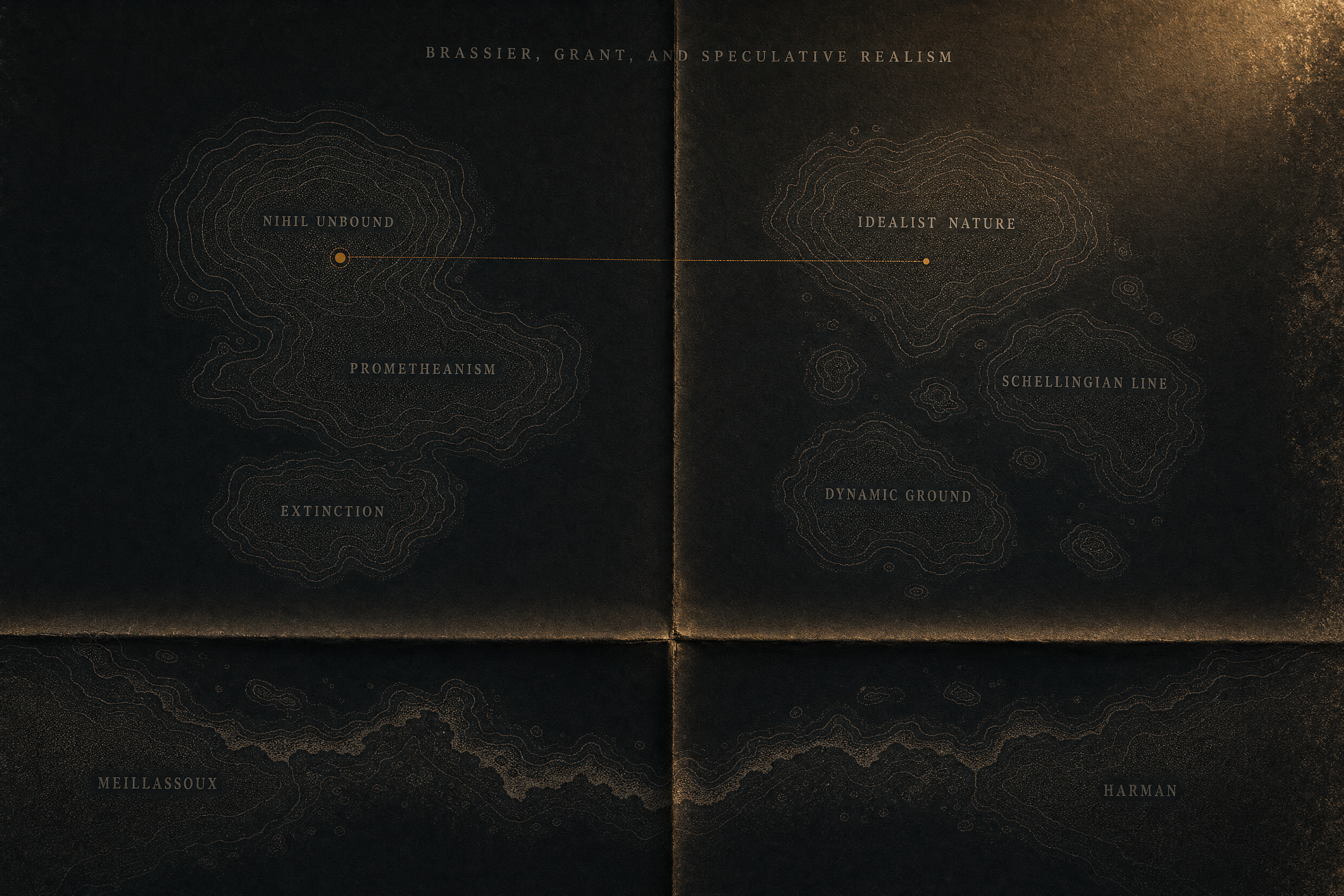
The aftermath that reads back
This is the crucial gesture: speculative realism reads the CCRU rather than continuing it. Brassier in particular treats Land's metaphysics as a philosophical position to be contested, not a legend to be honored. Grant does something different — routes backward through Schelling to argue that the naturephilosophical claims the CCRU skirted have a much older lineage. Neither is a disciple. Both read the archive closely enough to disagree productively.
Brassier against Land's metaphysics
The disagreement standardly attributed to Nihil Unbound (Brassier, Palgrave, 2007) — and here I am reporting the common reading of that book rather than quoting it, since the retrieval for this section rests on the Land material Brassier is reading — runs like this. Land's libidinal materialism, visible in passages like the one the Land Reader reproduces from Anti-Oedipus and extends: 'matter that occupies space to a given degree — to the degree corresponding to the intensities produced… Matter equals energy. Production of the real as an intensive magnitude starting at zero,' risks converting every terminus into a productive circuit. Brassier's widely discussed objection is that a cosmic nihilism that keeps producing intensity is not quite nihilism.
Brassier's counter-move, as generally understood, is to take extinction seriously as extinction: not as acceleration, not as a productive limit, but as the thermodynamic cancellation of thought. This is where the speculative-realist reception turns against the CCRU's most characteristic gesture — the conversion of every terminus into a generative circuit. Readers inside the archive have to decide whether the charge lands; some think it mistakes the rhetorical register of Land's 1990s writing for its ontological commitment. The dispute is real regardless of which side one takes, and it is the reason the two projects cannot be collapsed into each other.
Grant's Schellingian detour
Iain Hamilton Grant's Philosophies of Nature After Schelling (Continuum, 2006) takes a different exit, and here too the retrieval constrains what can be shown directly. Grant's older CCRU-adjacent writing is visible in the archive — the 'Demonology of the New Earth' essay on Freud's Rat-man tracks 'becomings-rat,' 'molecular affectivity for death,' and the pack's escape from Oedipal coordinates, sharing the archive's commitment to intensive matter and pre-individual process.
The 2006 book, by its title and by standard accounts, relocates these commitments into a reading of Schelling's Naturphilosophie; I am reporting rather than quoting that relocation, because the retrieval here supplies the earlier Grant, not the Schelling book itself. The wager, as generally understood, is that the interesting CCRU claims about matter, ground, and production are Schellingian claims that never quite admitted it. This is an irenic reading compared to Brassier's. It is also more demanding, because it asks the reader to do serious history of philosophy rather than accept the archive as sui generis.
Collapse as the adjacent surface
Collapse, edited by Robin Mackay at Urbanomic from 2006 onward, is where the two receptions — CCRU-continuing and speculative-realist — visibly cohabit without resolving. A single volume can carry Land's 'Qabbala 101,' with its insistence that 'no polemic against numerology… will transcend the magmic qabbalistic flux that multiplies and mutates its sense' and its claim that numbers 'do not require — and will never find — any kind of logical redemption' (Collapse, 2007), beside material from Brassier, Meillassoux, Grant, and Negarestani. The journal is the archive's most honest document of how these projects overlap on the page while disagreeing in principle.
Treat Collapse as surface, not synthesis. Readers who scan a table of contents and conclude that everyone in the vicinity holds the same position will miss the actual structure: Mackay is curating a conversation, not hosting a movement. Urbanomic later publishes Fanged Noumena itself (2011), edited by Mackay and Brassier — a collaboration that makes the tension into a textual object. The editor who anthologizes Land is the same philosopher who contests Land's metaphysics.
What survives, what doesn't
The useful question for a reader entering this cluster is not 'what did speculative realism take from the CCRU?' but 'what does the CCRU look like after Brassier and Grant have read it?' Two things visibly survive: the anti-correlationist core (the refusal to center the human observer), and the seriousness about cosmic timescales and inhuman process. Both Brassier's extinction-horizon and Grant's geological Schelling retain these.
What does not survive unmodified: the implicit productive vitalism, the conversion of death into circuit, and the numerological-qabbalistic apparatus that runs through Land's later work — 'Qabbala 101' is the clearest case, with its 'eternal hypercosmic delight' of number that refuses logical redemption. Brassier's reception excises the first two on philosophical grounds. Grant quietly leaves the third aside. The internal archive disagreement here is sharp — some readers think this pruning is the necessary discipline, others think it subtracts exactly the gesture that made the CCRU the CCRU.
The common trap
The trap is treating speculative realism as the CCRU's completion or graduation — the moment the mythographic and theory-fiction material finally becomes 'real philosophy.' This story is wrong in both directions. It flatters speculative realism by making it the telos of a decade of Warwick writing it in fact contests. And it condescends to the CCRU by implying the numogram, the hyperstitional apparatus, and the theory-fiction voice were placeholder scaffolding waiting for analytic reconstruction.
The more accurate picture: two neighboring projects with real overlap and real disagreement, written partly by the same people, published partly by the same press, arguing about whether intensive matter is vitalist contraband and whether extinction is productive or terminal. Read for the argument, not the continuity. For a more focused entry into Land specifically as speculative realism receives him, the deepest single document is Fanged Noumena: Collected Writings 1987–2007, whose editorial apparatus by Mackay and Brassier is itself a speculative-realist reading of the CCRU's central author.
Speculative realism is the philosophical aftermath that took CCRU material seriously enough to argue with it — Brassier and Grant clarify what survives the original moment and what gets discarded.
Core argument
Later readers change the archive by interpreting it. The section treats contextualization as part of the afterlife rather than as neutral commentary.
Speculative-realist adjacency is illuminating but not identical to the CCRU. That keeps neighboring philosophical scenes in proportion.
Worked examples
These named texts, talks, sites, and records show where the argument becomes concrete.
Nick Land Reading Guide Guide
Start with "Nick Land Reading Guide" if you want the wider frame before dropping into Brassier Grant And Speculative Realism.
Ray Brassier Person
"Ray Brassier" is one of the clearest figures for the pressures gathered inside Brassier Grant And Speculative Realism.
Accelerationism Concept
"Accelerationism" names one recurring problem inside Brassier Grant And Speculative Realism.
Ray Brassier Mad Black Deleuzianism Record
"Ray Brassier Mad Black Deleuzianism" is a checkpoint where Brassier Grant And Speculative Realism stops sounding abstract.
Invaders From The Future Record
"Invaders From The Future" is a checkpoint where Brassier Grant And Speculative Realism stops sounding abstract.
Common misreadings
These are the recurring simplifications, exaggerations, and misreadings that make the subject look flatter than it is.
- Later philosophical neighbors explain the archive's original center completely.
They help clarify reception and re-situation more than origin.
Significance
This section matters because it gives readers a clearer philosophical register for later receptions without turning those receptions into the archive itself.
Themes
- brassier
- grant
- speculative realism
- critique
- philosophical afterlives
Where this section sits in the archive
2007 is the hinge. Ray Brassier's Nihil Unbound: Enlightenment and Extinction (Palgrave, 2007) appears the same year Robin Mackay's Urbanomic begins publishing Collapse, and a year after Iain Hamilton Grant's Philosophies of Nature After Schelling (Continuum, 2006). The CCRU as an operational entity is gone by then. What these books do is take the 1990s Warwick material — Land's Fanged Noumena writings, the Deleuzean metaphysics, the anti-correlationist heat — and submit it to philosophical argument rather than mythographic extension.
Sources by cluster
These mini-clusters widen the section through named works and support traces rather than through adjacent keywords alone.
Section source cluster
Brassier Grant And Speculative Realism: public editions and anchor texts
Brassier Grant And Speculative Realism becomes clearer through named edition pages such as Ray Brassier - Mad Black Deleuzianism; On Nick Land, @OUTSIDENESS, Brassier - ALIEN THEORY (PhD Thesis). These are the quickest public routes into the section's central problem without dropping to raw support material first.
Work
Ray Brassier - Mad Black Deleuzianism; On Nick Land
Brassier's talk re-reads Land through conceptual critique, arguing that the politics of accelerationism cannot be grasped without confronting its philosophical commitments. Ray Brassier's Mad Black Deleuzianism re-rea...
Work
A major late Land collection that gathers the Outsideness years into one long archive of teleoplexic notes, interviews, fragments, and political intensities. "From cyberspace you can eat economies, start nuclear wars,...
Work
Brassier - ALIEN THEORY (PhD Thesis)
A major early Brassier text that makes nihilism, realism, and anti-human abstraction into one of the clearest philosophical re-readings of the archive's terrain. April 2001, Warwick Department of Philosophy. Ray Brass...
Work
A Conversation with Nick Land (Part 2) - by Vincent Lê
A conversation that makes later Land's political and teleoplexic vocabulary unusually explicit without dissolving its hostility or abstraction. A conversation that makes later Land's political and teleoplexic vocabula...
Work
Invaders from the Future-The CCRU and Their Legacy.pdf
This course text presents the CCRU as a legacy problem, explaining why the archive became mythic and why it still attracts philosophical and aesthetic interest. A reading list arrives labelled with the CCRU's name, an...
Work
Xenofeminism; A Politics for Alienation
The core Laboria Cuboniks statement, treating alienation as a resource for technical emancipation rather than a condition to be overcome through return to the natural. The core Laboria Cuboniks statement, treating ali...
Section source cluster
Brassier Grant And Speculative Realism: routes out and adjacent arguments
What Is Hyperstition?, Nick Land: A Reading Guide, CCRU Key Texts widen Brassier Grant And Speculative Realism back out into adjacent guides and arguments once the local pattern is visible.
Guide
Hyperstition is the CCRU term for stories, diagrams, entities, or signs that start helping to make the realities they describe. The easiest way to say it is that some fictions do not stay fictional in any passive sens...
Guide
The best way to start Nick Land is to separate phases before you make judgments. Read the Warwick and CCRU-era work as one phase, the editorial and spoken entry points as another practical route into it, and the later...
Guide
The search behind “CCRU key texts” is usually not really about canon formation. It is about triage. Readers want to know which texts, talks, and source pages will make the scene open up fastest without turning the mat...
Guide
The Cybernetic Culture Research Unit, or CCRU, was a loose research formation that emerged around Warwick in the 1990s and then persisted through texts, events, recordings, websites, and arguments long after its origi...
Guide
Accelerationism After the CCRU
Accelerationism is one of the most public labels attached to the CCRU, but it is not the archive's secret essence. The more accurate starting point is that accelerationism is a later umbrella term that gathered togeth...
Guide
The fastest way to make the CCRU less mystical is to put it back into time. Most readers do not meet the Cybernetic Culture Research Unit at Warwick in the mid-1990s. They meet it through Mark Fisher, k-punk, Nick Lan...
Texts in this section
113 classified works grouped into 3 editorial subclusters. Reviewed: 103; needs review: 10.
Ray Brassier and rationalist realism 73 works
- Brassier - ALIEN THEORY (PhD Thesis)
- Brassier - Alien Theory - The Decline of Materialism in the Name of Matter (Actual Layout)
- Brassier - Alien Theory - The Decline of Materialism in the Name of Matter (Cleaned Layout)
- Brassier - Axiomatic Heresy - The Non-Philosophy of Francois Laruelle
- Brassier - Badiou's Materialist Epistemology of Mathematics
- Brassier - Behold the Non-Rabbit - Kant, Quine, Laruelle
- Brassier - Comments on Danielle Macbeth's Realizing Reason - A Narrative of Truth and Knowing
- Brassier - Concepts and Objects (Chapter 5 from The Speculative Turn - Continental Materialism and Realism)
- Brassier - Concepts, Objects, Gems (Chap. 19 from Theory After 'Theory')
- Brassier - Correlation, Speculation, and the Modal Kant-Sellars Thesis (Chapter 3 from The Legacy of Kant in Sellars and Miellassoux)
- Brassier - Deleveling - Against 'Flat Ontologies' (Chapter from Under the Influence - Philosophical Festival Drift)
- Brassier - Dialectics Between Suspicion and Trust
- Brassier - Genre Is Obsolete
- Brassier - Laruelle and the Reality of Abstraction (Chapter 5 from Laruelle and Non-Philosophy)
- Brassier - Nominalism, Naturalism, and Materialism - Sellars's Critical Ontology (Chapter 7 from Contemporary Philosophical Naturalism and Its Implications)
- Brassier - Non-Rabbit
- Brassier - Presentation as Anti-Phenomenon in Alain Badiou's Being and Event
- Brassier - Refusal (Chapter from Bad Feelings)
- Brassier - Science (Chap. 6 from Alain Badiou - Key Concepts)
- Brassier - Solar Catastrophe - Lyotard, Freud, and the Death-Drive
- Brassier - Speculative Autopsy (Postscript from Object-Oriented Philosophy - The Noumenon's New Clothes)
- Brassier - Stellar void or Cosmic Animal (Pli 10) (2000)
- Brassier - Stellar Void or Cosmic Animal - Badiou and Deleuze on the Dice-Throw
- Brassier - Strange Sameness - Hegel, Marx and the Logic of Estrangement
- Brassier - That Which Is Not - Philosophy as Entwinement of Truth and Negativity
- Brassier - The Enigma of Realism - On Quentin Meillassoux's After Finitude
- Brassier - The Thanatosis of Enlightenment (Chapter from Origins and Ends of the Mind - Philosophical Essays on Psychoanalysis)
- Brassier - The View from Nowhere
- Brassier - Transcendental Logic and True Representings
- Brassier - Wandering Abstraction
- Brassier - Диалектика между подозрением и доверием
- Brassier and Andonovski - 'Philosophy Is Not Science's Under-Labourer' - An Interview with Ray Brassier
- Brassier and Rychter - I Am a Nihilist Because I Still Believe in Truth - Ray Brassier Interviewed by Marcin Rychter
- Brassier and Toscano - Postface - Aleatory Rationalism (from Alain Badiou - Theoretical Writings)
- Brassier et al - Discussion 2 (Chapter from Speculative Aesthetics)
- Brassier et al - Discussion 3 (Chapter from Speculative Aesthetics)
- Brassier et al - Pricing Time - Outline and Discussion on Suhail Malik's 'The Ontology of Finance'
- Brassier et al - Speculative Realism
- Cecile Malaspina Ray Brassier - An Epistemology of Noise (2018, Continnuum-3pl) - libgen.li
- Collapse; Philosophical Research and Development Issue #3; Unknown Deleuze and Symposium on Speculative Realism - Editorial Introduction
- Concrete Rules and Abstract Machines; Form and Function in A Thousand Plateaus
- Devastation
- francois-laruelle-controversy-over-the-possibility-of-a-science-of-philosophy
- From Decision to Heresy - Introduction Laruelle Undivided
- Interview with Ray Brassier by Leon Niemoczynski (2017)
- Object-Oriented Philosophy The Noumenon's New Clothes
- Philosophys Dark Heir On Nick Lands Abst
- Ray Brassier in conversa... Metzinger Senselogi©
- Ray Brassier on Nick Land - The Pinocchio Theory
- ray-brassier-comments-on-danielle-macbeths-realizing-reason-a-narrative-of-truth-and-knowing
- ray-brassier-concepts-and-objects-1
- ray-brassier-concreteinthought-concreteinact-marx-materialism-and-the-exchange-abstraction-1
- ray-brassier-deleveling-against-flat-ontologies-1
- ray-brassier-dialectics-between-suspicion-and-trust-1
- ray-brassier-jameson-on-making-history-appear-2
- ray-brassier-metal-machine-theory
- ray-brassier-presentation-as-antiphenomenon-in-alain-badious-being-and-event
- ray-brassier-that-which-is-not-philosophy-as-entwinement-of-truth-and-negativity
- ray-brassier-the-expression-of-meaning-in-deleuzes-ontological-proposition
- ray-brassier-the-view-from-nowhere
- ray-brassier-unfree-improvisationcompulsive-freedom
- Reason Is Inconsolable and Non-Conciliatory
- Science
- Speculative Realism
- The Decline of Politics in the Name of S
- The Kantian Catastrophe Conversations on Finitude and the Limits of Philosophy
- The Metaphysics of Sensation; Psychological Nominalism and the Reality of Consciousness
- Ireland2013Needs editorial review
- One Two Many On Nick Lands Numbering PraNeeds editorial review
- Practical Eliminativism; Getting Out of the Face, AgainNeeds editorial review
- The Conspiracy against the Human Race A Contrivance of HorrorNeeds editorial review3 source files
- thomas-ligotti-the-conspiracy-against-the-human-race-a-contrivance-of-horror-3Needs editorial review
- wk5 accelerating speculationsNeeds editorial review
Iain Hamilton Grant and nature philosophy 33 works
- Collapse; Philosophical Research and Development Issue #6; GeoPhilosophy - Editorial Introduction
- Does Nature Stay What-it-is Dynamics and the Antecendence Criterion
- Dustin McWherter - Iain Hamilton Grant, Philosophies of Nature after Schelling
- Everything
- Everything is Primal Germ or Nothing Is; The Deep Field Logic of Nature
- Grant - LA2019 Demopathy Xenogenesis (1996)
- Grant - Prospects for Post-Copernican Dogmatism (Collapse V) (2009)
- How Nature Comes to be Thought; Schelling's Paradox and the Problem of Location
- iain-hamilton-grant-everything-is-primal-germ-or-nothing-is-the-deep-field-logic-of-nature-1
- iain-hamilton-grant-movements-of-the-world-the-sources-of-transcendental-philosophy
- iain-hamilton-grant-postmodernism-lyotard-and-baudrillard-1
- iain-hamilton-grant-world-in-middle-schelling-why-nature-transcendentalizes
- Interview with Iain Hamilton Grant by Leon Niemoczynski (2013)
- Mind that Abides. Panpsychism in the new millennium
- Mining Conditions A Response to Harman
- Nature After Nature, or Naturephilosophical Futurism
- New Essays on Fichte's Later Jena Wissenschaftslehre, eds Daniel Breazeale and Tom Rockmore
- Paul Butel. The Atlantic. (Seas in History.) Translated by Iain Hamilton Grant.
- Review by N. A. M. Rodger - The Atlanticby Geoffrey Scammell Paul Butel Iain Hamilton Grant (2000)
- Review by Nick Groom - Symbolic Exchange and Deathby Jean Baudrillard Iain Hamilton Grant (1996)
- Review by Seymour Drescher - The Atlanticby Paul Butel Iain Hamilton Grant (2001)
- Review by Trevor Burnard - The Atlanticby Paul Butel Iain Hamilton Grant (2000)
- Spinal Catastrophism A Secret History (Urbanomic Mono) -- Thomas Moynihan; Iain Hamilton Grant -- 1, 2019 -- MIT Press; Urbanomic -- 9781913029562 -- 9bd71da3f13a846e0d127f61e87c9607 -- Anna's Archive
- Strange Sameness Hegel, Marx and the Logic of Estrangement
- The "eternal and necessary bond between Philosophy and Physics"
- The Chemical Paradigm
- The Tour
- The Universe in the Universe; German Idealism and the Natural History of Mind
- Truth of Zizek
- Grant - Energumen Critique (Pli v.4) (1992)Needs editorial review
- Only What Acts ThinksNeeds editorial review
- Philosophy Become Genetic The Physics of the World SoulNeeds editorial review
- Suprematist Ontology and the Ultra Deep Field Problem Operations of the ConceptNeeds editorial review
Speculative realism anthologies and critiques 7 works
- Aesthetics After Finitude
- Aesthetics After Finitude Meillassoux's Speculative Materialism
- Aesthetics After Finitude The Inauguration of Finitude
- baylee-brits-aesthetics-after-finitude-1
- Collapse; Philosophical Research and Development Issue #2; Speculative Realism - Editorial Introduction
- Naught is More Real Meillassoux Bataille
- robin-mackay-introduction-to-the-medium-of-contingency
References
Records cited
These linked sources are the quickest way to test the argument against named materials rather than second-hand summary.
Ray Brassier Mad Black Deleuzianism Record
"Ray Brassier Mad Black Deleuzianism" is the first record to test the framing around Brassier Grant And Speculative Realism.
Invaders From The Future Record
"Invaders From The Future" is the first record to test the framing around Brassier Grant And Speculative Realism.
Nick Land Reading Guide Guide
"Nick Land Reading Guide" gives the larger argument around Brassier Grant And Speculative Realism before you widen sideways.
External references
Inherited outward references from the guides, exhibits, people, and concept pages that anchor this section cluster.