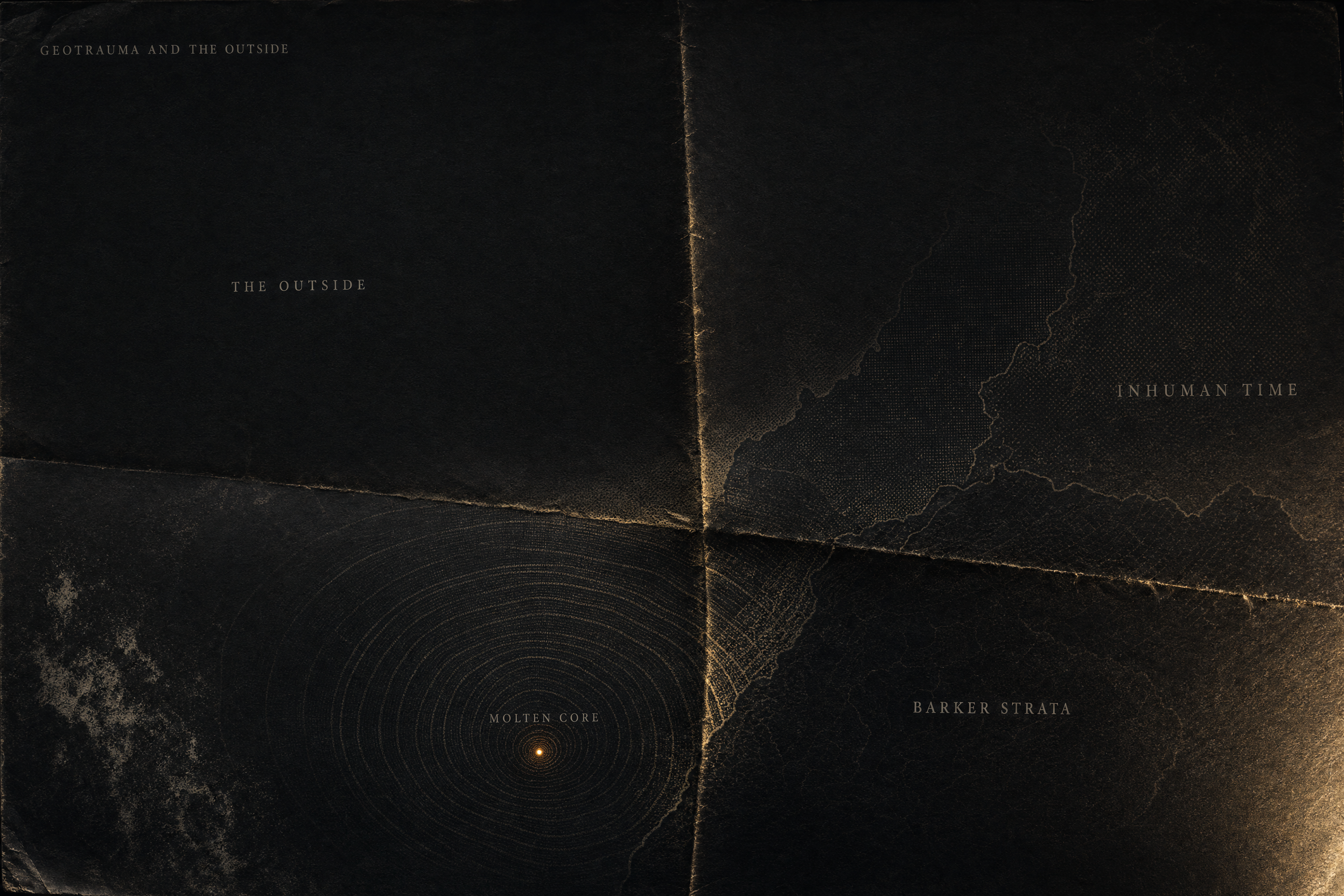
Where the concept lands
The concept lands, then, at a specific conjunction: a materialist theory of mind that insists thought carries geological debt, and a rhetoric of the Outside strong enough to prevent that debt from being paid off by metaphor. These are not the same register, which is why the cluster fractures internally the moment you start reading across it.
The Outside as constitutive, not exotic
The load-bearing philosophical claim across this cluster is that exteriority is not a region thought travels to but a condition thought runs on. Iain Hamilton Grant's 'Black Ice' (in Virtual Futures, Routledge, 1998) states the move in compressed form: thought is modelled as 'datapulsional syntheses' that 'impact isotropically on the analytical engines', breaking 'immanence out of the nets of transcendental determination'. Reasoning is not synthesised from above by a sovereign subject; it is impacted from below by processes indifferent to the categories that would organise them. Grant's Philosophies of Nature After Schelling (Continuum, 2006) is the extended systematic statement of the same inversion, re-reading the post-Kantian tradition through a Schellingian nature that produces mind rather than being described by it.
This is the move readers must hold: the Outside is constitutive, so geotrauma is not a vivid way of saying 'the world is big and old', it is a claim about what reasoning is made of.
Trauma as a model of memory, not a mood
Geotrauma imports a specific psychoanalytic vocabulary — trauma as compacted, stratified, time-scrambling memory. Grant's 'Black Ice' leans explicitly on Freud's 1900 model of memory, cathexis, and 'short circuits in the relays and repetitions' to describe how intensities bypass identity. Mackay extends the same structure downward: the human nervous system is a late, thin membrane reading signals that were already inscribed as geological events, and 'the lagoon of personal memory drains into a sea of cosmic trauma'. That line is not ornamental; it is the model. Stratigraphy is a memory system; the nervous system is one of its surface readouts.
The disagreement inside the cluster sits here. Negarestani treats trauma as irreducibly narrative — Cyclonopaedia needs fiction, oil, theology, conspiracy to do its work, because geotrauma surfaces only through leaky textual hosts. Land's version is more austere: trauma is a thermodynamic and cybernetic process, and narrative is incidental. Grant, from the Schellingian side, resists framing the ground in strictly psychoanalytic terms, preferring the vocabulary of productivity. Readers who flatten these three into one voice lose the concept.
Scale and the problem of what counts as thought
The CCRU lecture material pushes the scale question through set theory and the Numogram rather than through geology directly. Its discussion of Cantor — thought can 'think the infinite as a well-defined rigorous mathematical concept' and set theory 'shows how we can take any well-ordered number line and proceed further down' — is the abstract twin of the stratigraphic argument. Deep time and transfinite number are treated as structurally similar provocations: both force thought to operate at scales where the thinker is a negligible local event.
This is why the geotrauma cluster and the numogram cluster keep touching without merging. Geotrauma gives the Outside a body (the planet, the hot core, the oil); numogramming gives it a syntax (ordinal descent, time-circuit). What to read for: whether a given text treats scale as a wound (Negarestani, Mackay) or as a structure (Grant, the lecture materials). Both are in the archive; they are not the same argument.
The capital question, held at arm's length
Land's 'Machinic Desire' (Textual Practice, 1993) and 'Meltdown' (collected in A Nick Land Reader and in Fanged Noumena) braid geotrauma together with capital as planetary process — 'transscalar entropy-dissipation', 'self-organizing planetary commoditronics', markets thawing out of 'the cryonics-bank of modernist corporatism'. This is where the cluster bleeds into accelerationism, and where readers should be most careful. Geotrauma does not require the capital thesis. Grant's Schellingian version runs without it. Negarestani's oil-theology runs alongside it but is not reducible to it.
The archive contains sharp internal pushback here. Critiques of Landian accelerationism argue that once geotrauma is yoked to capital-as-cosmic-process, the Outside becomes an alibi for a pseudo-transgressive imaginary. Whether you accept that critique or not, the cluster only stays philosophically honest if the geology argument and the capital argument are allowed to come apart and be tested separately.
The trap, and how to spot yourself falling into it
The common trap: reading this cluster as atmospheric vocabulary — Lovecraft flavour, stratigraphic adjectives, 'cosmic horror' as cultural studies garnish. You can tell you have fallen in when every use of 'the Outside' becomes substitutable with 'the weird' or 'the uncanny' without loss. If that substitution works on your reading, you have lost the philosophical claim. The claim is that nonhuman scale is not an aesthetic mood but a constraint on what can count as reasoning.
A second, subtler trap: treating geotrauma as a metaphor for psychic damage scaled up. The archive's strong version runs the opposite direction — personal trauma is treated as a surface symptom of processes that were never psychic to begin with. Get the vector wrong and the concept collapses into therapy-talk.
Where to go deepest first
Cyclonopaedia is the maximalist entry and Fanged Noumena is the sharpest source, but the single document that does the most orienting work — because it names the concept, reconstructs its sources, and refuses both the atmospheric and the therapeutic readings — is Mackay's A Brief History of Geotrauma. Read it against Grant's 'Black Ice' to keep the Schellingian ground visible; read it against Negarestani to see what the concept does when it is allowed to go fictional.
Geotrauma names the archive's argument that the outside is already inside thought — geological scale, trauma, and nonhuman process shape what counts as reasoning.
Core argument
Geotrauma names one of the archive's strongest routes to nonhuman scale. It shifts thought away from human-centered history and toward exterior pressure.
The outside is not a decorative abstraction here. It is a recurring way of testing how far the archive can think beyond human comfort and narrative continuity.
Worked examples
These named texts, talks, sites, and records show where the argument becomes concrete.
What Was The CCRU Guide
Start with "What Was The CCRU" if you want the wider frame before dropping into Geotrauma And The Outside.
Reza Negarestani Person
"Reza Negarestani" is one of the clearest figures for the pressures gathered inside Geotrauma And The Outside.
Numogram Concept
"Numogram" names one recurring problem inside Geotrauma And The Outside.
Invaders From The Future Record
"Invaders From The Future" is a checkpoint where Geotrauma And The Outside stops sounding abstract.
CCRU Lecture 1 Record
"CCRU Lecture 1" is a checkpoint where Geotrauma And The Outside stops sounding abstract.
Common misreadings
These are the recurring simplifications, exaggerations, and misreadings that make the subject look flatter than it is.
- This cluster is only atmospheric vocabulary.
Its language is charged, but it is tied to recurring questions about scale, exteriority, and material process.
Significance
This section matters because it pushes the archive toward geology, scale, and nonhuman pressure rather than purely cultural self-reference.
Themes
- geotrauma
- outside
- barker
- earth
- inhuman
Where this section sits in the archive
Geotrauma enters the archive through two hard documents: Reza Negarestani's Cyclonopaedia (re.press, 2008), where the Earth is reread as a tortured object whose interior pressures leak upward as petropolitics and xeno-chemical insurgency, and Nick Land's Barker-voiced materials, in which the planet's stratification is presented as a literal history of compaction injuries stored at depth — the CCRU lecture archive preserves Barker's argument that the crust was 'further stratified into distinct layers, continents, atmospheres and oceans' as a record of geological injury. Robin Mackay's 'A Brief History of Geotrauma' (in Leper Creativity, Punctum, 2012) is the document that stitches these into a shared concept: the planet as a body whose scars are ours because we are one of its surface epiphenomena.
Sources by cluster
These mini-clusters widen the section through named works and support traces rather than through adjacent keywords alone.
Section source cluster
Geotrauma And The Outside: public editions and anchor texts
Geotrauma And The Outside becomes clearer through named edition pages such as cybergothic.pdf, , . These are the quickest public routes into the section's central problem without dropping to raw support material first.
Work
abstracted from the banks of every computer in the human system. Unthinkable complexity. Lines of light ranged in the nonspace of the mind, clusters and constellations of data' (Gibson). - Even primitive VR corrodes b...
Work
Invaders from the Future-The CCRU and Their Legacy.pdf
"Invaders From The Future" is already promoted as a public work page for this section.
Work
"CCRU Lecture 1" is already promoted as a public work page for this section.
Work
Brassier Alien Theory Phd Thesis
"Brassier Alien Theory Phd Thesis" is one of the nearby public work pages that helps turn this section into a usable source cluster rather than a keyword shelf.
Work
Ray Brassier Mad Black Deleuzianism
"Ray Brassier Mad Black Deleuzianism" is one of the nearby public work pages that helps turn this section into a usable source cluster rather than a keyword shelf.
Work
Endgamers History Of Accelerationism
"Endgamers History Of Accelerationism" is one of the nearby public work pages that helps turn this section into a usable source cluster rather than a keyword shelf.
Section source cluster
Geotrauma And The Outside: talks, captures, and support traces
How does the archive turn geology, the Earth, and the Outside into active philosophical agents rather than scenic backdrop? stays grounded through traces like Scrap Metal and Fabric, nick-land-making-it-with-death-remarks-on-thanatos-and-desiringproduction, Accelerationism Ray Brassier moskvax. This cluster keeps the section attached to lectures, captures, and support pages where the scene still has friction.
Text page
[1] Artificial Intelligence The cyberfeminist account of artificial intelligence is an emergentist one, modelled on feedback: an artificially intelligent system is one that learns by breaking down. Where Plant remarks...
Text page
nick-land-making-it-with-death-remarks-on-thanatos-and-desiringproduction
And in A Thousand Plateaus: After all, is not Spinoza's Ethics the great book of the BwO? The attributes are types or genuses of BwO's, substances, powers, zero intensities as matrices of production. The modes are eve...
Text page
Accelerationism Ray Brassier moskvax
Accelerationism: Ray Brassier | moskvax https://moskvax.wordpress.com/2010/09/30/accelerationism-ray-brassier/[9/23/2017 12:12:03 AM] phenomenological subjectivity and he’s not interested in experiences insofar as the...
Text page
Rules - by Zero Philosophy - Outsideness Newsletter
Firstly, they can only be played by the rules. Cheating is forbidden less than it is made impossible. Physics is like this. It proscribes nothing that can be done (as Crowley notoriously noticed). Rules that can be br...
Record
"Nick Land Fanged Noumena" is one of the local source traces that keeps this section tied to named material.
Section source cluster
Geotrauma And The Outside: routes out and adjacent arguments
What Was The CCRU, Nick Land Reading Guide, Reza Negarestani widen Geotrauma And The Outside back out into adjacent guides and arguments once the local pattern is visible.
Guide
"What Was The CCRU" gives the wider argumentative frame around this section.
Guide
"Nick Land Reading Guide" gives the wider argumentative frame around this section.
Person
"Reza Negarestani" is one of the figures most closely bound up with this section's local problem.
Person
"Nick Land" is one of the figures most closely bound up with this section's local problem.
Concept
"Numogram" names one of the recurring conceptual pressures inside this section.
Concept
"Hyperstition" names one of the recurring conceptual pressures inside this section.
Texts in this section
30 classified works grouped into 3 editorial subclusters. Reviewed: 21; needs review: 9.
Barker and geotrauma 3 works
Inhuman earth and geology 22 works
- cave - LD50
- CCRU- Black Ice
- Collapse; Philosophical Research and Development Issue #7; Culinary Materialism - Editorial Introduction
- Determination and World Possession
- Gordon Matta-Clark; ‘Somewhere Outside the Law'
- Grant - Black Ice (Virtual Futures) (1998)
- Grant - Demonology of the New Earth
- HOLES READER
- Kant After Geophilosophy The Physics of Analogy and the Metaphysics of Nature
- Land - Other Endings (Unpublished Cyclonopedia Blurb) (2008)
- LAND -- Cryptolith
- Leper Creativity (Cyclonopedia Symposium) (2012)
- SUM-13-WEB-single
- The Brain-Eye - Translator's Preface
- Land - Mechanomics (Pli v.7) (1998)Needs editorial review
- Medium Earth; Seismic Sensitivity as Planetary PredictionNeeds editorial review
- Negarestani-2002-a good mealNeeds editorial review
- Reaching Beyond to the Other On Communal Outside-WorshipNeeds editorial review
- Synthetic Fabrication The Myth of the Politics-to-Come (Part 1 The Generative Myth)Needs editorial review
- The Only Thing I Would Impose is Fragmentation - An Interview with Nick Land synthetic zerøNeeds editorial review
- The Open Spiral Compact MagNeeds editorial review
- The StrangerNeeds editorial review
Horror, slime, and planetary decay 5 works
- Being and Slime The Mathematics of Protoplasm in Lorenz Oken's ‘Physio-Philosophy'
- Grant - The Chemistry of Darkness (Pli v.9) (2000)
- Negarestani - The Corpse Bride
- Revolution Goes Ferric; Notes on the Deeper Traumatic History of the Industrial Revolution
- Goodman - Programmed CatastropheNeeds editorial review
References
Records cited
These linked sources are the quickest way to test the argument against named materials rather than second-hand summary.
Invaders From The Future Record
"Invaders From The Future" is the first record to test the framing around Geotrauma And The Outside.
CCRU Lecture 1 Record
"CCRU Lecture 1" is the first record to test the framing around Geotrauma And The Outside.
Nick Land Fanged Noumena Record
"Nick Land Fanged Noumena" is the first record to test the framing around Geotrauma And The Outside.
What Was The CCRU Guide
"What Was The CCRU" gives the larger argument around Geotrauma And The Outside before you widen sideways.
External references
Inherited outward references from the guides, exhibits, people, and concept pages that anchor this section cluster.