Nature as ground, not correlate
The polemical force of the book, as the present essay reads it, is directed at what Grant names a somatist habit running through modern philosophy — the habit of taking the finite body, or the finite ego, as the unit within which nature must be legible. Against this, Schelling is read not as a romantic or an idealist but as the thinker who insisted that any adequate Naturphilosophie has to start from productivity rather than product. Nature is not the totality of things; it is the unconditioned that never fully arrives as a thing.
Schelling before Speculative Realism
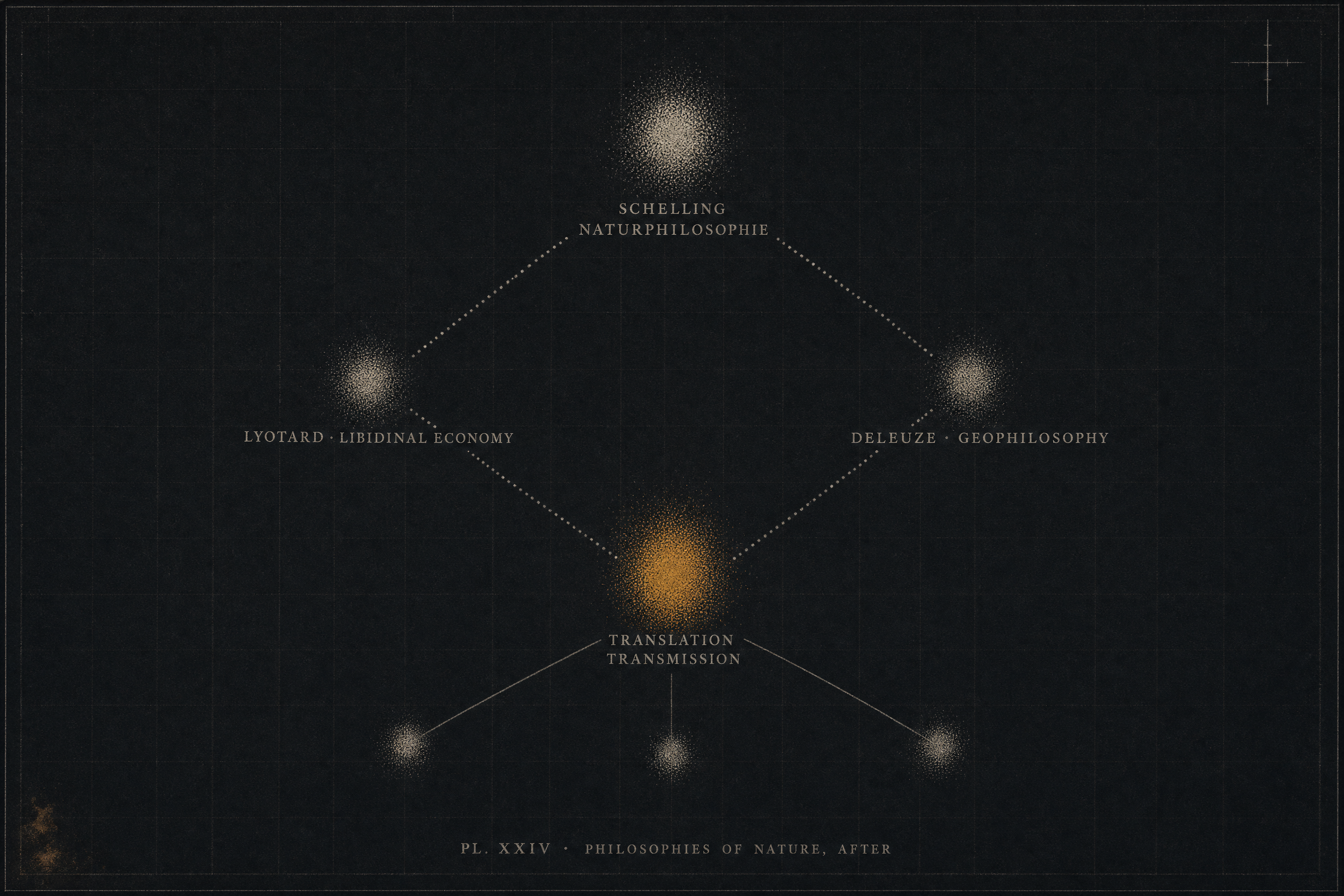
Grant's reception depends on the speculative-realism scene as its institutional frame, but — this is editorial framing rather than a claim from retrieved corpus — the Schelling project precedes that scene and outlasts its polemics. The translation of Lyotard's Libidinal Economy (Athlone, 1993) and the sustained engagement with German Naturphilosophie that culminates in the 2006 book together indicate a research programme whose shape is not determined by the later SR workshops or the subsequent Urbanomic Collapse volumes.
This matters because the SR framing tempts a reader to treat Grant as running one of four parallel anti-correlationist arguments, interchangeable in principle with the others. The portrait's reading is that he is not. Where adjacent SR projects work from the mathematizability of the ancestral, or from an eliminative nihilism, Grant works through a textually granular reconstruction of Schelling's own system, arguing that the resources for defeating correlationism were already present in the Naturphilosophie of the late 1790s and were subsequently closed down by the idealist and phenomenological traditions. The argument is a scholarship argument as much as a speculative one, and its force depends on that philological weight.
Why the CCRU cluster needs him
Grant's presence in the CCRU orbit does specific work. Land's acceleration arguments and the Ccru's hyperstitional machinery need a metaphysics in which geological, cosmological, and pre-biotic processes are not merely the setting for capital's self-intensification but the register in which capital itself has to be understood. The editors' introduction to Fanged Noumena registers something close to this pressure when it describes Land's writing as a space where "advanced technologies invoke ancient entities" and civilization hurtles toward an artificial death — a cosmic and pre-biotic register that the cluster's own cybernetics vocabulary does not ground. The Lyotard translation can be read as an early version of the required metaphysics — libidinal economy as a theory of intensities that do not first pass through a subject — and the Schelling book as a mature version.
Without something like Grant's move, the cluster's claims about inhuman process default to a cybernetics vocabulary that cannot answer why the process is ontologically primary rather than merely empirically pervasive. The Schellingian answer, on this portrait's reading of Grant: the process is primary because ground is productive before it is anything else, and any attempt to locate the principle of the process within one of its products — the human, the market, the machine — reproduces the somatist error. Whether the cluster borrows the move directly or converges on it is a question for a different essay; what matters here is that Grant supplies the argument the cluster's strongest claims require.
The internal tension
The work carries a real tension between its scholarly and its speculative registers. The Schelling reconstruction is meticulous, constrained by the archive, and answerable to historians of German Idealism; the speculative Naturphilosophie it licenses is scale-free, pitched at geology and cosmology, and answerable to nobody in particular. Grant's strongest pages hold these two registers together — the textual claim that Schelling already thought this underwrites the speculative claim that we should think it now — but the synthesis is fragile. When the reception picks up only the speculative half, the project looks like one more anti-correlationist manifesto. When it picks up only the scholarly half, it looks like intellectual history.
The productive reading holds both. Grant's bet, as this portrait construes it, is that a sufficiently serious return to Schelling is already a speculative intervention in the present, because what Schelling was doing and what a twenty-first-century Naturphilosophie would have to do are continuous problems rather than successive ones. That bet is what the portrait has to preserve.
Deepest single document
For the reader who wants to see the ground-productivity argument worked out against its actual philosophical competition rather than inferred from the SR anthologies, start with Philosophies of Nature After Schelling.
Iain Hamilton Grant is the Warwick philosopher whose Schellingian naturphilosophie underwrites several CCRU and adjacent positions on capital, system, and inhuman process. His 1993 translation of Lyotard's Libidinal Economy and Philosophies of Nature After Schelling (Continuum 2006) are the principal works.
Core argument
Grant's contribution to the archive is Schellingian naturphilosophie. It supplies the philosophical background several CCRU-adjacent arguments about nature, capital, and inhuman process tacitly assume.
His Lyotard translation is part of the same project. Libidinal Economy in English is one of the documents that made the wider Warwick scene's vocabulary available; the translation is editorial as much as linguistic.
Worked examples
These named texts, talks, sites, and records show where the argument becomes concrete.
Cybernetics and Capitalism Guide
The lineage Grant's Schellingian framework helps philosophically anchor.
Teleology vs Teleonomy Guide
The conceptual distinction his naturphilosophie engages from a different angle than cybernetics.
Capitalism as AI (concept) Concept
An adjacent argument his philosophical work helps situate.
Common misreadings
These are the recurring simplifications, exaggerations, and misreadings that make the subject look flatter than it is.
- Grant is the speculative-realist who happens to know Land.
He was at Warwick well before the speculative-realist label crystallised. Schellingian naturphilosophie is what he gave the wider CCRU scene; the speculative-realist association came later.
Significance
Grant's Schellingian framework supplies a vocabulary for nature, productivity, and ground that the contemporary AI-and-capital debate increasingly needs and rarely has at hand. Reading him directly recovers a philosophical resource the wider conversation undervalues.
Stakes of this figure
Warwick philosopher whose translation of Lyotard's Libidinal Economy (1993) and Philosophies of Nature After Schelling (Continuum 2006) supply the CCRU scene with Schellingian naturphilosophie as a working philosophical resource.
Periodisation
- 1990s Warwick
- 2000s onward
Key works for entering the figure
- Jean-François Lyotard — Libidinal Economy, trans. Iain Hamilton Grant (Continuum 1993)
- Iain Hamilton Grant — Philosophies of Nature After Schelling (Continuum 2006)
References
Records cited
These linked sources are the quickest way to test the argument against named materials rather than second-hand summary.
What Was the CCRU? Guide
Where Grant's place inside the Warwick scene is established at the formation level.
Cybernetics and Capitalism Guide
The lineage his naturphilosophie helps anchor philosophically.