The Thesis before the Numogram
This is why she matters differently from the other cluster members. The numeric and diagrammatic apparatus that saturates CCRU writing can be read as branded ornament or as serious conceptual machinery; Greenspan's thesis is the single document in the cluster whose genre commits her to the second reading. Whatever one ultimately concludes about the argument, the thesis is what forces the question from 'does the numogram look interesting?' to 'does it do philosophical work?' Treat her as a Land adjunct rather than as the cluster's most formally committed philosopher and the structure of intellectual dependency in the archive gets read backwards.
Modernity and the time-form of Capital
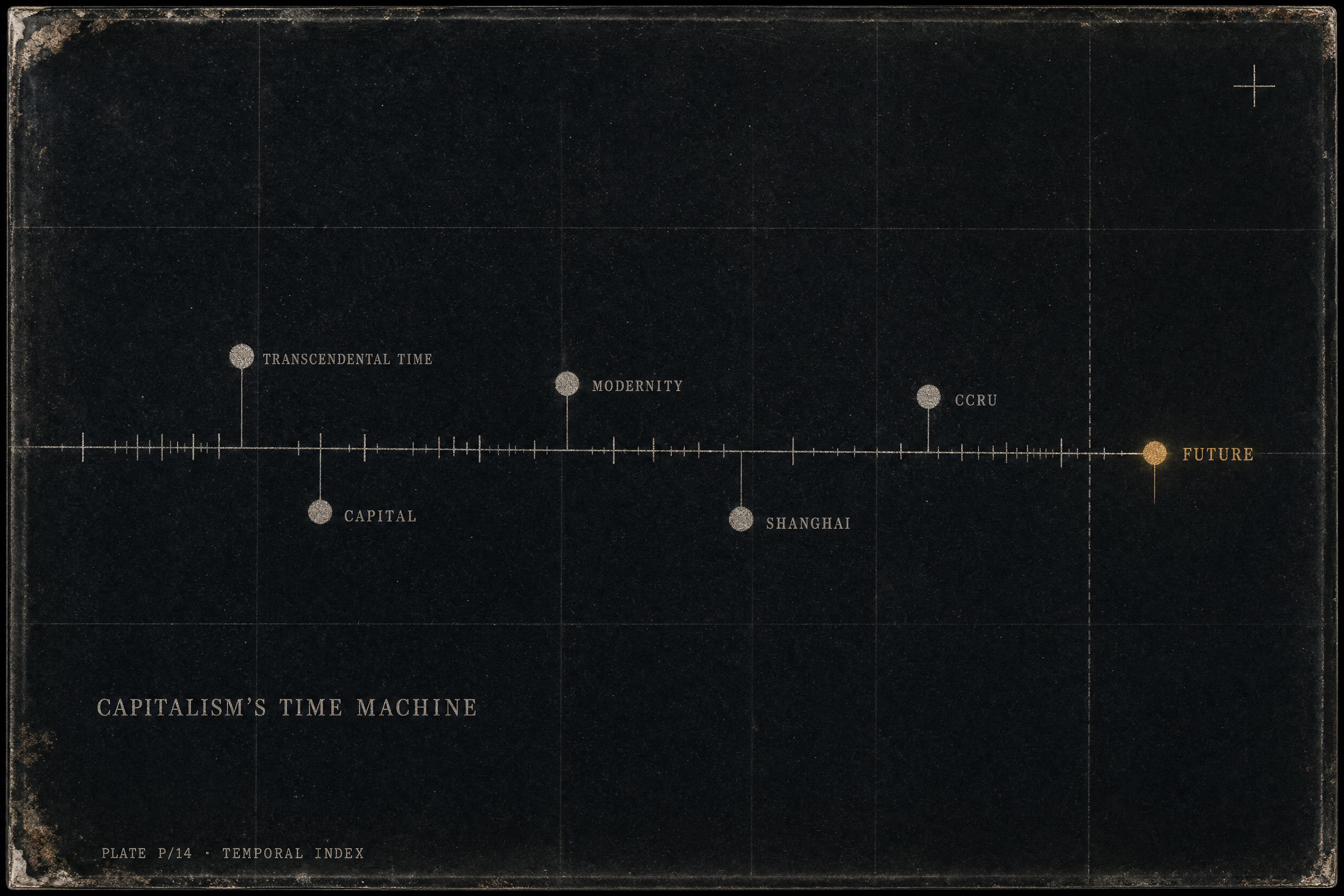
The title of the thesis — Capitalism's Transcendental Time Machine — already indicates the register. 'Transcendental' is a specific philosophical vocabulary, not decoration: it names the form of argument that asks after the conditions of possibility of a given experience rather than describing the experience itself. The project, on the evidence of its own framing, is therefore not a cultural study of capitalism-as-acceleration but an argument about what kind of temporal apparatus capital is. The through-line from this project to Shanghai Future thirteen years later runs through exactly this question — what time-form modernity is — and not through any change of subject matter from philosophy to urbanism.
This is as far as the argument can go on the evidence available to this portrait; the detailed reconstruction of the thesis's moves belongs in a reading of the document itself rather than in a portrait. What the portrait can assert is the structural point: subsequent cluster claims about hyperstition, templexity, and time-sorcery have a more rigorous warrant available to them in Greenspan's thesis than in any other single document the CCRU produced, and readers who want to know whether the numeracy survives philosophical pressure should go to her first.
Shanghai as the argument at Urban scale
Shanghai Future: Modernity Remade (Hurst / OUP, 2014) is routinely read as a second career — a move from speculative philosophy to urban studies, as if Greenspan had settled down. The internal tension of the portrait is that the two books really do occupy different registers: a Warwick thesis and a commercial-press trade book pull in opposite directions on prose, on apparatus, on who the reader is imagined to be. The thesis purchases formal rigour at the cost of readership; Shanghai Future purchases readership at the cost of visible philosophical machinery.
The claim worth defending is that these are not separate projects but the same argument at different scales. Shanghai Future is the book in which the question of modernity's time-form is asked of a built environment rather than of an abstract apparatus. Whether the specific urban arguments of the book succeed is a question for a reading of the book; what matters for the portrait is that without the thesis as its missing appendix, Shanghai Future collapses into either travelogue or comparative-modernities commentary, which is precisely the register it is trying to exceed. The philosophical commitment of the Warwick work is what licenses the urban writing to claim more than description.
Co-authorship and the Ccru volume
Greenspan's contributions, with Suzanne Livingston and others, to Ccru: Writings 1997–2003 (Time Spiral Press / Urbanomic, 2017) sit on the other side of the authorial ledger: collective, pseudonymous in places, stylistically heterogeneous. The volume is where the numeric and temporal materials circulate in their native form, unmoored from thesis apparatus. The relation worth noting is asymmetric. The Ccru volume is legible without Greenspan's thesis; the thesis is legible without the Ccru volume; but the question of whether the Ccru volume's numeracy is doing philosophical work, rather than producing an aesthetic, is one the thesis is uniquely positioned to answer. This is the sense in which her single-author work underwrites the collective work — not that she invented the material, but that her thesis is the cluster's most serious attempt to show that the material can bear philosophical weight.
Where to Start
For the single deepest document, go to Capitalism's Transcendental Time Machine. The distinctive claim of this portrait — that Greenspan is what makes the archive's numeracy defensible rather than merely atmospheric — stands or falls with a reading of that thesis, and every downstream claim about Shanghai, the Ccru volume, and the cluster's temporal vocabulary is ultimately answerable to it.
Anna Greenspan is one of the CCRU's most underread philosophers. Her doctoral work on capital, time, and modernity (Warwick 2000) underwrites several of the archive's recurring motifs, and her later book Shanghai Future (2014) extends the project into the geography of accelerated urban form.
Core argument
Greenspan is a philosopher of capital and time, not a Land adjunct. Capitalism's Transcendental Time Machine is the document several later CCRU and accelerationist arguments are tacitly building on.
Shanghai Future extends the project geographically. It moves the cybernetic-and-capital frame out of Warwick prose and into the texture of an actual accelerated city.
Worked examples
These named texts, talks, sites, and records show where the argument becomes concrete.
Capitalism as Artificial Intelligence Guide
The structural argument Greenspan's PhD thesis prepares from a different angle than Land's.
Cybernetics and Capitalism Guide
The deeper history her time-machine framework belongs to.
Accelerationism (concept) Concept
The conceptual cluster her doctoral work helps anchor philosophically.
Common misreadings
These are the recurring simplifications, exaggerations, and misreadings that make the subject look flatter than it is.
- Greenspan is Land's collaborator and that is the headline.
She is independently a philosopher of capital and time. Capitalism's Transcendental Time Machine and Shanghai Future are her own project, not annotations on someone else's.
Significance
Greenspan's framework gives contemporary capital-and-AI debate a vocabulary for time that the dominant accelerationist commentary lacks. Reading her directly recovers an underused theoretical resource.
Stakes of this figure
Philosopher of capital, time, and modernity. Her Warwick PhD Capitalism's Transcendental Time Machine (2000) and Shanghai Future (Hurst 2014) underwrite several CCRU motifs in their own right.
Periodisation
- 1990s Warwick
- 2000s onward
Key works for entering the figure
- Anna Greenspan — Capitalism's Transcendental Time Machine (PhD thesis, Warwick 2000)
- Anna Greenspan — Shanghai Future: Modernity Remade (Hurst 2014)
References
Records cited
These linked sources are the quickest way to test the argument against named materials rather than second-hand summary.
What Was the CCRU? Guide
Where Greenspan's place inside the formation is established at the scene level.
Capitalism as Artificial Intelligence Guide
Where her capital-and-time argument informs the structural identification.