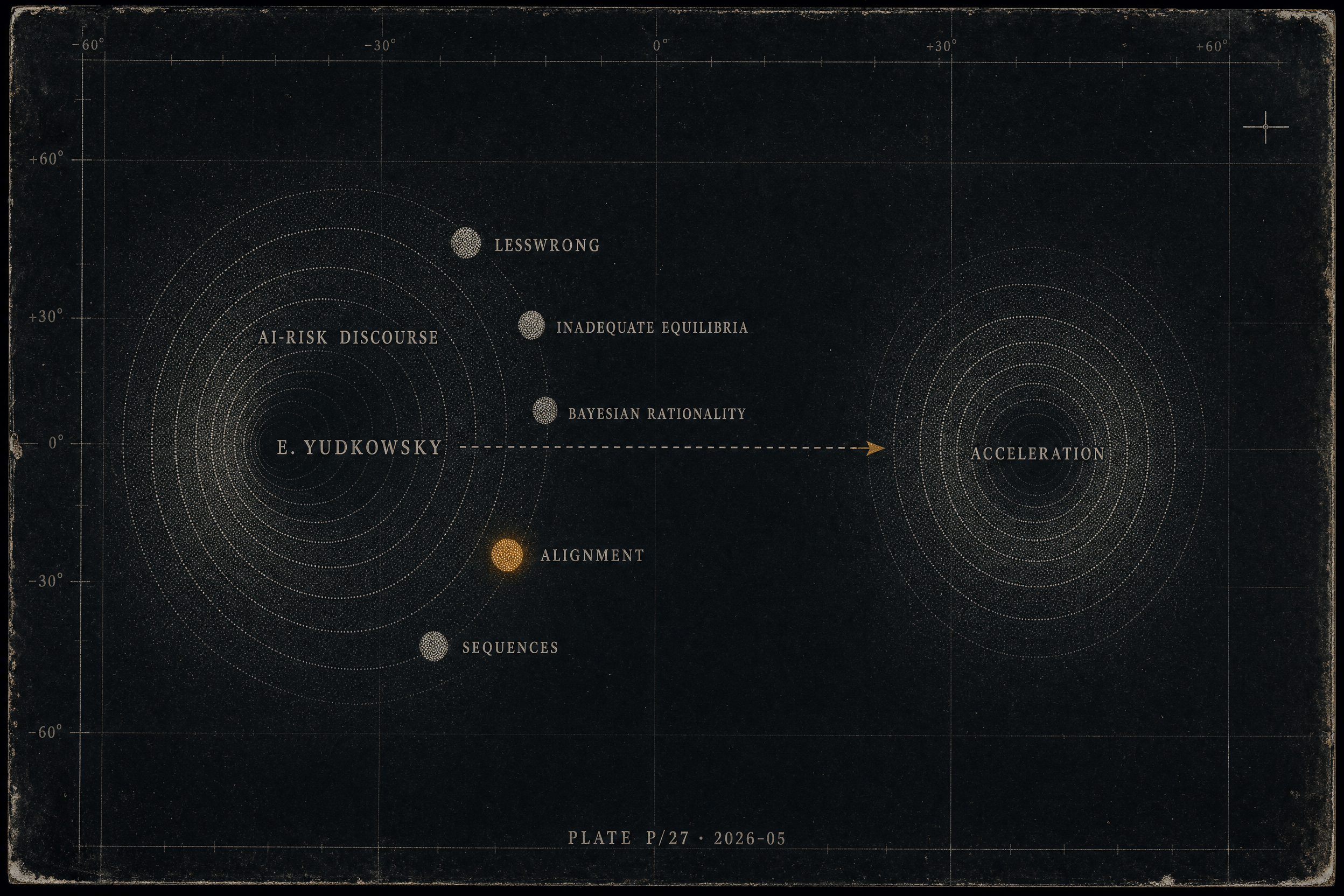
Counterpart, not ancestor
The CCRU's claim about machine intelligence runs on a different substrate. For CCRU-adjacent writing, capital is already the intelligence-amplifying process; the agent is the circulation, not the optimizer. Yudkowsky's scenario requires a discrete artifact whose goals can be specified or misspecified; the CCRU's requires no artifact at all, because the runaway has been underway since the industrial feedback loop closed. Holding these two frames apart is the archive's reason for citing him. Collapsing them — treating Yudkowsky as a late entrant into the same tradition — erases what is actually distinctive on both sides.
The sequences as epistemic infrastructure
The Sequences are load-bearing not for their AI content but for the epistemic protocol they install in their readers: Bayesian updating as a mandatory hygienic practice, 'rationality' as a cultivated personal discipline, and the community forum as the site where that discipline is tested. The intellectual move is to treat cognitive biases as debuggable — to rewrite epistemology as applied programming, where the mind is a system whose failure modes can be enumerated and patched. This is why the AI-risk argument lands where it does in that readership: the argument form (specify the system, locate the failure, intervene) is already the reader's native operating procedure.
*Inadequate Equilibria* generalizes the protocol outside of AI, arguing that civilizational failures persist because no individual actor has incentive to fix them even when the fix is visible. The book's usefulness to a CCRU-adjacent reader is diagnostic: it is a clean statement of a position the CCRU tradition rejects on principle. Yudkowsky's inadequacy analysis assumes that the correct counterfactual is a better-coordinated humanity; CCRU-derived analysis treats the same coordination failures as constitutive of the circulatory system, not bugs in it. The disagreement is not about facts but about where agency is located.
The Fiction as recruitment surface
*Harry Potter and the Methods of Rationality* (web serial, 2010–2015) is the piece most readers encounter first, and it is the reason the audience for the AI-risk writings is as large and as young as it is. The move is specific: take a franchise whose central pedagogical device is mystery and rewrite it so that every mystery is a puzzle the protagonist solves by applying the Sequences. Fiction becomes a delivery mechanism for epistemic method, and the reader who finishes the serial has already been trained in the style of reasoning the non-fiction will later require.
This creates an internal tension the portrait should name. Readers who entered through *Methods* often do not track the philosophical ancestry Yudkowsky is drawing on — decision theory, Bayesian statistics, the cognitive-bias literature, older AI-safety writing — and so the recruitment surface produces an audience whose confidence in the conclusions outruns their familiarity with the arguments. The work invites this: its rhetorical mode rewards fluency in the protocol over engagement with its sources.
The moratorium Break
The *Time* essay of March 2023 calling for an indefinite international moratorium on frontier AI training, with enforcement mechanisms extending to kinetic action against non-compliant training infrastructure, marks a sharpening that the earlier writing does not straightforwardly predict. The continuity is real: the existential-risk argument has been stable since the early LessWrong period, and the claim that alignment is unsolved has not shifted. What is new is the policy register. Earlier work treated alignment as a research problem whose solution was prerequisite to safe deployment; the *Time* position treats the problem as already lost at the research level and transfers the entire burden onto political coordination.
The discontinuity matters because it inverts the Sequences' own procedure. The earlier writing located agency in the trained individual cognizer and was suspicious of institutional solutions. The moratorium position requires exactly the kind of supranational coordination that *Inadequate Equilibria* catalogues as civilizationally unavailable. One can reconcile the two — the stakes now justify demanding the impossible — but the reconciliation is a political judgment, not a deduction from the earlier framework. Reception has largely failed to register this, treating the moratorium stance as the natural endpoint of the AI-risk argument rather than as a distinct claim about what political instruments exist.
What the Archive uses him for
The useful function, for a reader arriving here through CCRU materials, is calibration. Yudkowsky gives the cleanest available statement that intelligence explosion is a property of prospective artifacts, not of existing circulatory systems. That single commitment is the axis of divergence. The CCRU lineage does not locate the runaway in a future artifact; it locates it in the system already running. Everything else — the tractability through human decision, the moral urgency pitched to a unified human interest — follows from where the process is said to live. Reading Yudkowsky directly rather than through critics makes the location visible, and the archive's interest is in keeping both positions legible as positions rather than adjudicating between them.
For the deepest single-document entry point, read Inadequate Equilibria — it states the epistemic and civilizational premises on which the AI-risk writings rest more explicitly than the AI writings themselves do.
Eliezer Yudkowsky is not a CCRU figure. He is included on this archive's people surface as the AI-risk discourse counterpart that current AI-accelerationism reception maps explicitly set against. The principal works are the LessWrong Sequences (2009–2010) and Inadequate Equilibria (2017).
Core argument
Yudkowsky is not a CCRU figure. He is included as the AI-risk pole against which contemporary AI accelerationism explicitly defines itself; treating him as part of the CCRU lineage misreads the historical record.
His role in this archive is contemporary contrast. The AI-accelerationism guides depend on a clear account of what they are arguing against; Yudkowsky's project is the most consistent statement of that opposing position.
Worked examples
These named texts, talks, sites, and records show where the argument becomes concrete.
AI Accelerationism Explained Guide
The guide where Yudkowsky's position is explicitly set against the e/acc and Land-inheriting strands.
Effective Accelerationism (concept) Concept
The movement whose self-positioning is partly constituted by its opposition to the AI-risk discourse Yudkowsky organises.
Capitalism as AI (concept) Concept
The structural argument the AI-risk frame and the accelerationist frame disagree about.
Common misreadings
These are the recurring simplifications, exaggerations, and misreadings that make the subject look flatter than it is.
- Yudkowsky belongs to the CCRU lineage.
He does not. He is included here as the contemporary AI-risk counterpart that current accelerationist reception explicitly opposes. Reading him as part of the Warwick scene or its inheritors collapses the historical picture.
Significance
Yudkowsky's project is the AI-risk pole that the AI-accelerationism debate sets itself against. Reading the archive's accelerationist material without acknowledging the opposing position produces a one-sided map; the dossier is here to keep both sides legible.
Stakes of this figure
Founder of LessWrong and author of Inadequate Equilibria (2017). Included on this archive as the AI-risk discourse counterpart that contemporary AI accelerationism explicitly opposes.
Periodisation
- 2000s onward
Key works for entering the figure
- Eliezer Yudkowsky — The Sequences (LessWrong, 2009–2010)
- Eliezer Yudkowsky — Inadequate Equilibria: Where and How Civilizations Get Stuck (MIRI 2017)
References
Records cited
These linked sources are the quickest way to test the argument against named materials rather than second-hand summary.
AI Accelerationism Explained Guide
Where the AI-risk pole and the accelerationist pole are placed in direct comparison.
Effective Accelerationism (e/acc) Concept
The movement whose rhetoric is partly defined by opposition to Yudkowsky's project.