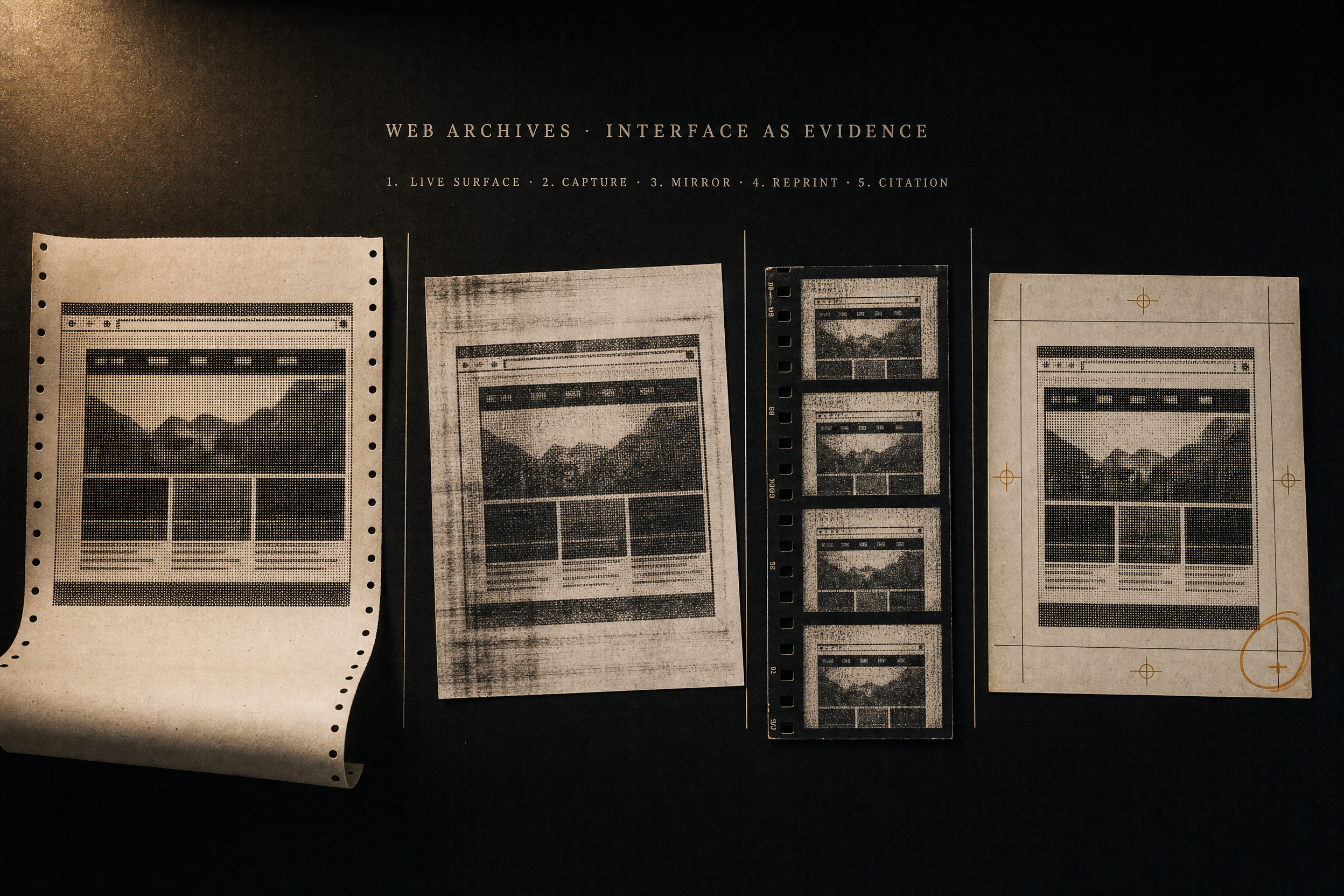
This collection preserves archived websites whose interfaces, navigation, and serial publication context are part of the evidence rather than incidental wrappers.
Core argument
Web captures preserve more than text. They preserve interface, arrangement, public tone, and serial form.
The web layer is one of the archive's strongest afterlife records. It shows how the CCRU and adjacent figures presented themselves publicly across time.
What this layer contains
This collection holds archived captures of sites like ccru.net, k-punk, and xenosystems, along with the public surfaces that shaped later memory.
Use it when you want to understand not just what was said, but how it was staged for readers at the time. The web layer is especially good for tracking serial publication and afterlife memory together.
The web-archive layer of the CCRU corpus is, materially, a collection of HTML captures, sidebar fragments, link rings, and serialised pages whose original hosts (ccru.net, the Hyperstition group blog, Cybernetic Culture mirrors) have either decayed, migrated, or vanished into Wayback snapshots. What survives in this layer is not only text. It is arrangement: which Numogram zone page linked to which demon entry, how the Pandemonium Matrix was tiled across frames, where a Carver fiction sat next to an apparently scholarly footnote. The collection thesis is simple. For a unit that published primarily online between roughly 1997 and 2003, the page was the argument. Stripping the page back to plain text deletes evidence.
Why interface is carrier
This matters because CCRU writing routinely used interface as a carrier. The Numogram entries C10 are diagrammatic before they are propositional, and the figure list (Fig. 1, Fig. 1.5, Figs. 10-19) presupposes a reader who can click between base-0 and base-9 variants in sequence. A printout flattens that. The Datastreams material C5 , with its codenames and cross-referenced agents like Iris Carver, depends on the reader encountering one fragment as a link out of another, not as a chapter in a bound volume. The web-archive layer preserves that adjacency. It is the only layer in which the seriality of the work, its drip-feed and its self-citation, is legible as it was first encountered.
What the collection lets a reader do
What the collection lets a reader do that a single guide or anthology cannot: reconstruct the publication surface. A researcher can check whether a given Zone-4 gloss C9 was published before or after a particular Hyperstition post, whether the 'Tak Nma' ethnography in Unleashing the Numogram C3 was cross-linked to the Cecil Curtis fiction at the time of capture, and which external sites (Orphan Drift, Syzygy, later Urbanomic) the CCRU pages reciprocally pointed to. Anthologies like the Urbanomic Ccru: Writings 1997-2003 volume settle the texts into a fixed order. The captures show the texts as they circulated, often without clear authorship, often signed by fictional agents, often undated.
Limitations of the captures
The limitations are real and should be stated. Wayback coverage of ccru.net is uneven; some pages exist only in late captures, after edits, and the earliest states of certain documents are lost. Image assets, especially the Numogram diagrams and the Barker Spiral, are frequently broken in archived snapshots and have to be reconstructed from secondary mirrors. Link rot inside the captures means that following an internal href often returns a 404 even within the archived frame. Provenance is the hardest problem: a page captured in 2004 may contain text first posted in 1999, revised in 2001, and the capture itself cannot tell you which. Cross-reference with the textual layer of this archive, and with adjacent scenes documented at Urbanomic and on Monoskop , is the only way to date a given state.
There is also a question of what the captures are not. They are not the mailing-list traffic, the Warwick seminar discussions, the Virtual Futures conference exchanges, or the private correspondence between Land, Plant, Fisher, and the others. The web layer is the published face of CCRU. Treating it as the whole record overstates how much of the unit's thinking happened in public. A reader who works only from the captures will tend to read CCRU as a finished mythos rather than as a working group leaving traces.
Surface, contradiction, authority
The interpretive mistake the collection invites is taking the surface as authoritative because it is what survives. The pages are heavily styled, often theatrical, and their tone of fictional bureaucracy (Sarkonian Mesh-Tags, M-numbers, Pandemonium catalogues) can read as a closed system when it was in fact provisional and frequently contradicted across pages. Cross-page contradiction is itself evidence and should not be smoothed over. Where the Numogram pages assign one demon to a zone and a Hyperstition post assigns another, both stand. The archive preserves the inconsistency rather than resolving it.
How to use it well
Use the web layer to understand presentation, navigation, and afterlife. Then move between archived HTML and record pages so interface and content can be read together.
Practical reading instruction. Open a capture alongside the corresponding plain-text item in the textual layer. Read the capture first, follow its internal links until they break, then read the plain text to fill in what the broken links would have reached. Note the capture date in the Wayback URL and treat any claim about a CCRU 'position' as dated to that capture, not to the original posting. When citing, cite both the capture URL and the textual extract. The web archive is the record of how the work was published; the text layer is the record of what the work said. Neither substitutes for the other.
Worked examples
These named texts, talks, sites, and records show where the argument becomes concrete.
Xenosystems Home Record
"Xenosystems Home" is valuable here because interface, tone, and circulation are part of the evidence rather than wrappers around it.
ccru.net Home Record
"ccru.net Home" is valuable here because interface, tone, and circulation are part of the evidence rather than wrappers around it.
k-punk Home Record
"k-punk Home" is valuable here because interface, tone, and circulation are part of the evidence rather than wrappers around it.
Common confusions
These are the mistakes readers most often make when they arrive through simplified internet summaries or personality cult retellings.
- Web archives are secondary to the real written sources.
For this archive, websites are part of the public object and not just transport containers.
Significance
This collection matters because many readers first meet the archive through screenshots, links, and archived HTML rather than through print-oriented discovery.
13695 files
Canonical path: web-archives/
How to use it
Use collection and record pages to understand what each site represented before diving into the archived HTML.
Why this layer matters
Archived web captures of xenosystems.net, ccru.net, k-punk, and related public surfaces where interface, sequencing, and serial publication matter as evidence.
Featured records
References
Records cited
These linked sources are the quickest way to test the argument against named materials rather than second-hand summary.
Xenosystems Home Record
"Xenosystems Home" keeps public self-presentation and web-era relay work visible, which is exactly what this collection is for.
ccru.net Home Record
"ccru.net Home" keeps public self-presentation and web-era relay work visible, which is exactly what this collection is for.
k-punk Home Record
"k-punk Home" keeps public self-presentation and web-era relay work visible, which is exactly what this collection is for.
External references
Inherited outward references from the guides and pages that frame this collection.
Read next
Guide
CCRU And Internet Native Theory Culture
"CCRU And Internet Native Theory Culture" is the guide to open once Web Archives has shown you its strongest materials.
Guide
"What Was The CCRU" is the guide to open once Web Archives has shown you its strongest materials.
Section
Virtual Futures And Para Academia
"Virtual Futures And Para Academia" is the section that carries Web Archives into a larger cluster.